
Research Signal – Source date 2026-03-17
A cancer vaccine has to do more than carry a tumor antigen. It must deliver that antigen to the right immune cells, prompt those cells to activate a useful response, and do so with enough control that the contents and activity are predictable. Exosomes—tiny packages released by cells—offer a natural way to move biological cargo between cells. But their natural origin does not automatically make them reliable vaccine vehicles.
A review published on March 17, 2026, examines how researchers are trying to engineer exosomes for cancer immunotherapy. Its central question is practical: what must change when a cell-made package is asked to carry an immune message? The answer depends on how the package reaches dendritic cells, what it contains, and how consistently it can be made.
The immune message has to reach a dendritic cell
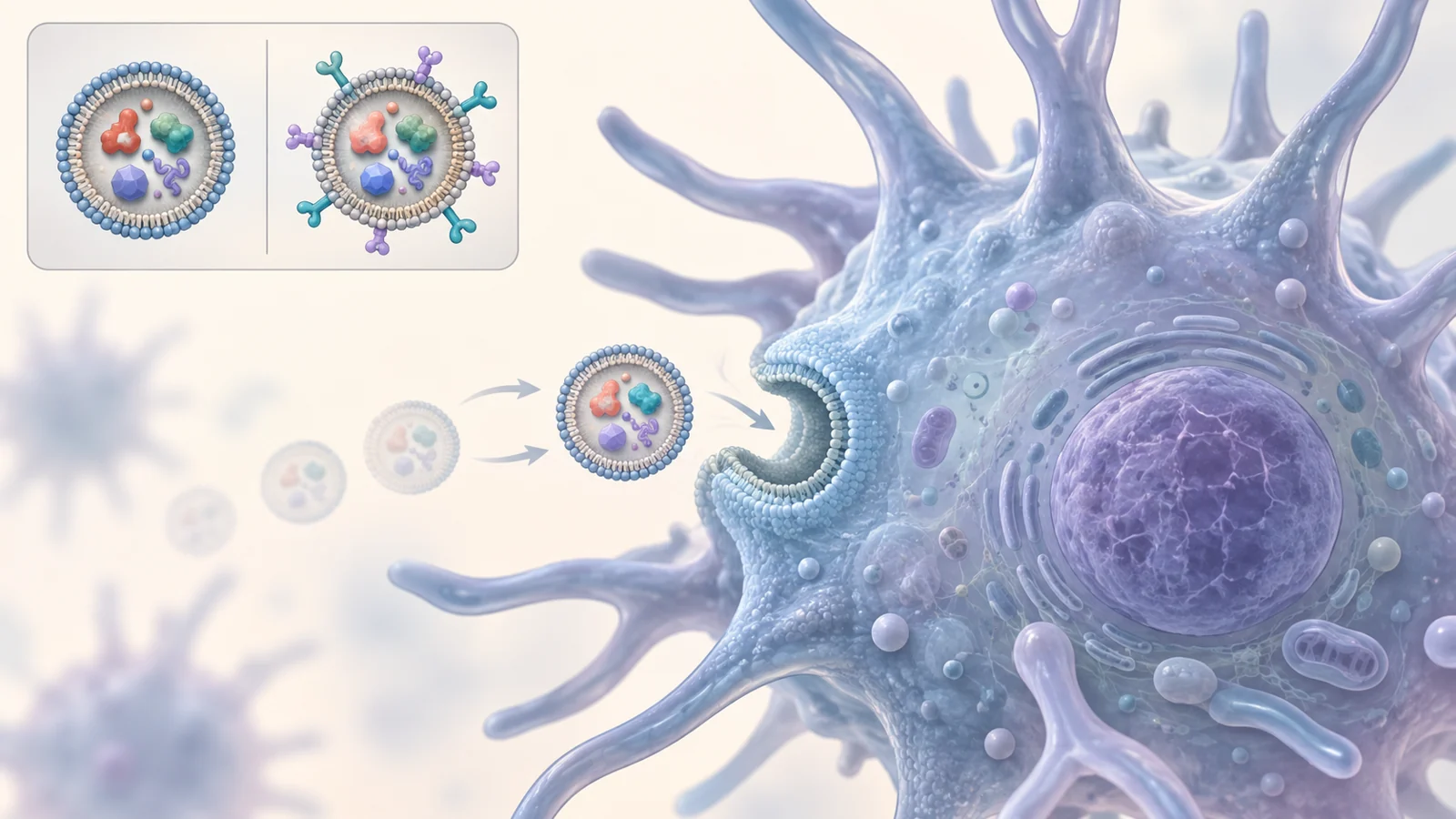
Exosomes are nanoscale vesicles, generally described as 30 to 150 nanometers across. Cells release them after internal compartments called multivesicular bodies fuse with the cell membrane. Their contents can include proteins, lipids, and nucleic acids, and their molecular makeup reflects the state and type of the cell that produced them.
For a vaccine, one important recipient is the dendritic cell. These immune cells can take up an exosome, process its antigen cargo, and display resulting pieces on major histocompatibility complex (MHC) molecules at their surface. That presentation can activate CD4 helper T cells and CD8 cytotoxic T cells. The latter can recognize matching antigen–MHC complexes on tumor cells and release molecules that damage those cells.
The handoff depends in part on what is displayed on the exosome surface. Molecules such as ICAM-1, CD11a, phosphatidylserine, and tetraspanins can help vesicles interact with dendritic cells. The review also describes mannose-modified exosomes designed to bind the mannose receptor found on these cells. These examples show why delivery is not just a matter of putting an antigen inside a carrier: the recipient cell and the route of uptake matter too.
Nor are all exosomes interchangeable. Vesicles from immune, tumor, or other cell types carry different molecular features. Their effects therefore depend on their parent cell and that cell’s state. A package’s origin can shape both what it delivers and how the immune system responds to it.
Loading cargo can trade convenience for control
Physical loading methods, including electroporation, sonication, and freeze-thaw cycles, introduce material into already collected exosomes. They can accommodate different kinds of cargo and are useful when researchers need flexibility. The review gives examples of variable loading efficiencies, with reported ranges depending on the cargo and method.
The process can also disrupt the vesicle membrane. Cargo may leak, and damage can affect the exosome’s own functions. That makes loading efficiency only one part of the decision: a method that places material inside a vesicle may still leave uncertainty about how much remains there or whether the package retains its useful properties.
A different route is to engineer the parent cell so that it incorporates desired cargo as it makes exosomes. This can preserve vesicle structure and support stable inclusion of selected molecules, but it brings its own constraints. Results depend on the cell type and the efficiency of the engineering process, and establishing a suitable production line takes more work. The choice turns on the intended cargo and how much flexibility or structural preservation the application needs.
Surface changes can steer a different part of the job
Researchers can also modify the surface of exosomes after collection. Chemical attachment methods, such as click chemistry, can add targeting ligands to harvested vesicles. This offers a flexible way to test different targeting ideas. The review notes that surface chemistry can affect membrane properties and that maintaining consistent results across batches remains difficult.
Engineering the parent cell can instead make it produce exosomes that display selected targeting or immune-related molecules. This integrates those features during vesicle formation and may support more consistent populations, though it requires more complex cell development. The review presents surface modification as useful for flexible targeting tests and parent-cell engineering as a stronger foundation for integrated, standardized products.
These approaches address distinct needs. Loading methods change what the package carries; surface changes influence which cells it can reach; parent-cell engineering can shape both cargo and displayed features. A candidate vaccine may combine methods, but each added function also raises questions about manufacturing and control.
Personalized vaccines and combinations need different designs
Patient-specific neoantigen vaccines aim to deliver tumor antigens identified for an individual patient. That use puts a premium on flexible, efficient loading and on activating dendritic cells strongly enough to prime new T-cell responses. The review describes an MC-38 model experiment in which engineered exosomes reduced tumor volume and increased CD8 T-cell infiltration compared with liposomes. Such results illustrate a design rationale; they do not establish a benefit for patients.
Combination treatment poses another challenge. A vaccine may help prime an immune response, while the tumor environment can contain signals and cells that suppress it. The review discusses engineered exosomes intended to alter that local environment, including approaches involving immune-stimulating signals or interference with suppressive pathways. The goal is to make immune activation more useful alongside other treatments, not merely to deliver an antigen.
The review also describes early human studies of dendritic-cell-derived exosome vaccines and later combination research. In the early trials it cites, antigen-specific T-cell responses ranged from about 6.7% to 33.3%, while one reported objective response rate was 6.7%. A later Phase II study combining a polyantigen-loaded vaccine with chemotherapy reported long-term disease stabilization in approximately 31.8% of patients. These studies involved different settings and designs; the combination result cannot show that exosomes alone caused the outcome. Taken together, the human evidence remains limited and responses vary, leaving efficacy and the best role for these vaccines unresolved.
A reproducible dose starts with knowing what is in it
Exosome preparations are mixtures of vesicles that can differ in size, molecular contents, and function. Their physical properties overlap with those of other extracellular vesicles, which makes complete purification difficult. Low yields and high preparation costs add pressure when moving beyond small experiments.
For a clinical dose, researchers need to know more than how many particles it contains or how large they are. They also need ways to characterize composition and test function, including antigen-loading efficiency and immune-stimulating activity. A batch could look similar by physical measures yet differ in what it does. The review points to multi-parameter analysis and scalable purification approaches as parts of the work needed to identify active vesicles while preserving yield and biological activity.
This is a manufacturing question as much as a laboratory one. If one batch primes immune cells differently from the next, a dose cannot be assumed to have consistent potency. Stable engineered cell sources and production processes aligned with clinical quality requirements may help, but the review describes this as work still needed to move from promising experiments to reproducible products.
What reliable exosome vaccines could mean for cancer care
If researchers can make exosome vaccines with reliable targeting, controlled cargo, and consistent immune activity, these packages could give personalized cancer vaccines a more adaptable way to carry patient-specific antigens and help prime tumor-directed T cells. That capability could support more tailored treatment strategies, including combinations designed around the immune conditions inside a tumor. It depends on solving the practical barriers to consistent production and showing in well-designed human studies that the engineered vaccines provide meaningful benefit.
Key Sources
- Primary source: Exosome-based vaccines in cancer immunotherapy: antitumor mechanisms, engineering strategies, and challenges.
DOI or Journal Page · Review or Meta-Analysis · 2026-03-17
Keep exploring