
Research Signal – Source date 2026-01-10
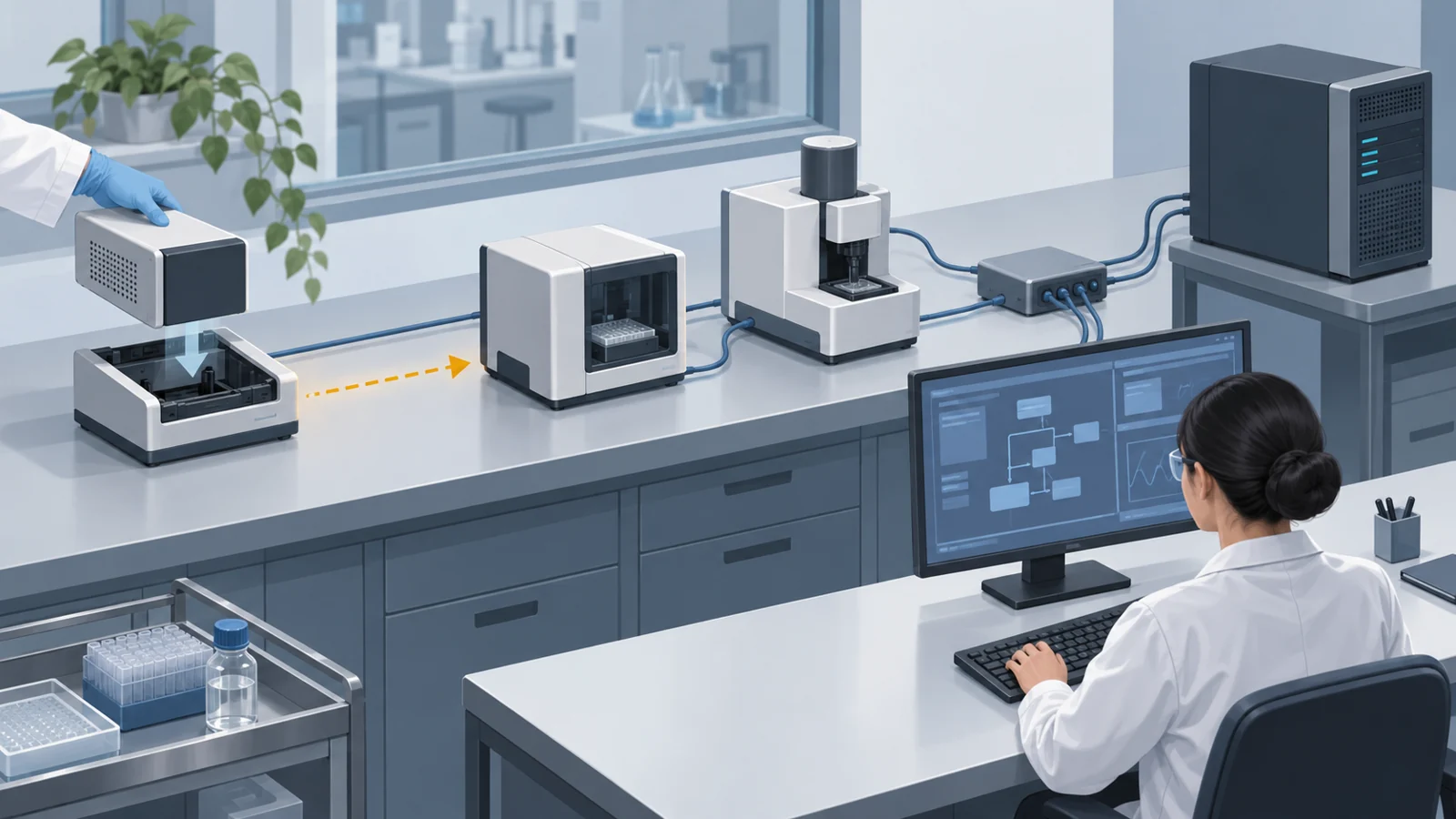
A laboratory experiment can depend on several instruments working at once: detectors, motion stages, timing hardware and other devices, each with its own control software. When a team changes the setup for a new measurement, it must also make sure those separate controls still work together and that the data they collect remain coordinated.
A paper published on arXiv on January 10, 2026, presents Constellation, a distributed control and data acquisition system designed for laboratory test stands and beamline experiments. Its central design choice is to divide a setup into software components that can operate independently while communicating with one another. The authors describe the architecture, its operator interfaces and monitoring tools, a network benchmark, and deployments involving real instruments. Those accounts offer evidence of practical use in particular settings, while leaving broader performance comparisons for future evaluation.
A changing experiment needs more than a collection of controls
Separate instrument controls can make a setup difficult to reconfigure. A new device may bring its own hardware and software, and the experiment still needs a way to start the right components, monitor their condition and collect data across the arrangement. The challenge grows when the equipment varies from one measurement or facility to another.
Constellation is designed around that variability. The system represents instruments and other functions as networked components called satellites. A satellite is a software component responsible for controlling an instrument or performing a role in the setup. The paper describes an extensible interface intended to make instrument integration more straightforward, along with network discovery mechanisms that help components find one another.
This arrangement gives a team a way to add or reorganize components without treating the entire control system as one indivisible program. Satellites can make decisions about their own operation and communicate those decisions to other components. In practical terms, a device can participate as one part of a coordinated setup while retaining responsibility for its own function. The paper presents this autonomy as a basis for flexibility and stable operation; it does not quantify a general reduction in the time or cost of changing experiments.
A clock dependency makes start order matter
Independent components still have to begin in a workable order. Consider an instrument that needs a hardware clock from another component. The clock-providing component may need to finish initializing before the instrument can proceed. If each waits for the other to complete a step first, the setup can stall.
Constellation represents operation through states and transitions. Commands that control or configure instrument hardware correspond to transitions into particular states, giving the system feedback about where a component is in its operation. The paper also describes dependencies between satellites as a directed graph. A controller can validate this graph for cycles using a depth-first search, helping detect circular dependencies that could lead to deadlocks. Some dependency combinations may still time out if components are arranged incompatibly, so the ordering information matters when a team configures the system.
The point is not that every instrument can be started in any order. A clock-dependent device illustrates why a distributed setup needs explicit ways to express dependencies and manage state changes. For operators, that makes the relationship between components part of the control problem rather than an assumption hidden in a collection of separate interfaces.
Operators can use a screen or a script
Constellation provides two described controller interfaces: a graphical user interface and a scriptable command-line interface. Operators can use these to set up the system and change its state. A Python controller can query and control individual satellites or the whole Constellation. The paper gives automated parameter scans as an example of a routine that can be written in a few lines of Python.
That example shows how the system can support automation without suggesting that it independently plans or runs every experiment. A researcher still defines the routine and the parameters to scan; the controller provides a way to issue those operations through the connected components. A graphical interface gives operators another route for interacting with the setup.
Monitoring is also configurable while Constellation is running. The paper describes a logging interface in which listeners can alter their subscriptions to messages at different severity levels without interrupting the system. In one described sequence, a listener subscribes first to warning messages and then to informational messages. That can help operators adapt what they watch as conditions change, alongside other setup information displayed through the system’s interfaces.
A 10G benchmark tests data transfer, not a whole experiment
The paper includes a throughput benchmark run over a 10-gigabit fiber-optic network using randomly generated data. It compares data-transfer behavior under different build configurations and memory allocators. This provides a test of network data movement under the benchmark’s conditions.
Generated data sent across a network are not the same test as acquiring data from a particular detector while coordinating a full experiment. The benchmark therefore helps characterize one part of the software’s behavior, but it cannot stand in for end-to-end performance across every mix of instruments, timing dependencies and data rates. The paper’s deployment reports address a different question: whether the system was used with real experimental equipment in the cases described.
Real setups provide evidence of practical operation
The authors report deployments across experimental environments that include charged-particle tracking, spent nuclear fuel characterization and cryostat temperature monitoring. They describe Constellation as coordinating heterogeneous components and providing a stable basis for control, monitoring and data acquisition in small to mid-size setups.
One account concerns a measurement campaign using a tracking telescope. The system display included trigger-related information, sensor bias voltage and leakage current, data transmission rate and available disk space. The authors report stable operation over several days. This is a concrete example of operators using the framework to monitor an active setup, rather than evidence from the generated-data network benchmark.
Another deployment involved the BIPXL telescope at the CERN SPS North Area, used to characterize bent silicon crystal assemblies. The setup combined custom satellites for Timepix3 readout and as many as 14 motion stages, with other components supporting alignment routines and operator feedback. The paper reports that Constellation was deployed at CERN within four weeks and operated reliably during a multi-day commissioning campaign.
These reports show the framework being used with real instruments and changing experimental configurations. They are accounts of particular measurement and commissioning campaigns, not a controlled comparison demonstrating that Constellation outperforms other control systems across facilities. The evidence is useful for judging whether its architecture has been put to work, while the reported cases remain bounded to the setups described.
Where the design is intended to operate
The authors target laboratory test stands and small to mid-sized experiments. They state that the current version is intended to run on closed internal networks. That scope matters: the paper’s deployments support practical use in those environments, but do not establish suitability for larger facilities or operation beyond the stated network setting.
For teams within that scope, Constellation offers a way to coordinate devices whose roles and dependencies may change between experiments. Its component model, state transitions, operator interfaces and monitoring tools address different parts of that task. Whether it fits a particular lab will depend on the instruments and control requirements involved; the paper does not report a broad, facility-to-facility comparison or a general measure of setup effort.
What adaptable control could mean for small experiments
If the component model continues to work across a wider range of instruments and remains stable as setups change, teams could spend less effort stitching separate controls together whenever an experiment is reconfigured. That could make small and mid-sized test stands easier to adapt for new measurements, while giving operators a shared way to manage device state, dependencies and data collection. The reported deployments show that this kind of coordination has been used in specific settings; extending the benefit to other laboratories depends on how well their instruments and network conditions fit the design.
Key Sources
- Primary source: Constellation: The Autonomous Control and Data Acquisition System for Dynamic Experimental Setups
arXiv · Preprint · 2026-01-10
Keep exploring