
Research Signal – Source date 2025-11-06
A single poor night can be memorable, and a questionnaire can capture how someone feels about sleep. But neither offers the same view as repeated measurements. In a study following 179 older adults across three assessments, sleep patterns changed differently among people with two forms of mild cognitive impairment and a cognitively healthy comparison group. The clearest differences emerged over time, especially for participants whose difficulties chiefly affected thinking abilities other than memory.
Mild cognitive impairment (MCI) describes early difficulties in thinking that are greater than expected for a person’s age but do not, by themselves, establish a particular cause. In amnestic MCI, memory is the main affected area. Non-amnestic MCI affects other abilities, such as attention, executive function, visuospatial skills, or language, while memory is relatively preserved.
The study included 46 cognitively healthy adults, 75 people with amnestic MCI, and 58 with non-amnestic MCI. Their average age was about 70. Researchers assessed them three times. Follow-up visits took place about eight months apart, with the same sleep-assessment approach used at each visit.
A wrist monitor added a repeated view of sleep
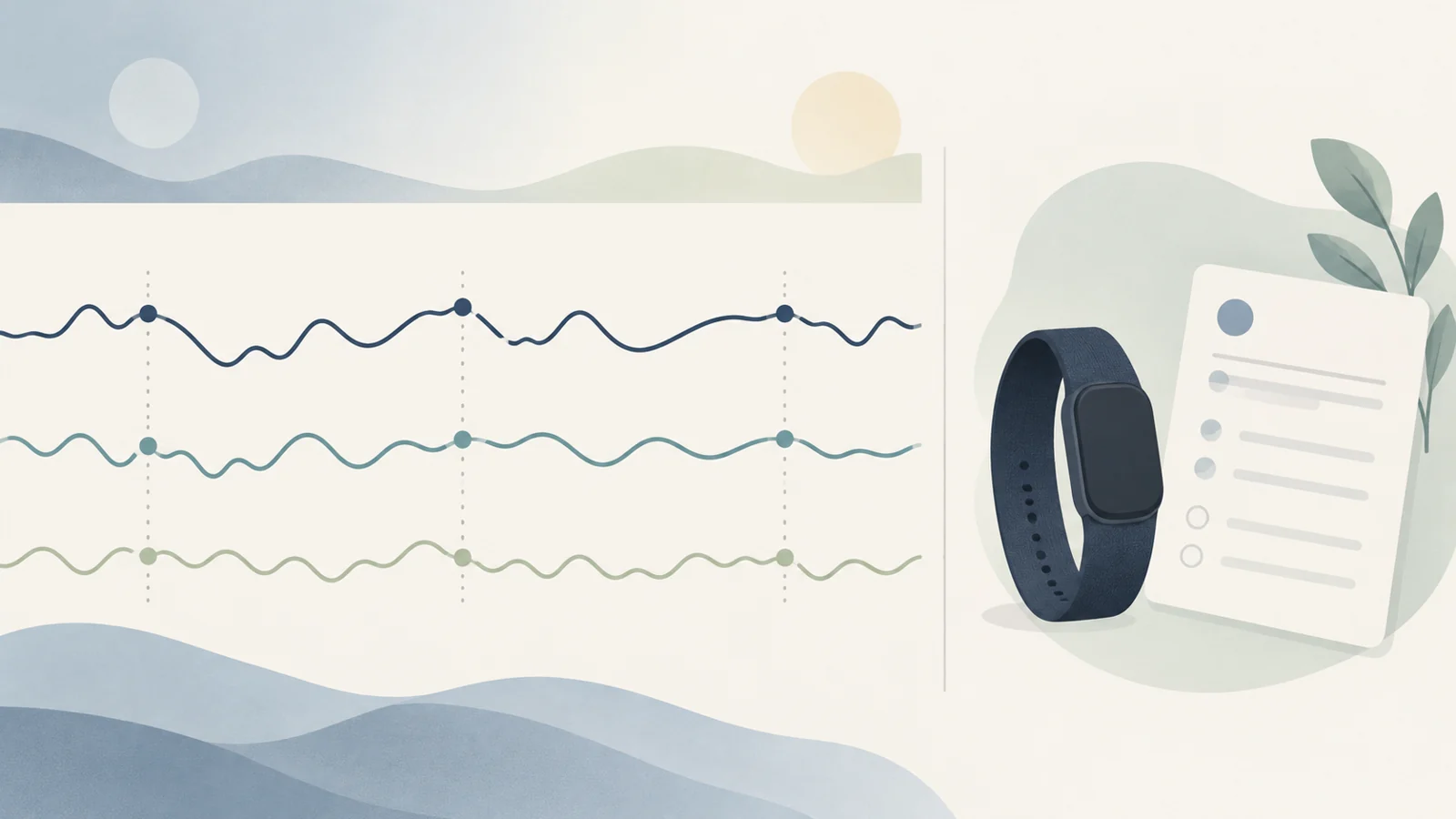
At each assessment, participants wore a wrist actigraphy device for seven days. It recorded movement, from which researchers estimated total sleep time (TST), wake after sleep onset (WASO), and sleep efficiency (SE)—the proportion of time in bed spent asleep. These are movement-based estimates of sleep and wake patterns, collected in everyday settings; they do not directly record detailed sleep stages.
Participants also completed questionnaires about insomnia symptoms, perceived sleep quality, and risk of sleep-disordered breathing. The measures capture different things: actigraphy estimates sleep from movement, while questionnaires record reported experiences or screening risk. Looking at both over repeated visits made it possible to ask whether groups followed different paths, rather than relying only on a difference at the first visit.
Later visits separated the sleep trajectories
Total sleep time differed across groups and changed over time, with a statistically significant group-by-time interaction. An interaction means the pattern of change was not the same for every group; it does not mean that all groups were already different at the outset. In later comparisons, participants with non-amnestic MCI slept less than healthy controls: the difference was about 83 minutes at the second visit and 82 minutes at the third.
Sleep efficiency showed a similar time-dependent pattern. There was no significant group difference at the first assessment, but differences appeared at the second and third. At those later visits, the non-amnestic group had lower sleep efficiency than controls. The repeated measurements therefore revealed separation that a baseline comparison alone would have missed.
WASO increased over time, adding another measure of changing sleep continuity. Across the objective measures, the most consistent later disadvantage was in the non-amnestic group’s sleep duration and efficiency. These findings describe group averages in this sample, not a forecast for any individual participant.
Questionnaires tell a less tidy story
Reported sleep quality also changed over the follow-up. Scores on the Pittsburgh Sleep Quality Index (PSQI) worsened over time, including among healthy controls. Within the non-amnestic group, scores rose progressively across all three assessments. Yet when groups were compared at each individual visit, PSQI scores did not differ significantly between them.
Those results can coexist. A group’s scores can worsen over time without becoming clearly different from another group at any single measurement. The trajectory captures change within people and groups; a snapshot comparison asks whether their scores differ at one particular visit. Here, the questionnaire’s time pattern was informative, while its individual-visit comparisons did not establish a significant gap between groups.
STOP-BANG scores, which screen for risk of sleep-disordered breathing, also changed over time. Scores rose progressively within the non-amnestic group. However, they are a screening signal, not a diagnosis of a breathing disorder, and the study found no significant difference between the cognitive groups at any individual assessment on this measure.
A later insomnia report was associated with earlier sleep efficiency
The researchers tested whether objective sleep measures at the second visit were related to subjective complaints at the third. In a model using the full sample, sleep efficiency at the second assessment significantly predicted later insomnia complaints. Total sleep time and WASO did not show direct effects in that model. Some indirect pathways also appeared through the stability of sleep measures and earlier questionnaire scores.
This is a narrower result than a subtype-specific prediction. The mediation analysis pooled participants because the subgroup sizes were too small for the planned analysis within each cognitive group. It therefore cannot show that sleep efficiency predicts later insomnia specifically for people with non-amnestic or amnestic MCI. Nor can a statistical association across visits establish that one measure causes another.
What the measurements leave unresolved
Actigraphy is practical for tracking movement-based sleep patterns over several days, but it cannot distinguish detailed sleep architecture such as REM or slow-wave sleep. The study also could not connect the observed sleep patterns directly with participants’ brain imaging or cerebrospinal-fluid biomarker data. Without those links, the results do not identify a biological pathway behind the group differences.
The study is observational, so it cannot establish that sleep deterioration causes cognitive decline or that improving sleep would prevent it. It also does not validate a threshold for diagnosing cognitive impairment or show that repeated sleep monitoring improves health outcomes. Sleep changes may be a useful complement to other observations, but these results do not make them a stand-alone marker of neurodegeneration.
What repeated sleep checks could change in cognitive care
If larger studies confirm these patterns and connect them with established clinical and biological assessments, repeated sleep checks could help clinicians notice changing needs earlier and decide when a fuller evaluation may be useful. The practical possibility is a low-burden way to add context to cognitive follow-up, especially when sleep efficiency, sleep duration, and reported symptoms shift together. Whether that approach improves decisions or outcomes remains to be tested.
Key Sources
- Primary source: Sleep Trajectories in Amnestic and Non-Amnestic MCI: Longitudinal Insights from Subjective and Objective Assessments.
DOI or Journal Page · Peer-Reviewed Paper · 2025-11-06
Keep exploring