
Research Signal – Source date 2025-11-05
A tumor-targeting antibody faces a practical problem: it must find and hold onto cancer cells inside tissue that can be difficult to enter. Immunoglobulin M, or IgM, offers an unusual kind of grip. Its many binding sites can help it attach where a target is scarce or unevenly distributed. But IgM is also a very large molecule, and strong binding at the tumor’s edge does not guarantee that enough antibody will get deeper inside.
A review published on November 5, 2025, surveys how researchers are trying to use IgM against solid tumors, what early candidates have shown, and what still stands between laboratory promise and a useful treatment. The central question is not simply whether IgM can bind a tumor marker. It is whether a design can reach the relevant cells, trigger a helpful immune effect, and be made and given reliably.
Many contacts can make a stronger combined grip
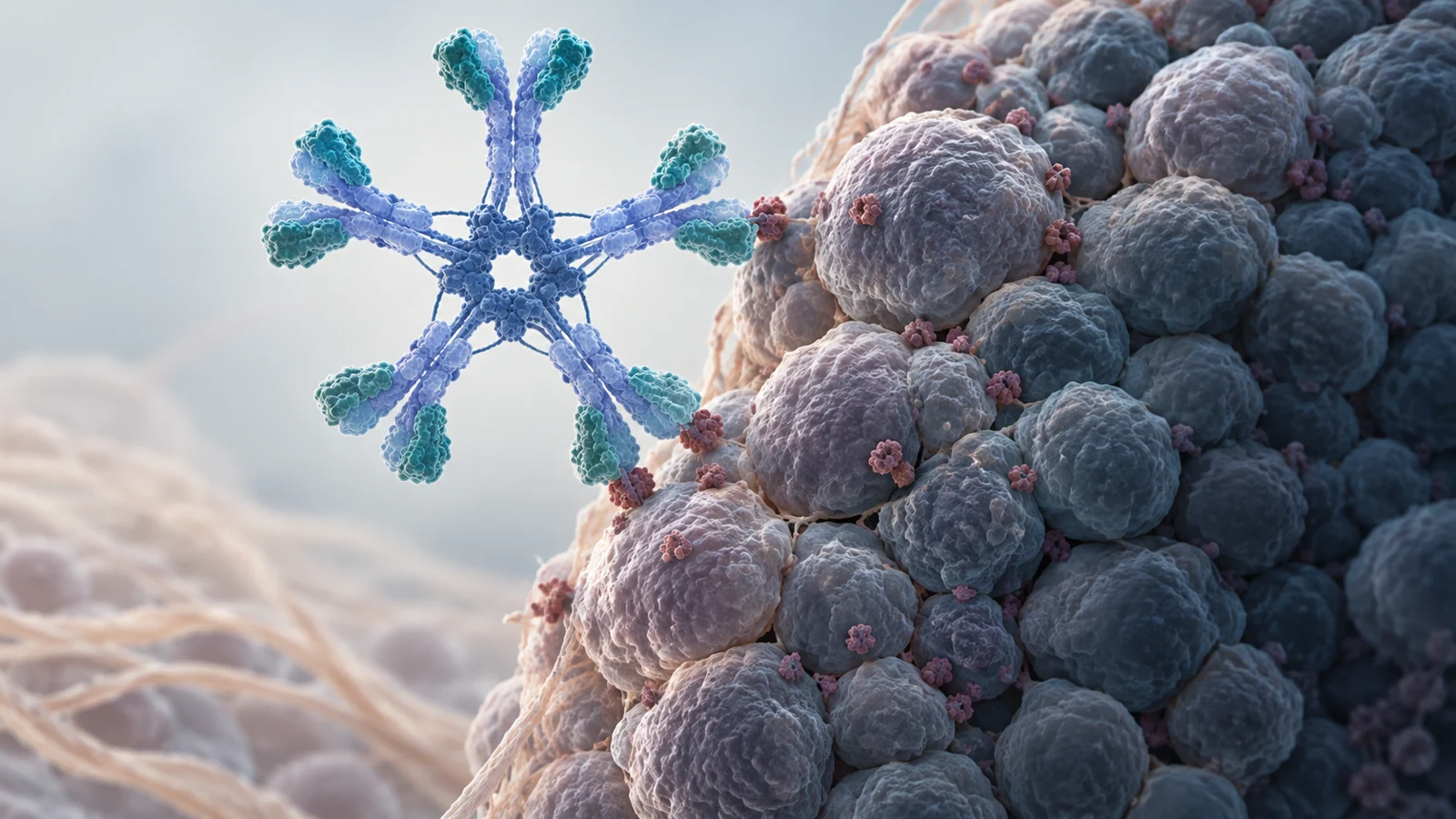
An IgG antibody, the familiar Y-shaped format used in many antibody medicines, has two antigen-binding sites. Pentameric IgM can have ten. This does not mean each individual contact is necessarily stronger. Rather, when several arms can attach to nearby copies of a target, their combined hold can be harder to break. This combined grip is called avidity.
That feature may matter when cancer cells display only small amounts of a marker, or when marker levels vary across cells in the same tumor. An antibody that depends on just a couple of contacts may have trouble holding on under those conditions. IgM’s multiple sites offer more opportunities to engage the target at once.
IgM’s architecture is not a simple flat ring. Structural studies described in the review show an asymmetric, disc-shaped core, with flexible arms that can move around it. That arrangement helps explain how a large molecule can make several contacts with surface targets. It also supports complement activation: IgM can start a cascade of immune proteins that may damage or lyse a cell. These are useful biological capabilities, but neither binding nor complement activity alone settles how well a treatment will work inside a human tumor.
Different IgM designs do different jobs
Natural IgM is part of the body’s early immune defenses. Some natural IgM recognizes a broad range of molecular patterns, including material associated with damaged cells and tumors. The review describes two proposed antitumor routes: activating the classical complement pathway, which can help lyse or mark tumor cells, and signaling through the Fcμ receptor, which may shape communication among immune cells.
Therapeutic monoclonal IgM takes a more directed approach. It is designed to recognize a particular tumor-associated target. Its many binding sites may help it engage that target repeatedly, while some candidates are intended to cluster receptors in ways that set off cell-death signals. This is a distinct purpose from natural IgM’s broad recognition: the goal is to focus the antibody on a chosen target and exploit the resulting binding or signaling.
Bispecific IgM designs aim to recognize two different targets at once. In principle, one set of binding sites can attach to a tumor marker while another engages an immune-cell marker, bringing the two into proximity. The multivalent structure could support repeated contacts at both ends, although designing and producing a molecule that performs both jobs consistently is demanding.
Other engineered formats add a specific immune-activating component. The review describes IGM-7354, which binds PD-L1 and carries an IL-15/IL-15Rα complex through its J chain. In preclinical work, the design stimulated natural killer and CD8-positive T cells and inhibited tumor growth in models of PD-L1-positive triple-negative breast cancer. Its intended role is to combine tumor recognition with immune-cell stimulation, rather than relying on target binding alone.
Promising results have different evidence settings
The examples in the review span cell experiments, animal models and entries in early human trials. Those settings answer different questions. A potent effect in cultured cells can support a mechanism; an animal model can show activity in a whole organism under specific experimental conditions. Neither by itself establishes that people with solid tumors will benefit.
AT101 is a complement-fixing mouse IgM directed at glypican-1, a surface protein described as highly expressed in pancreatic ductal adenocarcinoma tissue and low or absent in normal pancreas and chronic pancreatitis. In mouse xenograft studies, AT101 inhibited tumor growth and prolonged survival; most treated mice had reduced tumor mass, and one had complete remission. The review says the antibody remains preclinical and identifies humanization as a key translational step. These animal findings are encouraging for that candidate, but they are not evidence of patient outcomes.
IGM-7354 provides a different kind of example. The review records it as having completed a Phase 1 trial for advanced solid tumors. Its preclinical evidence includes immune-cell activation and tumor-growth inhibition in models. A Phase 1 listing or completed status identifies a stage in clinical development; by itself, it does not tell readers whether the candidate produced a clinical response or what safety results were observed.
The review also discusses IGM-8444, an IgM designed to cluster the death receptor DR5. It was much more potent than an anti-DR5 IgG in a specific cell-line comparison, and animal studies included tumor inhibition and complete remission in a gastric patient-derived xenograft model. That is a result for a particular design and set of models, not proof that IgM as a class outperforms IgG or that the same effect occurs in patients.
Getting beyond the tumor’s edge
The very scale that gives IgM many binding sites also creates a delivery challenge. Pentameric IgM is roughly 900–950 kilodaltons, far larger than a typical IgG antibody. Dense, stroma-rich tumors can be hard for large molecules to penetrate. High pressure within tumor tissue, low oxygen and acidic conditions may further affect where an antibody travels and how well it functions.
The picture is not simply that large size prevents IgM from entering tumors. The review discusses evidence that IgM may accumulate selectively in inflamed or tumor tissue, where leaky blood vessels and inflammatory processes can affect distribution. That possibility is a reason to study its delivery in particular settings; it does not remove the problem of reaching cells throughout a solid mass. If an antibody binds quickly near the outside, it may still have difficulty accessing less reachable regions.
This creates a design problem with more than one variable. Developers need enough circulation time for the antibody to encounter the tumor, enough access within the tissue to reach relevant cells, and binding that supports the intended immune activity without making distribution or safety worse.
Time, production and immune effects all matter
IgM generally stays in circulation for less time than IgG. The review attributes much of IgG’s longer persistence to the neonatal Fc receptor, which can protect IgG from breakdown and recycle it. IgM does not use that same protective route. Proposed approaches to extend its time in circulation include adding FcRn-binding features, albumin-fusion motifs, or protective strategies such as encapsulation or PEGylation. These are engineering avenues, not a guarantee that a longer-lived molecule will also reach a tumor effectively.
Manufacturing presents another hurdle. IgM’s large, multi-part structure must fold and assemble correctly, and the review describes low yields and batch variability as concerns, particularly for bispecific formats. A candidate must be stable during production, purification, storage and use. A molecule that shows a compelling effect in a small experiment still needs a reproducible way to make it at scale.
The immune effects also need careful control. Complement activation can damage tumor cells, yet strong or misplaced activation may add unwanted inflammation. Multifunctional formats that stimulate immune cells raise questions about cytokine release, off-target activity and tolerable dosing. The review identifies these as development concerns; deciding whether a particular candidate’s activity can be delivered safely requires clinical evidence for that candidate.
What IgM could add to solid tumor treatment
For patients whose tumors display sparse or uneven targets, a successful IgM medicine could offer another way to bind those cells and recruit an antitumor response. That possibility depends on candidate designs reaching enough of the tumor, being manufactured reliably, and showing acceptable safety and clinical benefit in people. The review describes a promising set of biological tools and early candidates, while the patient benefit remains a question for clinical evidence.
Key Sources
- Primary source: Harnessing IgM for solid tumor therapy: biology, engineering advances, and translational challenges.
DOI or Journal Page · Review or Meta-Analysis · 2025-11-05
Keep exploring