
Research Signal – Source date 2025-10-14
A drug can be chosen because a lung tumor carries a particular genetic change, yet the benefit may not last. The reason lies partly in how cancer cells use connected signaling pathways: blocking one growth route can leave other routes available, and tumors can change under treatment.
A review published October 14, 2025, brings together research on lung cancer pathways and treatment findings for selected groups of patients. Its examples show why matching a drug to a tumor alteration can matter, while also illustrating the challenge that follows: understanding what has changed when a treatment stops controlling the disease.
Four signal systems, different kinds of targets
Cells use signaling pathways to receive and relay instructions. In lung cancer, altered signals can help cells grow, survive, spread, or resist treatment. The review discusses several parts of this picture, but they do not all represent the same kind of drug target.
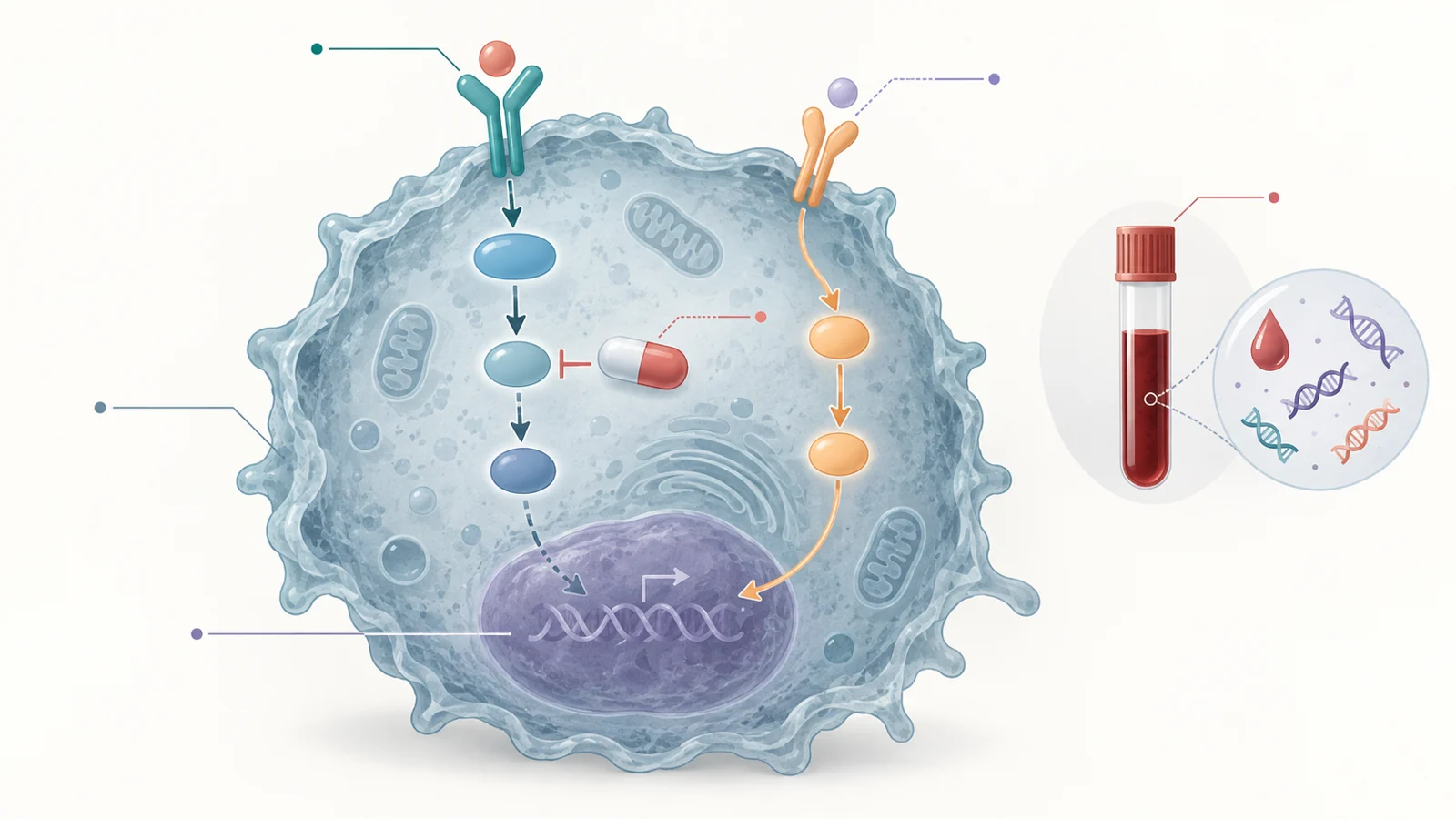
One useful mental model has four pieces. A growth-driving receptor, such as EGFR, receives an outside signal. A downstream switch, such as KRAS, relays growth instructions inside the cell. The PI3K/AKT/mTOR pathway acts as a shared survival and growth network. Immune checkpoints, including PD-1/PD-L1, work differently: they can dampen the immune response that might otherwise attack a tumor.
A specific genetic alteration can identify a subgroup whose cancer depends on a particular driver. That creates a more direct rationale for a targeted drug. A pathway’s involvement in cancer, by itself, does not mean there is an established treatment for every tumor that uses it. The review ranges across molecular drivers and immune regulation, and the evidence behind each approach differs.
When a defined alteration points to a drug
EGFR mutations and ALK rearrangements offer examples of treatment matched to defined tumor features. In EGFR-mutant non-small cell lung cancer (NSCLC), earlier tyrosine kinase inhibitors helped many patients, but some tumors acquired the T790M mutation, which can interfere with those drugs. The review describes osimertinib as designed to target both activating EGFR mutations and T790M. It cites clinical trials reporting better progression-free and overall survival than earlier-generation inhibitors, including in first-line treatment, and notes its activity against brain metastases.
For the smaller group of patients with ALK-rearranged NSCLC, the review describes lorlatinib as active against a range of resistance mutations, including G1202R. It cites the CROWN trial, in which lorlatinib showed longer progression-free survival and higher intracranial response rates than crizotinib in first-line treatment.
KRAS G12C illustrates another kind of advance. KRAS had long been difficult to target, but researchers identified a pocket near the G12C alteration that enabled development of drugs directed at that mutant form. The review cites response rates for sotorasib and adagrasib in their respective clinical settings. Those figures come from different studies and patient groups; they are not a head-to-head comparison with each other or with the EGFR and ALK results.
Together, these cases show how a defined alteration can guide drug development and patient selection. They do not mean that every pathway discussed in the review has a clinically validated drug, or that one treatment result applies to all lung cancers.
How tumors find ways around a blockade
Resistance can emerge through distinct biological changes. One is a new alteration in the drug’s target. In EGFR, T790M was one route around earlier inhibitors; after osimertinib, the review discusses C797S as a possible resistance mutation. In ALK-driven cancers, secondary changes in the ALK gene can also reduce the effect of an inhibitor.
A tumor can also route growth signals through a different pathway. MET amplification or HER2 activation can provide alternative signaling in some cases of EGFR inhibitor resistance. This is a bypass: the original target may still be blocked, while another route helps the cancer continue to grow or survive.
A third possibility is a change in tumor identity. The review describes transformation from NSCLC to small cell lung cancer (SCLC) as a resistance mechanism. In that case, the biology of the cancer has shifted, so the original molecular match may no longer capture what is driving the disease.
These routes help explain why targeted therapy can have a limited useful life. The review says primary resistance affects an estimated 20–30% of patients and that acquired resistance typically develops within 9–14 months after treatment begins. These are broad figures cited by the review, not a forecast for an individual patient or a single drug group.
More blockade can bring a dosing tradeoff
Combining treatments may help address a bypass route. The review gives EGFR and MET as an example: when MET signaling is active or contributes to resistance, blocking both pathways could make it harder for the tumor to evade treatment. It also discusses combinations more broadly, drawing on preclinical work and early-phase clinical trials. Those findings are promising but do not establish that combinations improve outcomes for all patients.
Broader pathway inhibition has its own challenge. The PI3K/AKT/mTOR network is involved in growth and survival, but inhibiting it can cause effects such as high blood sugar, rash, diarrhea, or liver toxicity. These adverse effects may force dose reductions or treatment stops, limiting how much pathway blockade a patient can tolerate. Compensatory signaling can also weaken the effect of an inhibitor. The practical question is not only whether a drug can interrupt a pathway, but whether it can do so at a dose that remains usable.
What changing tumor DNA can—and cannot—tell us
A tumor’s molecular profile may change as cancer cells evolve or respond to treatment. A tissue biopsy samples tumor material directly, but obtaining one can be invasive, and a sample may not capture differences across all tumor sites. A liquid biopsy instead looks for circulating tumor DNA (ctDNA)—fragments of tumor DNA in the blood—and can be repeated over time.
The review describes ctDNA analysis as a way to detect alterations such as mutations, amplifications, or gene fusions that may help identify a target or track molecular changes. Repeat blood sampling is appealing because it offers a less invasive way to follow tumor DNA. But detecting a change is not the same as knowing which treatment will help. The review notes limits in sensitivity and specificity, especially in early-stage disease and minimal residual disease monitoring.
Treatment selection also depends on how well a biomarker predicts benefit. PD-L1 expression is widely used to help guide immune checkpoint treatment, but the review describes imperfect prediction: some patients with low expression have durable responses, while some with high expression do not respond. Tumor mutational burden and other candidate markers may add information, but their assessment and predictive value remain challenges.
What could make tailored lung cancer treatment last longer
If clinicians can identify which tumor changes are driving resistance and match them to treatments that patients can tolerate, they may be able to adapt therapy and sustain disease control for longer. That possibility depends on reliable markers of clinically relevant change and treatment strategies that demonstrate benefit at usable doses. The review describes progress toward that goal, while showing why the biology and evidence must be considered patient group by patient group.
Key Sources
- Primary source: Role of signaling pathways in lung cancer development and advances in targeted therapies (Review).
DOI or Journal Page · Review or Meta-Analysis · 2025-10-14
Keep exploring