
Research Signal – Source date 2025-09-28
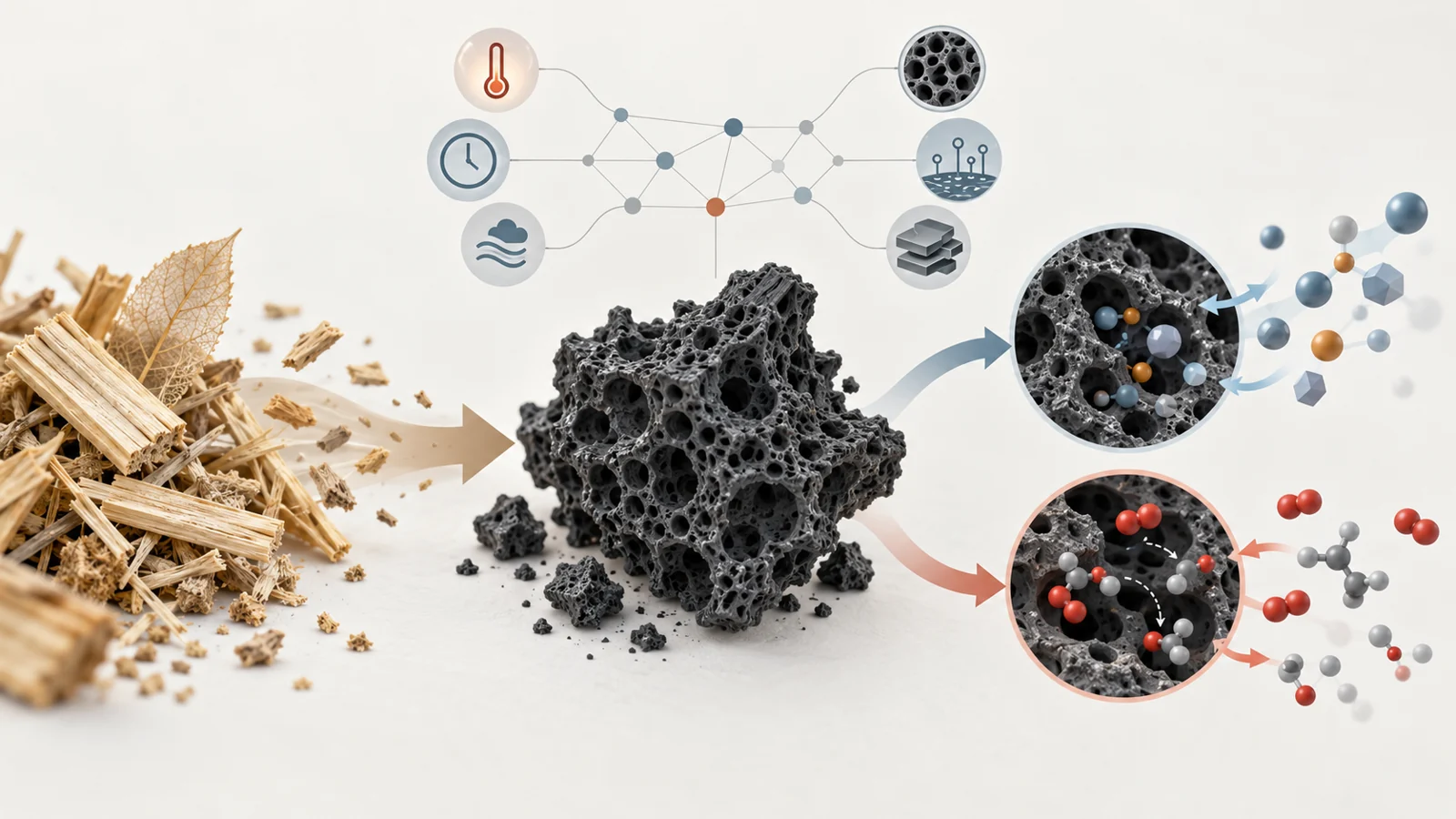
Biochar is carbon-rich material made by heating biomass. In wastewater treatment, its appeal is that it can adsorb pollutants and also take part in chemical processes that degrade them. But “biochar” does not describe one uniform material: how it is made and modified can change the properties that matter for treatment.
A review published on September 28, 2025, surveys this design question alongside the pathways used to remove organic pollutants and the growing use of machine learning to predict biochar performance. Its account helps explain what computer predictions may contribute, while the evidence described in its abstract remains a synthesis of research rather than a new treatment-system result.
Making biochar is a series of design choices
The starting point is biomass carbonization: heating the source material to produce biochar. The review also covers activation, heteroatom doping and composites. These are distinct approaches to preparing or modifying the material, not interchangeable names for the same step.
Those choices matter because treatment claims depend on what the resulting biochar is like. A material’s adsorption and catalytic properties are part of the reason it is studied, while the review connects machine-learning predictions to both production conditions and biochar characteristics. The abstract does not rank the preparation approaches, so it offers no basis for saying that one is generally best.
Pollutants can be captured or degraded
Adsorption means pollutants attach to the biochar. Degradation refers to chemical breakdown. The review discusses both and describes advanced oxidation processes, or AOPs, in which it distinguishes radical from non-radical pathways. These are different routes within degradation; the abstract does not supply further mechanism detail to compare them.
The applications surveyed include antibiotics, dyes, polycyclic aromatic hydrocarbons (PAHs) and endocrine-disrupting chemicals (EDCs). Covering several pollutant groups makes the range of research clear, but it does not mean one biochar removes all of them equally. The abstract gives no comparative removal percentages that would support such a conclusion.
What a model can predict
The review describes machine learning as a tool for optimizing biochar production, predicting pollutant removal efficiency and guiding material design. Random Forest and artificial neural network models are highlighted as having shown high predictive accuracy using inputs related to pyrolysis conditions, biochar characteristics and experimental parameters.
In practical terms, a model can use those inputs to estimate removal performance and help identify material or production choices worth examining. The prediction is about performance under represented inputs and conditions; it is not itself evidence that a treatment will work in a wastewater facility. The abstract provides no numerical model scores or independent validation conditions, so the accuracy claim cannot be translated here into a specific expected removal rate or a guarantee of transfer to operating systems.
What the review can and cannot tell us
This is a review of research directions, not a report of a new treatment installation or a single controlled comparison. The abstract describes the topics covered and the models’ qualitative performance, but it does not give a review protocol, numerical removal results or operational validation details. Those omissions in the supplied evidence leave no reliable basis for comparing the effectiveness of particular biochars or predicting outcomes for a particular wastewater stream.
The useful contribution is a connected view of the problem: material preparation, pollutant-removal pathways and prediction are treated as related questions. For readers, that helps clarify why a performance estimate needs to be tied to the material and experimental conditions behind it. Whether estimates transfer to real wastewater treatment remains a separate practical question.
How tailored biochar could help clean wastewater
If predictions based on production conditions, material characteristics and experimental parameters hold up under practical wastewater conditions, they could help operators choose biomass-derived materials and treatment settings for particular mixtures of organic pollutants. Better-matched choices could support more effective contaminant removal. That capability depends on both the relevant removal pathways and the models’ usefulness beyond the conditions represented in their data.
Key Sources
- Primary source: Advances on biochar applications for organic wastewater Treatment: Material design, removal mechanisms, innovative machine learning and challenges.
DOI or Journal Page · Review or Meta-Analysis · 2025-09-28
Keep exploring