
Research Signal – Source date 2025-09-01
Self-healing concrete is designed to seal cracks, but that idea depends on more than what happens inside a crack. The proposed use of the fungus Scopulariopsis brevicaulis relies on its ability to biomineralize, and the fungal spores—reproductive cells used to start growth—must first be produced in sufficient quantity. A study published on 1 September 2025 examined how to improve that supply. It did not test whether the spores healed concrete.
Soy hulls made a workable starting material
The researchers compared three soy-based materials as potential growth substrates: soy molasses, soy hulls and soy flour. They identified soy hulls as suitable and carried them forward for further production experiments. This screening made soy hulls the basis for comparing cultivation methods and conditions; it does not establish that every soy-hull source or preparation would perform the same way.
Solid fermentation produced spores sooner
On soy hulls, solid-state fermentation produced spores earlier and at a rate more than 4.5 times higher than submerged fermentation. In solid-state fermentation, the fungus grows on a moist solid substrate; submerged fermentation grows it in liquid. The result is a comparison of spore production under the tested conditions, not a measure of how much concrete the spores could ultimately repair.
The rate difference gives the study its clearest production result. The reported abstract does not provide sample sizes or variation estimates, so the numerical comparison should be read as the study’s finding rather than a guarantee of the same advantage at a larger scale.
Moisture, pH and salt shaped the yield
Within solid-state fermentation, the researchers varied several growing conditions. They identified moisture content of 60–67%, a medium pH of 10–11, and 15 grams of sodium chloride per liter among the settings that enhanced spore production. Larger soy-hull particles, above 850 micrometers, were also beneficial; the study’s summary links this to improved oxygen transfer.
Salt may have increased sporulation by stressing the fungus, but that is a proposed explanation, not a demonstrated mechanism. These values describe useful conditions in the reported cultivation work. They do not by themselves show that production is simple to control at industrial scale or establish its cost.
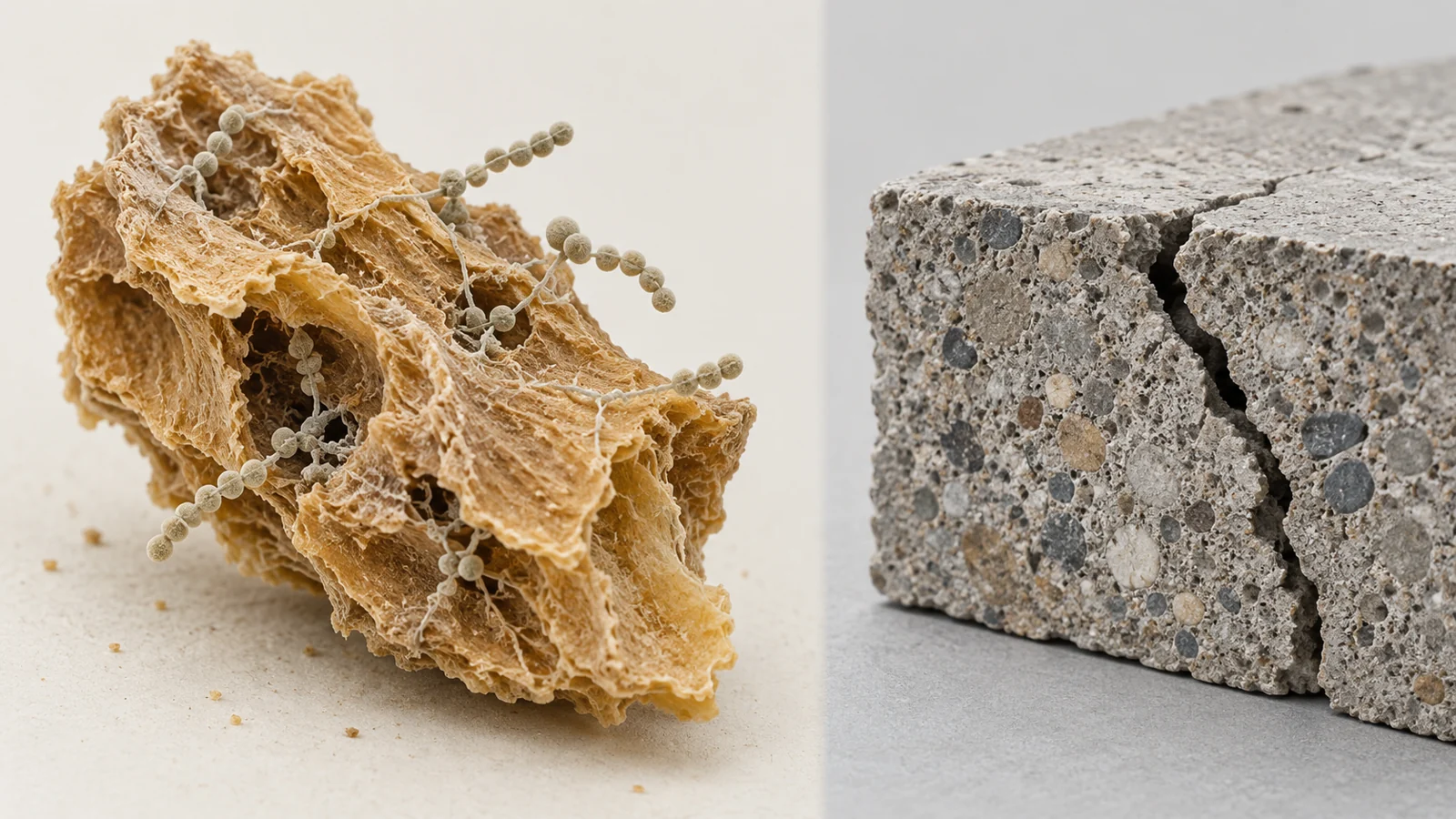
Electron microscopy showed chains of spores attached to and penetrating soy-hull particles. That observation helps explain how the fungus and the production substrate were associated during cultivation. It is evidence about growth on soy hulls, not evidence that spores survive within concrete, mineralize a crack, or improve a structure’s durability.
What a dependable spore supply could mean for concrete
A more dependable supply of S. brevicaulis spores could support development of concrete designed to mineralize and seal cracks, potentially easing repairs to structures. That practical benefit remains conditional: production must scale reliably, and the spores must be shown to survive and heal cracks in concrete. This study advances the production question, while the proposed repair capability remains to be demonstrated.
Key Sources
- Primary source: Factors affecting production of Scopulariopsis brevicaulis spores for use in self-healing concrete
DOI or Journal Page · Peer-Reviewed Paper · 2025-09-01
Keep exploring