
Research Signal – Source date 2025-09-01
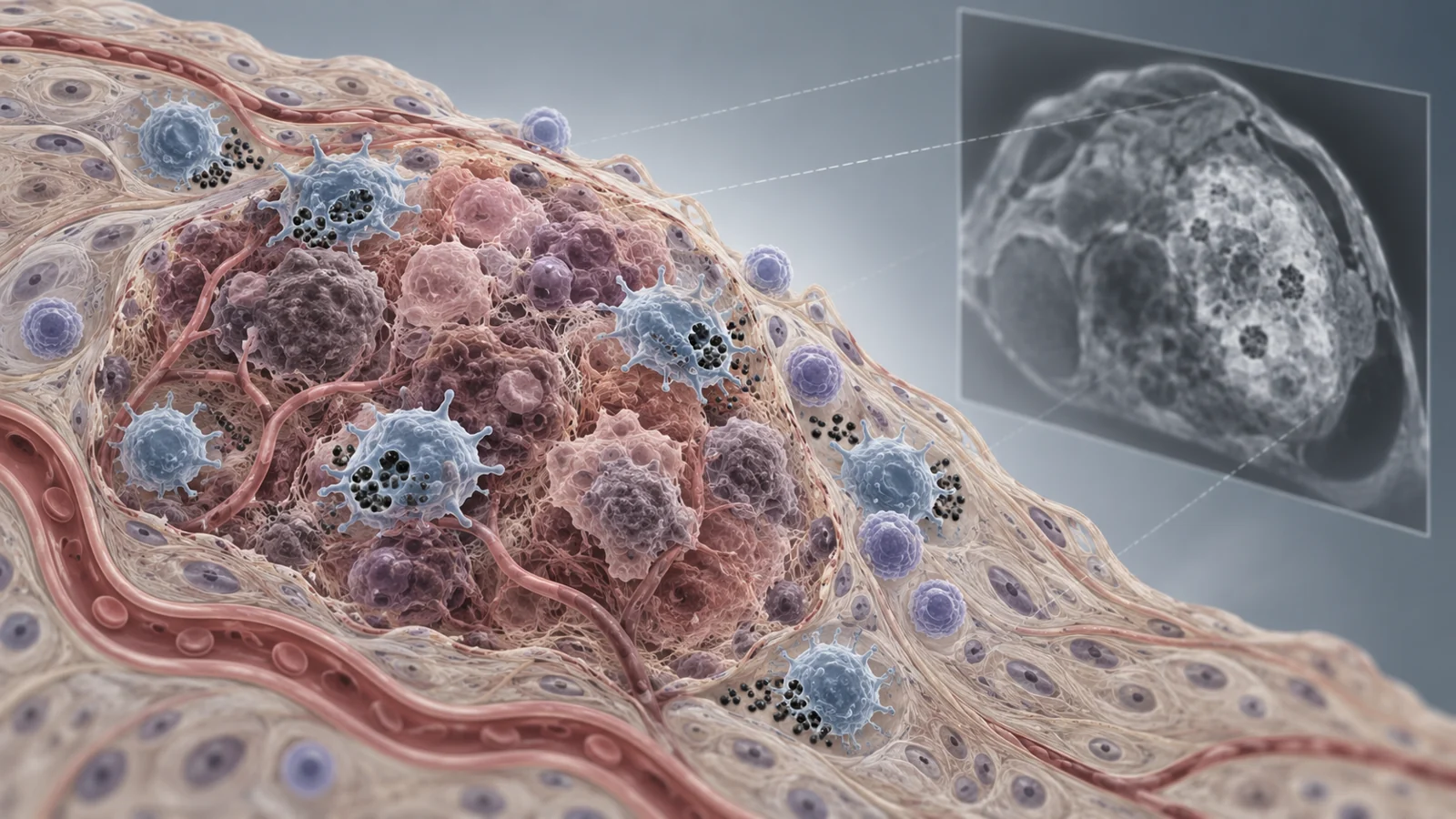
Immune therapy can falter when a tumor suppresses the cells meant to attack it. Some tumors contain suppressive immune cells and chemical conditions that blunt attack; dense tissue can also impede immune-cell entry. These features help create an “immune-cold” environment, where cancer-fighting T cells are scarce and checkpoint-blocking drugs may have little to work with.
A review published on September 1, 2025, considers whether engineered iron oxide nanoparticles could help address several parts of this problem. It brings together earlier research on particles designed to deliver treatment, alter immune activity, damage tumor cells, or make immune cells easier to track. The examples are chiefly laboratory and animal studies across different particle designs and tumor models. They offer possible routes to better-targeted treatment, but they do not show that iron oxide immunotherapy improves outcomes for patients.
A magnetic particle can do more than one job
Iron oxide nanoparticles are tiny iron-containing particles whose properties can be adjusted through their size, structure, and surface coating. Their magnetic response can support movement or detection with magnetic tools. Their surfaces can be modified to carry or interact with other materials. Iron chemistry can also take part in reactions that stress tumor cells. These are distinct capabilities: a particle’s magnetic behavior does not, by itself, ensure precise delivery, and a detectable imaging signal is not evidence of tumor control.
The review describes these particles as theranostic platforms—materials intended to connect treatment and diagnosis. In practice, a particular design may combine only some of the available functions. A coating might influence how a particle interacts with cells; a magnetic field might help guide it; iron-driven chemistry might contribute to cell damage. Each step raises its own question about whether the particle reaches the intended site and whether the resulting effect matters for the disease.
Reworking the immune cells already in a tumor
Tumor-associated macrophages can take on states that suppress immune attack. The review describes strategies intended to shift these cells toward a more inflammatory, anti-tumor state. One example uses mannose-decorated porous iron oxide particles to deliver 3-MA, a PI3Kγ inhibitor. In the reported work, the approach increased NF-κB p65 activity and moved macrophages from an M2-associated state toward an M1-associated one, alongside greater secretion of immune-stimulating signals.
The review also discusses ferumoxytol, an iron oxide formulation approved for clinical use in a different context. Cell and animal findings summarized in the review suggest that it can affect macrophage activity and cancer-cell killing. Its existing clinical status does not make it an approved cancer immunotherapy: evidence for diagnostic use or safety in that use cannot establish anti-cancer benefit. The reviewed macrophage findings describe a mechanism worth investigating, not a demonstrated patient response.
Getting a payload to the intended place
A treatment carried by a nanoparticle still has to reach the cells or tissue where it is meant to act. The review describes several approaches to that delivery problem. Surface changes and targeting ligands are intended to influence cellular uptake. Some designs rely partly on the enhanced permeability and retention effect, in which particles may accumulate in tumors because of features of tumor blood vessels. Other approaches use magnetic navigation, including efforts to direct particles toward lymph nodes.
Some biohybrid designs coat particles with cancer-cell membranes. The proposed advantage is that a membrane from a tumor cell may help a particle home to similar tumor tissue and remain in circulation longer. These strategies concern where a particle goes and what it carries. More accumulation at a tumor is not, on its own, proof that a payload reached the right cells, changed immune activity, or improved a treatment outcome. The review also identifies a practical limitation: passive accumulation may be less dependable in tumors with dense supporting tissue, and magnetic targeting can lose effectiveness for deep or widely spread disease.
Pairing tumor damage with immune treatment
Iron oxide platforms are also used in approaches that combine local tumor-cell stress with immune therapy. In one set of examples, magnetic heating is intended to injure tumor cells in a controlled area and prompt changes associated with an immune response. The review describes iron oxide nanorings that produce mild heat, with reported exposure of calreticulin on tumor cells, macrophage changes, and greater CD8-positive T-cell infiltration. When paired with PD-L1 blockade in the cited preclinical work, the combination suppressed recurrence and metastasis in the model studied.
The logic has two parts. Local heat or iron-driven reactions may create tumor-cell damage that serves as an immune stimulus; checkpoint blockade targets a separate restraint on immune activity. Other reviewed combinations use iron chemistry to promote ferroptosis, a form of cell death linked to lipid damage, alongside checkpoint treatment. The review reports that certain combinations achieved complete tumor regression in over 50% of the preclinical models it cites. That figure belongs to the cited experimental combinations and models. The reported proportion is not an overall response rate for iron oxide treatments, and different formulations cannot be assumed to behave alike.
Imaging can track cell location, with limits
Iron oxide particles may also help researchers see where immune cells travel. The review describes T cells, CAR-T cells, and natural killer (NK) cells labeled with particles so their distribution can be followed using magnetic resonance imaging (MRI). In examples involving NK cells, magnetic guidance was used to increase their recruitment to tumors; the reviewed work reported tumor-cell effects while preserving measured NK-cell function. Particle labeling of other immune cells is presented as a way to observe their spatial distribution in tumors.
Seeing where labeled cells are is useful information about trafficking. It does not by itself show that those cells are killing enough cancer cells, nor does it validate a system that adjusts a patient’s treatment in real time. The review discusses future possibilities involving MRI or magnetic particle imaging paired with treatment feedback, but presents these as a direction for development rather than an established clinical capability.
The gap between a design and a usable treatment
The variety of platforms is part of the challenge in interpreting the field. Particle size, coating, payload, magnetic behavior, treatment combination, and tumor model can all differ. A result from one setup cannot automatically be carried over to another. Tumors may also resist iron-driven stress by increasing antioxidant defenses, while suppressive conditions such as lactate and adenosine can continue to hinder immune activity.
Safety and manufacturing add further hurdles. Reactive oxygen species generated during treatment could affect tissue beyond the intended target. Repeated administration raises questions about accelerated blood clearance for some PEG-coated particles. Complex surface functionalization and biomimetic coatings may be difficult to produce consistently at larger scale. The review cites a pediatric safety experience with ferumoxytol used diagnostically, but that context does not resolve the safety or effectiveness of repeated anti-cancer treatment with other engineered particles.
These constraints matter because the proposed benefits depend on the full chain working: a formulation must be made consistently, reach the relevant tissue, produce the intended local effect, and do so without unacceptable harm. The preclinical studies summarized in the review test pieces of that chain in different ways. They provide a basis for further research, while leaving clinical benefit unestablished.
What magnetic particles could change in cancer care
If engineered iron oxide platforms can deliver their intended effects safely and reliably, they could give cancer treatment a way to combine localized tumor stress with immune activation, while imaging helps show whether immune cells reach the tumor. If such imaging is validated for treatment decisions, it could help clinicians identify when immune cells fail to reach a tumor; judging their activity after arrival would require other evidence. Reaching that capability will depend on overcoming resistance, targeting, safety, and manufacturing barriers; the review’s animal and laboratory findings are an early step toward it.
Key Sources
- Primary source: Engineered iron oxide nanoplatforms: reprogramming immunosuppressive niches for precision cancer theranostics.
DOI or Journal Page · Review or Meta-Analysis · 2025-09-01
Keep exploring