
Research Signal – Source date 2025-08-09
Polymer composites are plastics reinforced with fibers or particles. They can make a component lighter or change how it handles heat, friction, vibration or electrical current. But a useful material is only part of a useful part: its recipe, manufacturing route and operating environment all matter.
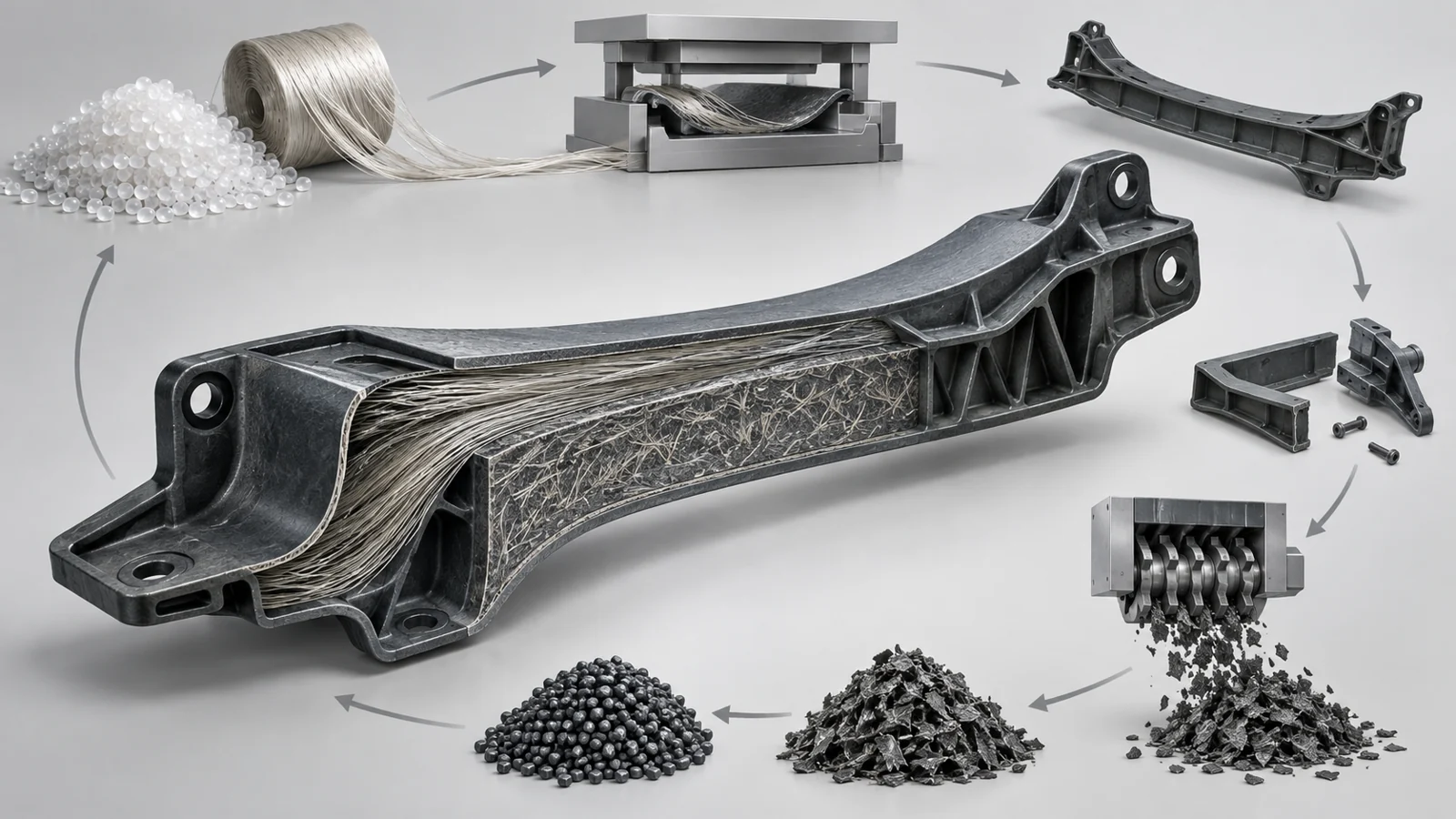
A review published on 9 August 2025 surveys production technologies and applications across engineering, with particular attention to vehicles and examples from medicine and aviation. It describes a field with many possible combinations, rather than one material or process that fits every job. The practical question is how to make a component whose properties hold up in the place it is meant to serve—and what happens when that component reaches the end of its use.
The recipe begins with a matrix and reinforcement
A polymer composite has a matrix, the material that forms most of the part and holds it together, and a reinforcement phase that contributes strength or stiffness. Fibers such as carbon fibers, oxide fibers or nanotubes can be added to alter mechanical and functional properties. Additives and modifiers can further affect workability, strength, heat resistance and service life.
That flexibility is useful because a brake pad, a structural panel and a medical device face different demands. It also means “composite” does not name a single predictable material. The matrix, reinforcement and other ingredients make up a recipe, and the process used to turn that recipe into a part influences its performance and durability. A design that works in one application cannot be assumed to suit another simply because both use polymer composites.
Production choices shape the part
Conventional methods can offer repeatable processing and control over manufacturing conditions. The difficulty is that complex shapes and changing cross-sections can complicate design and raise tooling costs. A method suited to a simpler part may not make an intricate geometry practical.
Other routes address different needs. Additive manufacturing builds material layer by layer, which can support complex forms and internal structures and can simplify some production steps. The review also identifies limits: material choices can be restricted and production relatively slow. It describes additive manufacturing in areas including biomedicine, electronics and aerospace, but those examples do not establish that every material or part is ready for a particular use.
Surface coating applies a thin film to a prepared substrate. It can be used across a range of materials and operating conditions, with relatively low raw-material and process costs. Controlling the coating thickness and handling post-processing are challenges. The review discusses uses such as corrosion protection, pipeline construction, antibacterial coatings and drug handling systems.
Magnetic pulse powder compaction uses pressure from a pulsed electromagnetic field to consolidate powders. It can be fast and relatively simple, but the review describes it as better suited to simple geometries and notes energy losses that reduce overall efficiency. The method appears in examples involving biomedicine, ceramic components and packaging. These routes change what can be shaped, finished or produced efficiently; none removes the need to match the process to the part.
A brake pad and a chassis solve different problems
In a vehicle, a brake pad must provide reliable friction and resist wear under specified loads, speeds and temperatures. The review describes phenolic composites used in brake pads, citing friction and wear performance at room temperature and at elevated temperatures up to about 250 °C. That is a component-specific example: the material must work under the conditions of braking.
A chassis has a different job. It is the structural foundation of a vehicle, so stiffness, fatigue resistance and damage tolerance matter. The review discusses syntactic foam as a core material in thin-sheet sandwich constructions and cites studies in which composite integration was associated with lower vehicle mass, lower fuel consumption, a higher power-to-weight ratio and greater damage resistance.
Those cited outcomes are application claims, not a common test of all composites or a general estimate of fuel savings. The examples show why the material must be judged by the work the component performs: friction at heat for one part, structural behavior over service life for another.
The destination sets its own demands
Aircraft parts face demanding operating conditions, including changes in temperature, pressure, speed and direction. The review discusses bio-composites in interiors and other aircraft components, where low mass can be attractive alongside strength. It also describes limits: bio-composites generally have low flame resistance, so fire requirements constrain where they may be suitable. The source cites linen-reinforced phenolic resin cabin panels and a reported reduction in wing-box weight compared with 7000-series aluminum alloys. These are particular examples, not proof that all bio-composites qualify for aircraft structures.
Medical applications bring another set of requirements. The review describes polymer composites used in dentistry and orthopedics, including as alternatives to metal devices for some people with metal allergies. It discusses strength, biocompatibility, elasticity and fatigue behavior as relevant properties. It also identifies concerns such as sensitivity to moisture and chemicals, limited resistance to ultraviolet exposure and weathering, lower high-temperature resistance than metals, and difficult recycling. Manufacturing requires precise control, which can add cost. The review’s examples do not establish approval or suitability for every device or patient.
Recovery remains part of the engineering problem
The review’s introduction presents recycling as a potential advantage, pointing to available processes and comparatively low costs. Its conclusion, however, calls for simpler, more effective recycling methods and safer production, use, disposal and recovery. Those points leave a practical task unresolved: a material may be attractive in service while still being difficult or costly to recover reliably afterward.
The review does not provide a single measured recycling or environmental benefit across the applications it surveys. Better recovery depends on methods that work for the materials and products involved, while protecting human health and the environment across the full life cycle. End-of-use handling therefore belongs in the design problem, alongside manufacturing and performance.
What lighter vehicle parts could change
If manufacturers can make durable composite components consistently, and recover their materials safely after use, weight reduction could extend to more suitable vehicle parts. Lower mass could reduce fuel demand in vehicles where the chosen component meets its specific performance requirements. The review gives no general estimate of fuel savings; manufacturing cost and safe recovery after use also affect whether a lighter part is practical.
Key Sources
- Primary source: Production Technologies and Application of Polymer Composites in Engineering: A Review.
DOI or Journal Page · Review or Meta-Analysis · 2025-08-09
Keep exploring