
Research Signal – Source date 2025-07-21
Modern communication systems use radio waves in the 1–8 GHz range. Materials that absorb these microwaves could help manage unwanted electromagnetic energy, but a promising laboratory design is only a starting point: it must also be affordable, durable and manufacturable at useful scale.
A review published on July 21, 2025, surveys how researchers are approaching that challenge. It covers established magnetic materials alongside newer combinations and structures, and explains how composition and design can influence absorption. It synthesizes a field of materials research; the supplied evidence does not describe a single new absorber or a deployed product.
The tradeoffs behind familiar materials
Ferrites and metallic powders provide a reference point for newer designs. The review describes conventional magnetic systems as limited by high density, narrow absorption bandwidth and environmental instability. Those drawbacks help explain the search for alternatives, while the older material classes remain important to the comparison.
The goal is not simply to make an absorber lighter or to broaden the range of frequencies it can absorb. A useful material must also manage the wave at its surface and within its structure. Composition and architecture offer ways to tune those properties, but claims of improvement in one dimension do not settle how a material will perform in practical equipment.
Letting waves enter, then lose energy
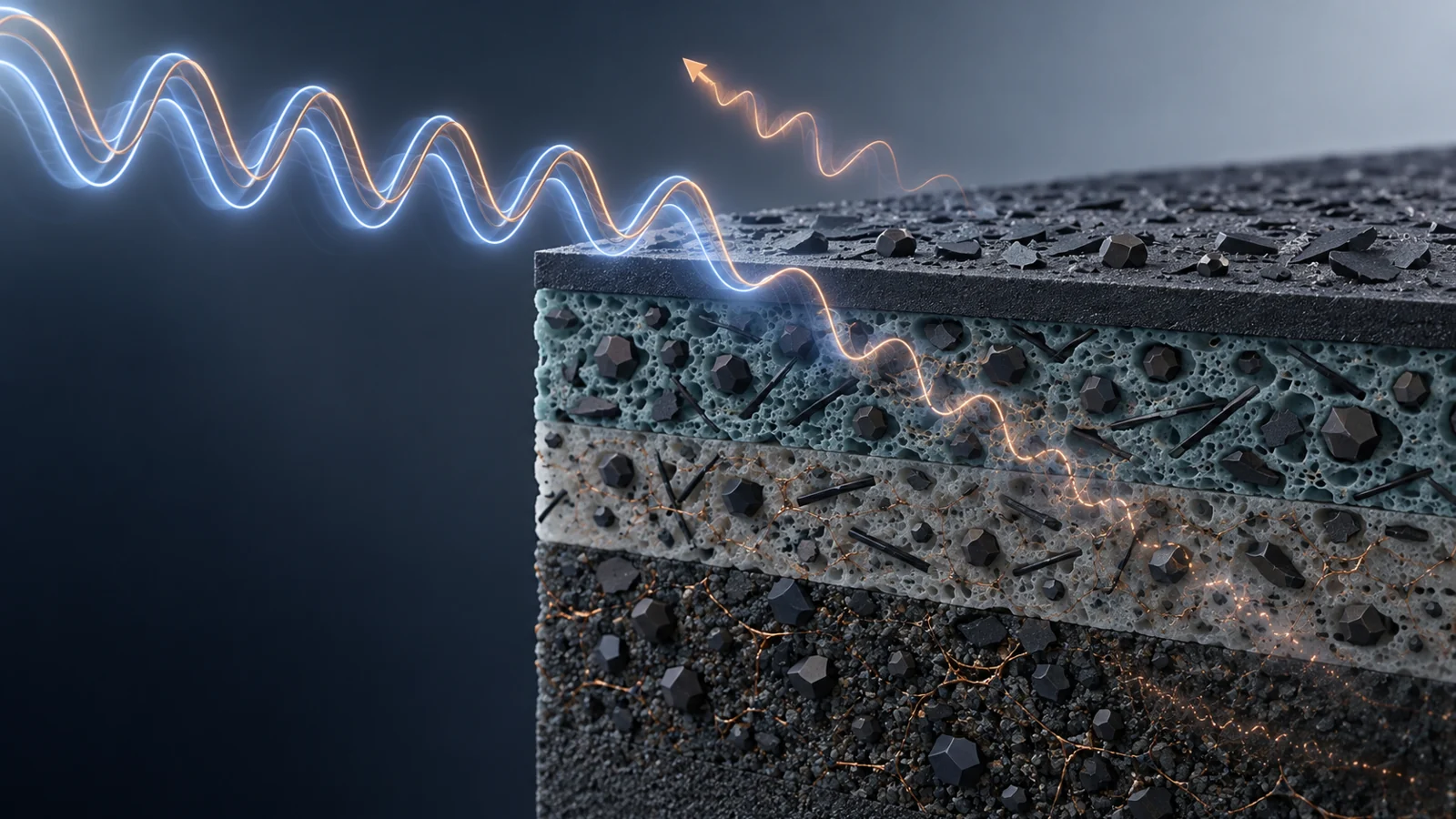
Three electromagnetic properties frame the review’s discussion. Permittivity describes how a material responds to an electric field; permeability describes its response to a magnetic field. Together with impedance matching, these properties help determine whether an incoming wave can enter the material rather than being reflected at its surface.
Once energy enters, it can be dissipated within the absorber. The review discusses interfacial polarization, which concerns charge behavior at boundaries between different parts of a material, and structural effects across multiple scales. These mechanisms connect material design to energy loss: the arrangement of components and their interfaces can shape how a wave interacts with the absorber. Matching the surface response with internal loss is part of the design problem, rather than a matter of adding more components alone.
Different routes to tuning absorption
Carbon-based hybrids, including those made with carbon nanotubes or graphene, are one route the review describes. Magnetic–dielectric heterostructures combine components with different electromagnetic roles. Emerging material families such as MXenes and metamaterials offer further options for adjusting composition and structure.
These approaches are distinct design directions, not a ranking. The review’s abstract identifies them as part of the field’s move toward lighter, broadband and tunable absorption, but the supplied evidence gives no study-level measurements for comparing their performance. No one family can be said here to resolve every tradeoff.
From material design to practical manufacture
The path from a promising composition to a usable absorber brings several separate hurdles. Cost affects whether a material is practical to produce. Durability concerns whether it can retain useful properties through use and exposure. Scalability asks whether a fabrication method can make enough consistent material beyond laboratory quantities.
The review points to machine learning-assisted design and scalable fabrication techniques as directions for future work. These proposals may help researchers explore candidate materials and manufacturing approaches, but they are not established solutions to the cost, durability or scale barriers. The practical question remains whether gains in absorption can survive those demands together.
What lighter microwave absorbers could enable
If lighter absorbers can retain useful performance while meeting cost, durability and manufacturing demands, they could give equipment designers more options for managing unwanted energy across several communication bands in the 1–8 GHz range. Lower weight could matter where heavy components constrain equipment design, while broader-band absorption could address more than one part of the range. Those capabilities remain conditional: advances described in materials research have yet to settle whether they can be delivered together in practical equipment.
Key Sources
- Primary source: Advances and mechanistic insights into low-frequency (Sub-8 GHz) microwave-absorbing materials: A critical review bridging conventional architectures and emerging frontiers.
DOI or Journal Page · Review or Meta-Analysis · 2025-07-21
Keep exploring