
Research Signal – Source date 2025-06-25
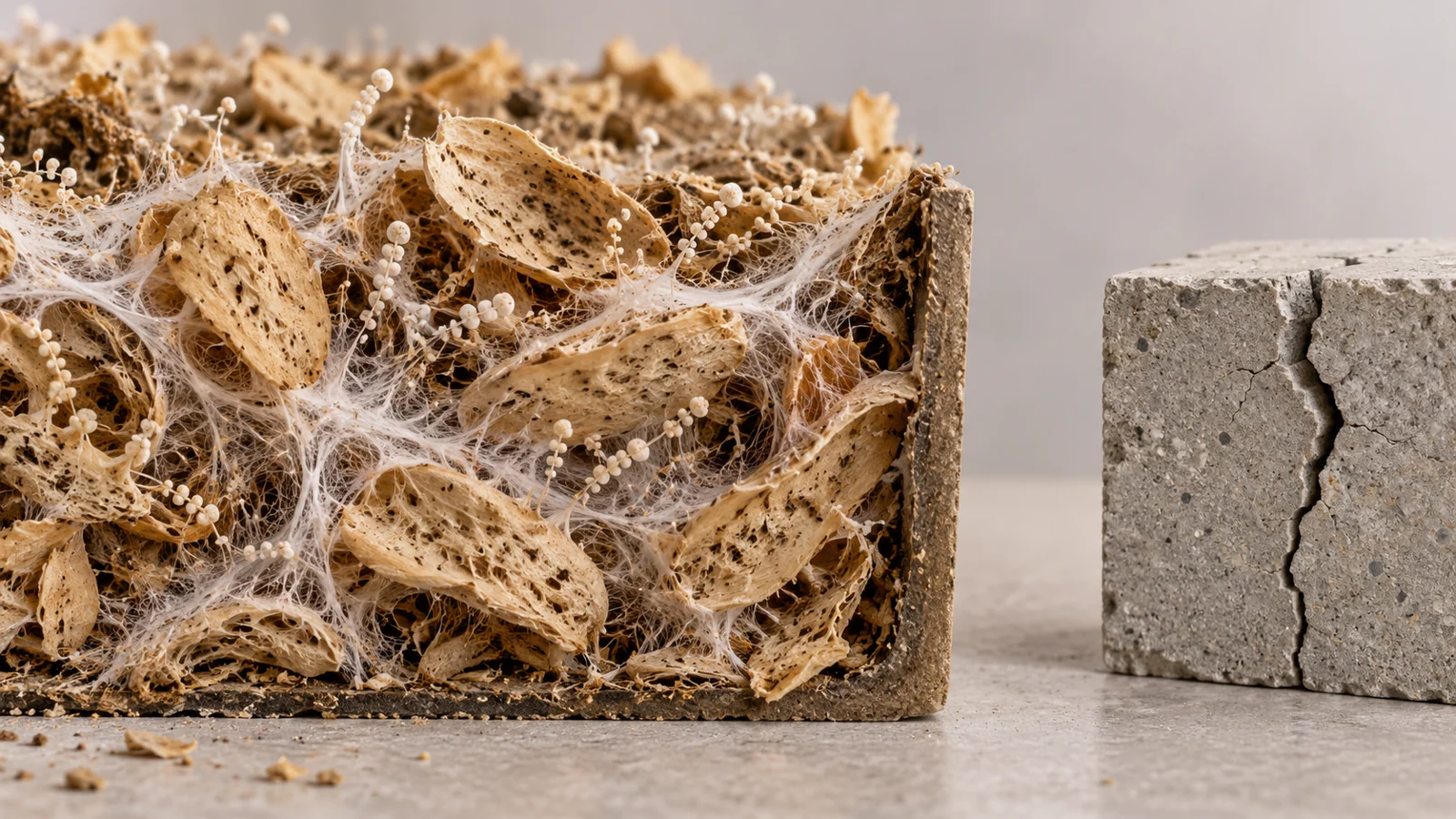
Concrete can crack, creating paths for water and other substances to enter and potentially expose reinforcing steel to corrosion. One proposed way to limit such damage is self-healing concrete, which uses microorganisms to form mineral deposits that fill cracks. For that approach, a supply question comes first: can the repair ingredient be produced in useful quantities and collected efficiently?
A study published June 25, 2025, investigated how to produce spores of the fungus Scopulariopsis brevicaulis. Spores are the fungus’s reproductive particles. The researchers tested soy-derived materials and cultivation conditions; they did not test whether the resulting spores could survive in concrete or seal a crack.
Soy hulls offered more than a food source
The researchers first compared soy hulls, soy flour, and soy molasses on agar plates. After 14 days, total spore counts were not statistically different among the three materials. The plate results alone therefore did not show that soy hulls produced more spores.
Their practical case came from other considerations. Soy hulls were reported to cost about $100 per ton, compared with about $400 per ton for soy flour. They could also serve as both a nutrient source and a rigid support for solid cultivation. That structure leaves spaces within the bed, while soy flour and molasses would need an inert support to create room for heat and oxygen transfer.
This combination made hulls a suitable material to carry into the fermentation tests. It did not establish that the material would deliver a particular industrial cost or production scale.
Solid cultivation produced spores sooner
Using soy hulls, the team compared solid-state fermentation, in which fungi grow on moist solid material without free-flowing liquid, with submerged fermentation in liquid. In the tested flasks, the solid system produced no spores in the first two days, then accumulated spores during Days 4–8; the liquid system produced none for about four days.
During the active production period, the measured daily rate was about 1.99 × 10⁸ spores per gram of soy hull per day in the solid system and 4.39 × 10⁷ in the liquid system. The solid system’s rate was more than 4.5 times higher. By Day 14, its yield was 1.33 × 10⁹ spores per gram of hull, compared with 5.49 × 10⁸ in the liquid system. The liquid culture continued producing spores through Day 21, reaching 8.27 × 10⁸ per gram.
These are separate measures: how quickly spores accumulated during the productive period and how many were obtained at a given harvest time. Solid cultivation also left the spores in a concentrated, relatively dry form, which the authors said could make collection and storage easier than processing a large volume of liquid. The experiments compared cultivation systems in flasks; they did not establish production performance at industrial scale.
Water and particle size shaped the cultivation bed
The solid bed needed enough water for fungal activity and movement of soluble nutrients, but excess water could reduce the open spaces between hull particles. Yield increased as moisture rose from insufficient levels and was highest around 60–67%. It declined at higher moisture, with a drop already apparent around 70% in these soy-hull systems. The authors proposed that water beyond what the particles could absorb reduced airspace and impeded oxygen movement through the bed.
Particle size also mattered. After 14 days, medium and large hull particles produced comparable yields, while small and mixed-size material produced significantly less. Microscopy showed spore chains attached to and covering hull surfaces. The authors observed that small particles clumped when wet, whereas larger particles left more open space and less aggregation. They proposed that this could support oxygen transfer and provide more usable surface for fungal growth and spore formation. The measured yield pattern and images support the particle-size finding; the oxygen-transfer explanation remains an interpretation rather than a directly demonstrated mechanism.
High pH and salt were tested in different ways
In soy-hull solid-state flasks, a higher initial pH improved final spore yield. Systems started at pH 10 or 11 produced more spores by Day 14 than the lower-pH comparisons, although the higher pH did not show the same advantage in early measurements. The authors suggested that alkaline conditions might stress the fungus and favor sporulation, or might alter the hull material so it was easier to break down.
Salt produced a distinct result in a different test. On agar plates, adding 15 g/L of sodium chloride raised spore production significantly compared with the no-salt control. In the soy-hull flask experiment, the 10 g/L salt condition had a higher average yield than the control, but the difference was not statistically significant. The plate result cannot be treated as proof that the same salt benefit occurs in soy-hull fermentation. Stress-triggered sporulation is one possible explanation offered by the researchers, not a mechanism established by these comparisons.
More fungal growth did not mean more spores
Nitrogen supplementation provides a useful contrast between fungal growth and spore production. With high levels of ammonium sulfate, the hull particles became more visibly covered in white fungal growth, yet sporulation was delayed and final spore yield fell as supplementation increased. More visible fungal growth did not translate into a higher final spore yield.
Small additions of glucose increased early spore production in some measurements, but the effect did not improve the final Day 14 yield. Higher glucose additions weakened or reversed the early benefit. Changing the initial spore inoculum also affected some early counts, but final yields converged across the tested levels. These results suggest that timing and the transition from growth to sporulation matter alongside the amount of visible fungal growth.
What a spore supply could mean for concrete crack repair
A more productive way to grow collectable fungal spores could make it more practical to investigate fungal biomineralization as an ingredient for concrete designed to seal cracks. If the solid-cultivation advantage holds at larger scale, and if the spores remain viable through incorporation and perform in concrete, this production route could help supply a biological repair approach for infrastructure. Those conditions are consequential: larger solid beds can be harder to control for temperature and oxygen, and this study did not measure crack sealing, spore survival in concrete, realized production costs, or maintenance and emissions benefits.
Key Sources
- Primary source: Factors affecting production of Scopulariopsis brevicaulis spores for use in self-healing concrete.
DOI or Journal Page · Peer-Reviewed Paper · 2025-06-25
Keep exploring