
Research Signal – Source date 2025-06-07
When a cancer target disappears
Engineered immune cells can be given receptors that recognize a chosen molecule on a cancer cell. CAR-T therapy uses this approach with a patient’s T cells, and it has achieved notable success against some blood cancers. But a treatment aimed at one marker can leave room for cancer cells that no longer display it.
The review published June 7, 2025, describes several routes to this escape. A tumor may acquire mutations in the gene for a target such as CD19 or BCMA, change cell lineage, or alter gene expression through epigenetic changes. Tumors can also contain different cell populations from the outset. If a treatment removes cells bearing its chosen marker, a marker-negative population may survive and later contribute to recurrence.
Target escape is only part of the durability problem. Engineered T cells may not persist in the body, and prolonged antigen stimulation or suppressive signals in the tumor microenvironment can contribute to T-cell exhaustion. In that state, the cells’ ability to suppress a tumor can diminish even when the target is still present. Changing the receptor’s target range addresses recognition; it does not by itself solve persistence or exhaustion.
The problem also differs between cancers. Blood and bone-marrow cancers can offer accessible targets and, in some settings, relatively consistent antigen expression. Solid tumors often present more uneven targets and a local environment that can suppress immune activity. A design that works well where target expression is comparatively uniform may therefore face different obstacles in a solid mass.
More than one marker changes the rule
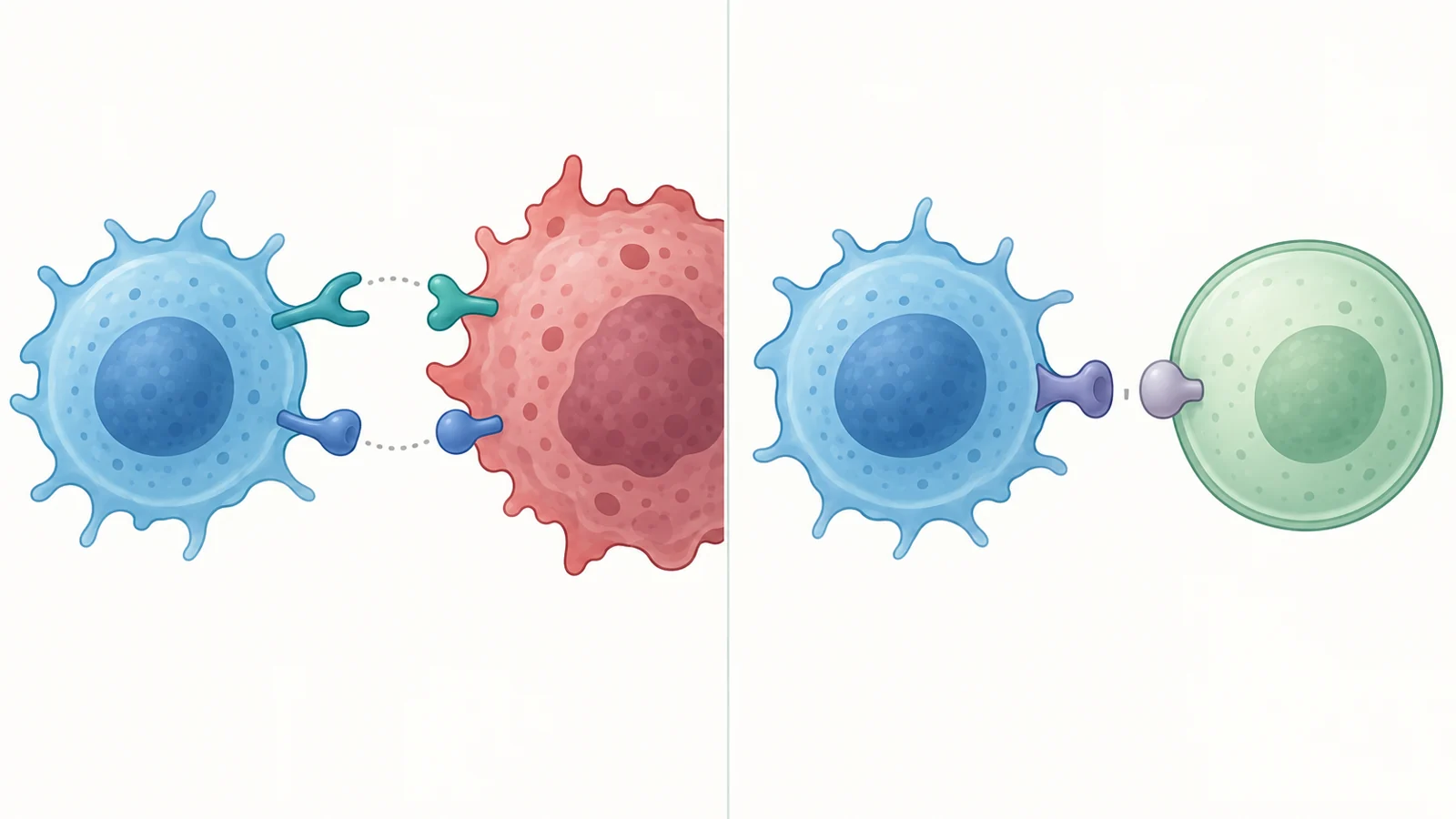
An OR-gate design lets an engineered cell respond to either of two tumor markers. A dual CAR-T cell, for example, can carry separate receptors for two targets. The review describes CD19/CD123-targeting cells as a proposed way to address CD19-negative relapse in B-cell acute lymphoblastic leukemia; the cited work reported better efficacy than single-target cells or a pooled-cell comparison. The example illustrates the purpose of broadening recognition: losing one marker need not make a cancer cell invisible if another recognized marker remains.
But recognizing more targets can enlarge the set of healthy cells that might also be recognized. Some tumor-associated antigens occur on normal tissue as well as cancer. An OR rule can increase the chance of reaching marker-diverse tumor cells while also increasing the chance of an attack where either target appears on healthy cells. Broader recognition is useful only if the design can manage that added exposure.
AND-gate designs make recognition more conditional. Instead of responding to either marker alone, the engineered cell is activated only when a combination of signals is present. This can help distinguish a tumor that carries both signals from healthy tissue carrying just one. The tradeoff is that the required combination may be missing or unevenly expressed across tumor cells, leaving some cancer cells outside the rule. More elaborate recognition logic also makes the cell design harder to build and tune.
NOT-gate designs add a protective check. An inhibitory receptor can dampen the engineered cell’s function when it encounters a marker associated with healthy tissue, while leaving it responsive after it moves away from that inhibitory signal. The review contrasts this reversible inhibition with a suicide switch, which destroys engineered cells and ends the therapy. A NOT gate can preserve activity elsewhere, but it adds another signal and another interaction that must work as intended. The review also discusses combining OR and NOT logic, such as a design intended to recognize tumor markers while sparing marker-bearing normal stem cells.
These gates are design strategies, not a settled ranking of which architecture best balances tumor control and harm. Their performance depends on which markers are present, how evenly they appear, and how the engineered cells interpret their combination.
The carrier cell matters too
The receptor is only one part of an engineered therapy. The immune cell carrying it brings its own biology, which can affect where it goes and how it acts.
Natural killer cells can recognize cells with reduced MHC class I, a pattern described as “missing self.” They can also respond to activating ligands and participate in antibody-dependent cell killing through CD16. These recognition routes differ from a CAR’s direct targeting rule. CAR-NK approaches may therefore draw on innate recognition as well as the added receptor, though the review notes that they have fewer clinical trials than CAR-T therapy.
Macrophages bring a different potential advantage in solid tumors. They are common in the tumor microenvironment and can infiltrate tumors, where their functions may be redirected by a CAR. The review describes engineered macrophages designed to engulf targets and remodel suppressive surroundings, including by producing enzymes that degrade fibrotic matrix. This could help address barriers that limit immune-cell entry, but CAR-M research was still at an early stage in the review’s account.
One example is HER2-targeted CAR-M therapy CT-0508. The review describes preliminary findings from a Phase I study in HER2-overexpressing tumors, mainly breast and esophageal cancers, as indicating favorable tolerability, early antitumor activity, and changes to the intratumoral immune environment. These early observations are not a final clinical result, and they do not establish how macrophage therapy compares with other designs. The review identifies further clinical limits for this approach.
A bridge can make targeting adjustable
Cell engagers work differently from engineered cells. They bind a tumor-associated antigen and an immune cell, bringing the two close enough to form a killing interaction. Rather than permanently changing the immune cell, an engager supplies a molecular bridge that can recruit it to a target.
Adapter-mediated CAR designs add a related layer of flexibility. An adapter connects the engineered receptor to a chosen tumor marker; changing the adapter can change what the cell recognizes. The review describes modular systems in which target choice or reaction strength may be adjusted through adapter design or concentration. This tunability could help respond to shifting tumor markers, but it creates a practical control problem: the effect depends on having the right adapter exposure and timing. Adapters also add components and complexity to a therapy that already has to reach the tumor and activate in the right place.
Engagers have their own constraints. The review discusses differences in size, half-life, tumor penetration, and risks such as cytokine release syndrome. Some designs may need continuous infusion because they have a short half-life. These features shape how an engager might be delivered and controlled; they do not make one format universally preferable.
What better tumor recognition could change
If multi-target recognition can account for tumor variation while logic gates, adapters, or cell-engager design keep activation sufficiently controlled, immunotherapy could reach cancers that evade a single-target attack and do so with fewer mistaken attacks on healthy tissue. Alternative carriers could also help address barriers in solid tumors by bringing different recognition or infiltration properties. For patients, the potential payoff would be treatments better matched to the markers and surroundings of an individual cancer. The review describes tools and early evidence toward that capability, while leaving the best clinical balance unresolved.
Key Sources
- Primary source: Insights into next-generation immunotherapy designs and tools: molecular mechanisms and therapeutic prospects.
DOI or Journal Page · Review or Meta-Analysis · 2025-06-07
Keep exploring