
Research Signal – Source date 2025-06-01
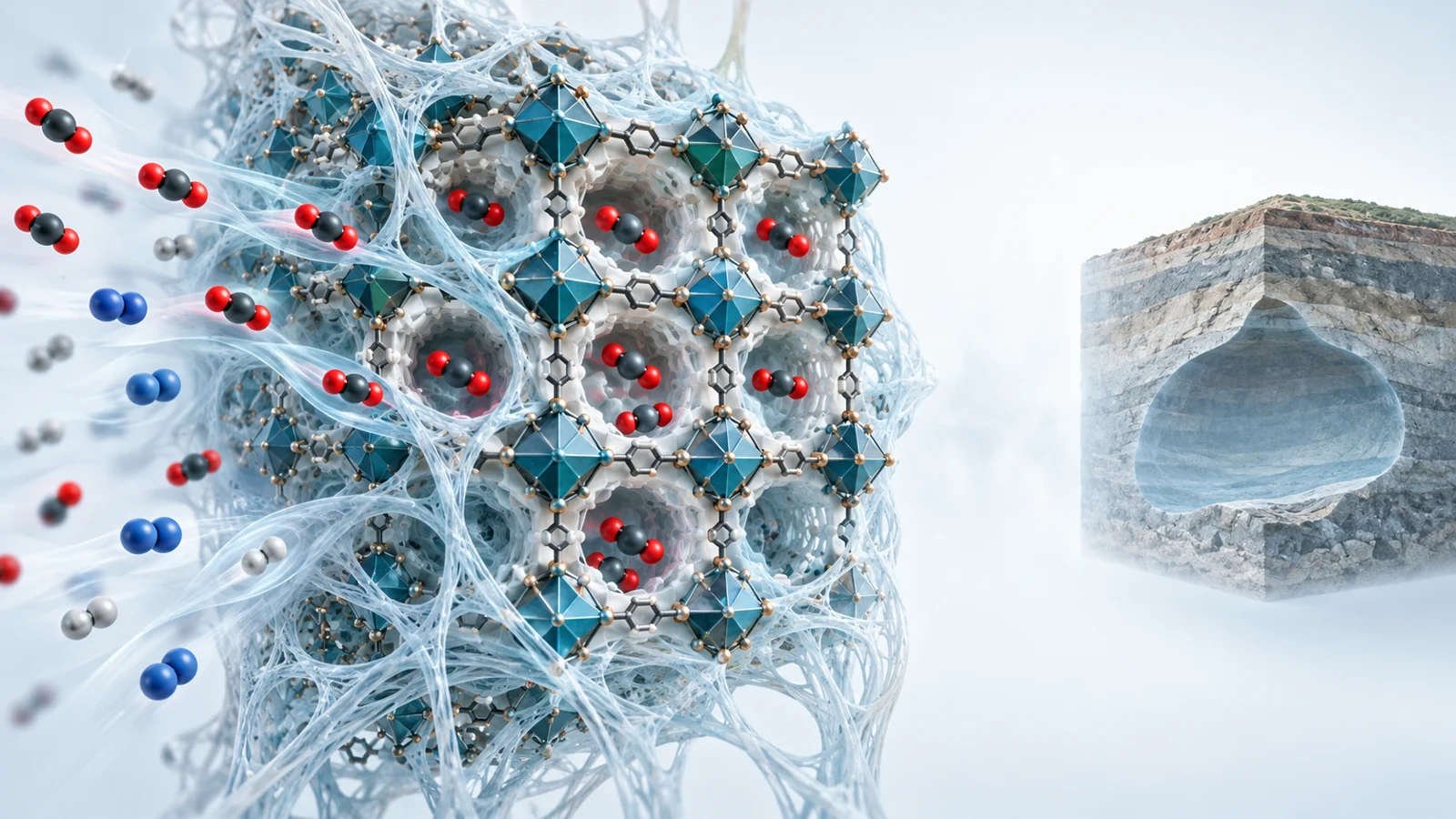
Metal-organic frameworks are built with pores whose sizes and structures can be tuned, a feature that makes them promising for separating carbon dioxide. Their fragility, however, poses a materials challenge. A review dated June 2025 considers whether nanocellulose, a flexible and strong material derived from cellulose, could support these porous frameworks.
The pairing has a clear rationale, but its promise needs careful reading. The review describes a materials approach to CO₂ adsorption and separation. The evidence available here does not give a quantified advantage for a particular composite or show how one performs in a capture system. And capturing CO₂ in a material’s pores is a step distinct from storing that carbon permanently.
Why pore structure matters
A metal-organic framework (MOF) combines organic and inorganic components. The review highlights its tunable pore sizes and high porosity as reasons it can be useful for CO₂ separation. Pores provide internal space where gas molecules can be adsorbed; their size and the framework’s structure can be adjusted as part of designing a material for separation.
That design rationale is not itself a performance result. The supplied abstract does not provide comparative capture capacity or selectivity for a named nanocellulose–MOF composite. It therefore supports the idea behind the pairing, but not a claim that a particular version captures more CO₂ or separates it better than alternatives.
A support with a different job
Nanocellulose is presented as a possible support for MOFs. The authors cite its flexibility and strength in response to the frameworks’ fragility. In the proposed composite, the cellulose-based material supplies a supporting matrix while the MOF contributes tunable porosity relevant to gas separation.
The review also points to nanocellulose’s abundance, renewability, low cost, non-toxicity and hydrophilicity. These are properties the authors identify as attractive; the abstract does not establish lifecycle or economic benefits for a manufactured composite. Whether the support improves stability or capacity depends on how the materials are combined and how the resulting material behaves. Those questions are among the factors the review surveys, rather than outcomes quantified in the supplied evidence.
Capture is not the same as sequestration
Adsorption means CO₂ is taken up by a material. Separation means it is distinguished from other gases in a mixture. Both can be useful parts of a carbon-capture process, but neither tells us what happens to the CO₂ afterward.
Sequestration requires a further step: keeping captured carbon out of the atmosphere over time. The review’s title invokes sequestration, while the supplied abstract focuses on composites for adsorption and separation. It does not establish a storage method or show that captured CO₂ remains contained. The fate of the separated gas needs its own evidence and process; pore capture alone cannot answer that question.
The review’s scope includes material properties, synthesis methods, different types of nanocellulose, adsorption mechanisms, and factors that influence stability and capacity. This is a broad examination of the approach, but the available abstract does not specify operating conditions or demonstrate durability under them. A useful capture material would need to retain its relevant performance in the conditions where it is intended to work.
What sturdier carbon capture materials could enable
If a nanocellulose-supported porous material combines useful CO₂ uptake with stability under relevant operating conditions, it could help separate carbon dioxide from emissions streams as part of a capture system. That could make the capture step more practical, especially if the support helps address the fragility that motivates the pairing. The review presents a route worth investigating; the supplied evidence does not establish that this capability has been demonstrated in deployment. Permanent storage would still require a separate solution for the captured CO₂.
Key Sources
- Primary source: Nanocellulose – metal-organic framework (MOF) composites for efficient carbon dioxide capture and sequestration: a review
DOI or Journal Page · Peer-Reviewed Paper · 2025-06-01
Keep exploring