
Research Signal – Source date 2025-05-01
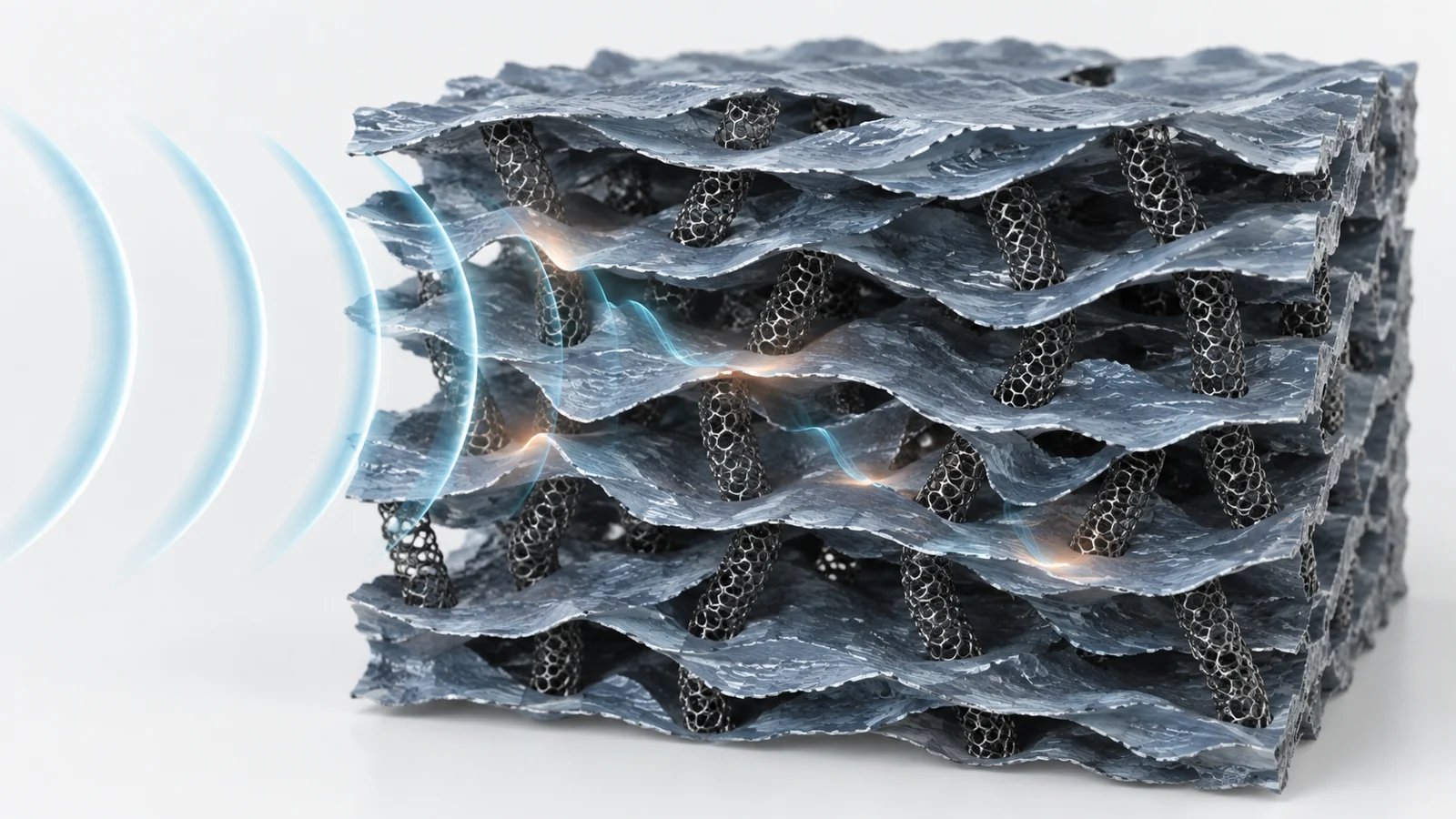
MXene sheets are two-dimensional, but this study turns them into a three-dimensional aerogel: a porous structure whose layers are held apart by helical, or coiled, carbon nanotubes. The design aims to tune how electromagnetic waves interact with the material. The reported absorption is striking, though its headline measurements describe different aspects of performance and, in one case, a different structure.
From flat sheets to a spaced network
The researchers used a one-step, ice-assisted process to form single-layer MXene aerogels, then incorporated helical carbon nanotubes to adjust the spacing between sheets. The assembled material, called an HCNT@MXene aerogel, had a regular porous structure and moderate electrical conductivity, according to the paper’s abstract.
The authors connect those features to the aerogel’s electromagnetic response. They used finite-element simulation, along with visualizations of surface charge distribution and power-loss density, to explain how the structure interacts with waves. These analyses offer a proposed account of the response; they are distinct from the reported absorption values.
Two numbers describe different performance features
At a reported filler ratio of 3.0% by weight, the HCNT@MXene aerogel had a minimum reflection loss of −51.45 dB and an effective absorption bandwidth of 6.48 GHz. Reflection loss compares reflected and incoming waves; a more negative value means less reflection at a test point. Effective bandwidth is the span of frequencies meeting the study’s absorption criterion. A deep minimum alone does not show how broad that span is.
The abstract supplies these headline values but not the detailed test conditions needed to judge how they translate to a particular manufactured absorber. The numbers therefore characterize the reported experiment, rather than establishing performance in a finished panel or across real installation conditions.
A separate design widens the reported range
The paper also reports an effective absorption bandwidth of 13.98 GHz using a hollow, gradient metamaterial design. This is a further design step, not another measurement of the same initial aerogel configuration. Its broader frequency span should be read alongside the structure that produced it, rather than merged with the 6.48 GHz result.
The abstract also reports radar cross-section reduction, with a maximum value of 27.08 dB m², and thermal insulation. These are additional reported properties; the supplied summary does not give a numerical insulation result or enough detail to assess how these characteristics would carry through manufacturing. A material’s laboratory response and its behavior as an integrated, durable part are separate questions.
What better radar-wave absorption could enable
Engineered panels that damp radar-frequency reflections while also providing insulation could be useful in settings where both properties matter. The study points toward that possibility through its absorption, radar cross-section, and insulation results. Such a capability would depend on those properties surviving fabrication and being confirmed in finished parts under relevant conditions; the reported material results alone do not establish operational radar concealment.
Key Sources
- Primary source: One-Click to 3D: Helical Carbon Nanotube-Mediated MXene Hierarchical Aerogel with Layer Spacing Engineering for Broadband Electromagnetic Wave Absorption.
DOI or Journal Page · Peer-Reviewed Paper · 2025-05-01
Keep exploring