
Research Signal – Source date 2025-04-16
A tiny engineered particle designed to respond to both light and conditions inside a tumor slowed tumor growth in mice with breast cancer cells. The study also found two immune-related changes in those cancer cells. Whether those changes helped cause the mouse result remains an open question.
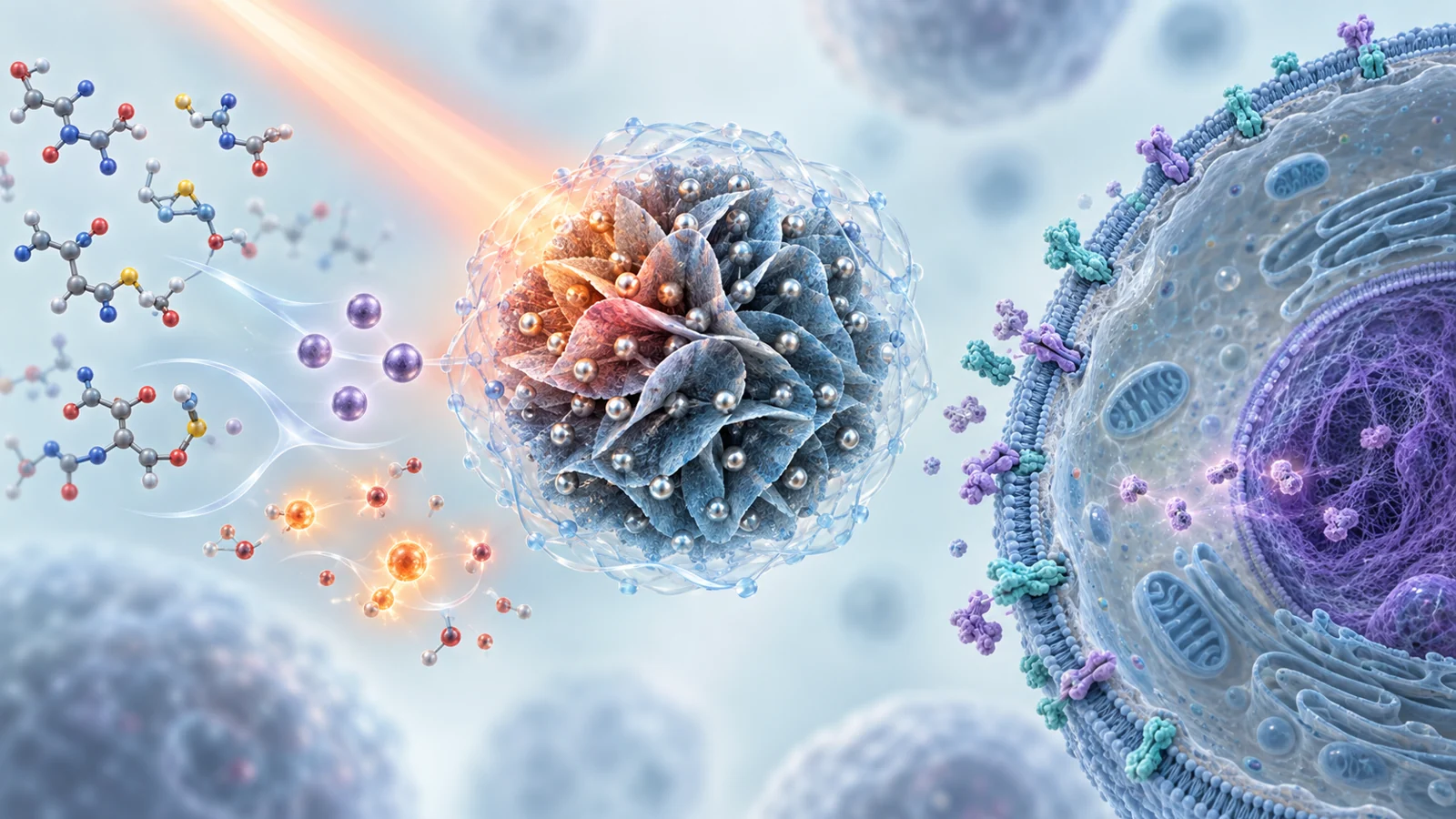
The researchers called their assembly HMP. It combines manganese dioxide structures, platinum nanodots grown on their surfaces, and an outer coating of hyaluronic acid. Instead of carrying a conventional drug, the materials are intended to coordinate several effects: light-driven heating, chemical damage inside the tumor environment, and cellular changes that may be relevant to immunity.
A layered design for several effects
The manganese dioxide forms flower-like structures, with platinum nanodots attached and hyaluronic acid around the outside. This puts the components into one coated assembly. In the proposed design, the coating and structure provide a platform for the particle to act within the tumor environment, while the platinum and manganese-containing parts contribute to different treatment mechanisms.
One mechanism begins with light. The assemblies absorb light and convert it to heat, a process called photothermal therapy. The abstract reports a photothermal conversion efficiency of 35.46% for HMP. This is the share of absorbed light energy converted into heat under the study’s measurement conditions; it is not a measure of how much tumor was destroyed or how much a treatment would benefit a patient.
The other proposed route is chemical. HMP can deplete glutathione, a molecule present in the tumor environment. The abstract says this is followed by release of manganese ions and platinum nanodots. The released manganese ions can react with hydrogen peroxide to generate hydroxyl radicals through a Fenton-like reaction. These highly reactive molecules are intended to damage tumor cells, an approach known as chemodynamic therapy.
Heating and radical generation are distinct actions, even when one assembly is designed to bring them together. The study describes their combined effects in 4T1 breast cancer cells and reports tumor-growth inhibition when HMP was paired with light in tumor-bearing BALB/c mice.
Cell changes that may matter to immunity
In 4T1 cells, the researchers reported release of HMGB1 and production of calreticulin, or CRT. These are cellular changes associated with signals that can be relevant to immune recognition of stressed or damaged tumor cells. Their presence offers a reason to investigate whether the particle’s effects might involve more than direct heating and chemical injury.
The observations are early steps in that argument. The abstract reports the markers in tumor cells, but does not establish that immune cells responded to them or that an immune attack caused the tumor-growth result in mice. Marker changes can motivate a proposed immune mechanism without demonstrating the full chain from cell stress to immune activity and tumor control.
What the mouse experiment adds
The mouse result moves the report beyond cell culture: HMP combined with light reportedly inhibited tumor growth in BALB/c mice bearing tumors. It is evidence of an effect in that animal experiment, alongside the separate findings in 4T1 cells. It does not show that the immune-related markers explain the result, or that the approach would work in people.
The supplied abstract does not give the comparative effect size, how long any effect lasted, detailed immune-cell involvement, or enough safety information to assess risks. Those details matter for interpreting how much the experiment supports a treatment strategy. The findings therefore point to a combined approach worth investigating, while leaving its contribution from immunity and its practical performance unresolved.
What a combined treatment could mean for breast tumors
A single drug-free assembly that coordinates local heating with chemical damage could, if its effects prove reproducible, offer a way to combine physical and chemical pressure on breast tumors. An immune contribution could add another form of tumor control, but that possibility depends on evidence beyond the reported cell markers. Any future use would also depend on safe performance and workable delivery of light to tumors. The mouse finding is an early step toward that capability, not evidence of a treatment for patients.
Key Sources
- Primary source: Nanoarchitectured hyaluronic acid-decorated hierarchical drug-like assemblies as synergistic immune modulators against breast carcinoma.
DOI or Journal Page · Peer-Reviewed Paper · 2025-04-16
Keep exploring