
Research Signal – Source date 2025-04-01
Immune checkpoint drugs can help the immune system recognize and attack cancer, yet they do not work equally well across cancers. Why can releasing an immune brake help in one setting and bring limited benefit in another? An April 2025 review of checkpoint pathways and previously reported clinical research offers a useful way to understand the tension: these medicines alter restraints on immune cells, but the surrounding cancer setting still matters.
The review brings together established uses, treatments under investigation, combination strategies, and known adverse effects. It is a synthesis of prior research, not a new clinical trial or a test of one regimen against another. Its examples show both why checkpoint therapy has changed cancer care and why a promising mechanism alone cannot predict who will benefit.
Two brakes act at different points in T-cell activity
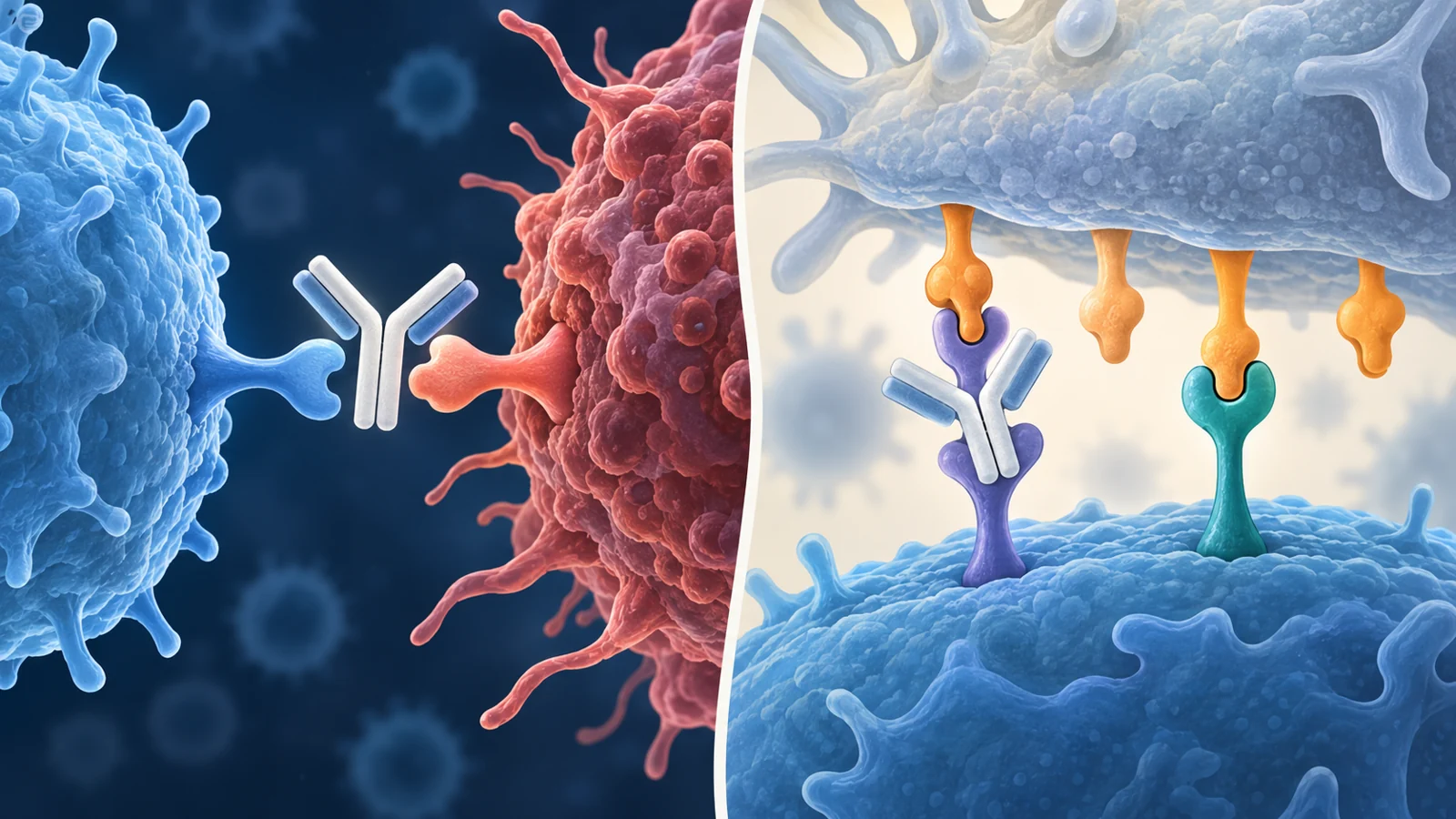
T cells need activating signals to respond. The immune system also needs ways to turn down that response after it has done its job. Checkpoints are part of this balancing system: they help limit immune activity, but tumors can take advantage of the restraint to evade attack.
PD-1 is a receptor on immune cells. When it binds to PD-L1, a partner molecule, the interaction suppresses T-cell activity and reduces cellular metabolism. In practical terms, the T cell receives a signal that dampens its response. Antibodies that block PD-1 or PD-L1 can interrupt that interaction and ease this restraint.
CTLA-4 limits T-cell activation through a different route. It binds to CD80 and CD86, also called B7.1 and B7.2, with greater affinity than CD28 does. CD28 uses those same molecules to provide a co-stimulatory signal that helps T cells activate and multiply. By occupying the shared partners, CTLA-4 leaves less available for CD28 and weakens that activating signal. An antibody against CTLA-4 can interfere with this brake.
These mechanisms explain the basic aim of checkpoint blockade, not a guaranteed result. A drug can release a restraint and still face limits imposed by the particular cancer and its immune environment.
A pathway’s promise depends on the cancer
The review describes checkpoint inhibitors as established treatments in several cancers, including melanoma and non-small-cell lung cancer. It identifies ipilimumab, which targets CTLA-4, among treatments approved for metastatic melanoma. It also describes PD-1 and PD-L1 inhibitors with approved uses across multiple cancers. Those approvals reflect clinical use in particular settings; they do not make every checkpoint drug interchangeable or establish one best regimen for every cancer.
The contrast between colorectal and prostate cancer makes the uneven picture concrete. The review describes PD-1 inhibitors as a potential first-line option for metastatic colorectal cancers with mismatch repair deficiency or high microsatellite instability, while also noting that further evidence was needed to guide decisions. The review also describes the combination of ipilimumab and nivolumab as approved for mismatch-repair-deficient colorectal cancer.
For prostate cancer, the review describes checkpoint-blocking effectiveness as low overall. It notes moderate effectiveness for ipilimumab combined with nivolumab in a particular group with AR-V7-expressing metastatic disease, while anti-PD-1 treatments were also being studied in metastatic castration-resistant prostate cancer. A result in a defined group does not erase the broader challenge: a biological target can be present without making the same treatment approach broadly effective.
These cases do not supply a simple rule for predicting response. They show why treatment prospects need to be read in relation to the cancer setting and the specific evidence being discussed, rather than inferred from the checkpoint pathway alone.
Combinations change the treatment question
Pairing treatments can serve more than one purpose. Combining chemotherapy with a checkpoint inhibitor adds immune restraint release to an existing cancer treatment. Combining two checkpoint inhibitors targets more than one inhibitory pathway. The approaches are not interchangeable, and the review’s examples do not establish one combination as best across cancer types.
In advanced non-small-cell lung cancer, the review discusses evidence favoring chemotherapy combined with pembrolizumab or atezolizumab in some comparisons over chemotherapy alone or combinations involving checkpoint inhibitors alone. It also describes a chemotherapy backbone as preferable to adding another checkpoint inhibitor in certain combination comparisons. The practical question is therefore not just whether to block a checkpoint, but what role that blockade plays alongside other treatment.
In triple-negative breast cancer, the review cites research suggesting that pairing PD-1/PD-L1 blockade with neoadjuvant chemotherapy may raise the pathological complete response rate. That is a specific reported outcome; it does not establish a survival benefit or a broadly suitable combination. The example shows why the accompanying treatment and measured outcome matter.
The review gathers findings from prior studies and does not itself compare every possible combination in a new trial. Its examples are reasons to examine treatment design in context, not a universal recipe.
New targets raise biological questions
LAG-3 and TIM-3 are among the additional inhibitory molecules discussed in the review. They offer researchers other ways to investigate how immune responses become dampened in tumors, especially alongside better-studied targets such as PD-1 and CTLA-4.
For LAG-3, the review describes expression on tumor-infiltrating T cells and a possible role in T-cell exhaustion, including cooperation with other inhibitory checkpoints. It also says the exact mechanism remains to be clarified. The review describes TIM-3 on tumor-infiltrating dendritic cells, where it can dampen innate anti-tumor responses; details of its signaling pathways remain unknown.
A pathway rationale can make a target worth studying. It cannot, by itself, show that a drug against that target will improve patient outcomes or reduce treatment harm. The gap between a plausible mechanism and a useful treatment is precisely why newer checkpoints remain research avenues in this account.
Releasing restraint can affect healthy tissue
The same immune activity that checkpoint therapy aims to restore can also cause harm. The review cites pneumonitis (lung inflammation), hepatitis (liver inflammation), and endocrinopathies (disorders of hormone-producing glands) among adverse reactions to some checkpoint drugs.
The risks vary among treatments, and this review does not provide a single rate that applies to every drug or cancer setting. The important clinical point is that immune restraint serves a purpose as well as creating an obstacle for cancer treatment. Blocking it makes careful treatment choices and continued study of side effects part of the same problem as improving anti-cancer responses.
What safer checkpoint combinations could mean for hard-to-treat cancers
If researchers can better match checkpoint strategies to the cancers and treatment combinations where they are useful, more patients could have access to durable immune-based treatment while avoiding approaches unlikely to help them. That possibility depends on clarifying which pathways matter in each setting and how to balance stronger immune activity against inflammation and other harms. The review presents that as an open clinical and scientific challenge, not an outcome already secured by the mechanisms it describes.
Key Sources
- Primary source: Immune Checkpoint Molecules: A Review on Pathways and Immunotherapy Implications.
DOI or Journal Page · Review or Meta-Analysis · 2025-04-01
Keep exploring