
Research Signal – Source date 2025-02-01
A treatment gap drives the search
Immune treatments targeting PD-1 or PD-L1 have the potential to prompt broad, lasting anti-tumor responses in head and neck squamous cell carcinoma (HNSCC). But the February 2025 review says only a small proportion of patients benefit, and many who do receive immunotherapy eventually experience relapse. Researchers are therefore investigating whether other immune targets could help address resistance and improve treatment outcomes.
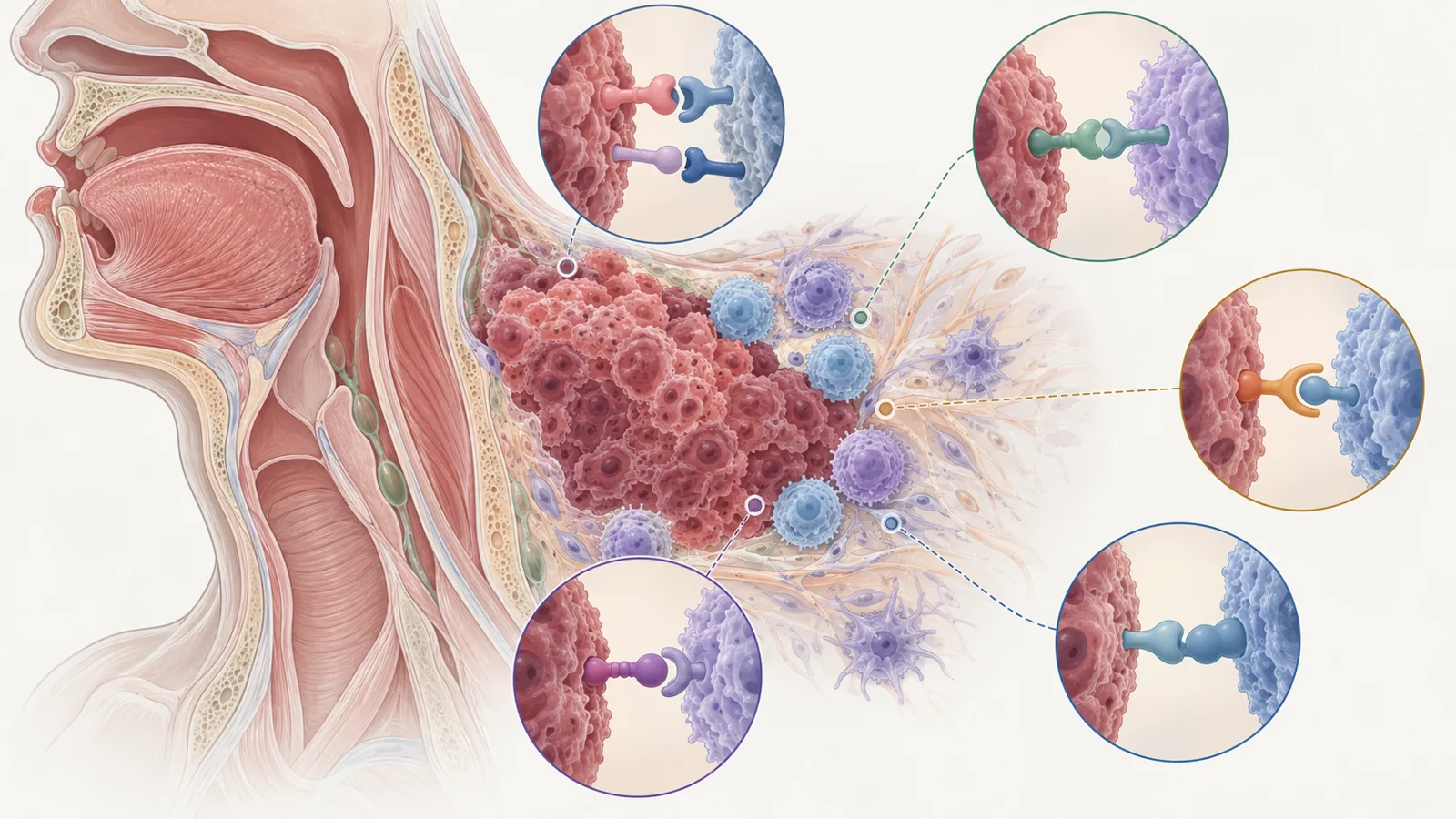
The question is not simply how many targets can be named. A new target matters to patients only if acting on it can produce a useful clinical benefit, with risks that can be managed. The review frames its discussion around four targets beyond the PD-1/PD-L1 pathway: TIM-3, TIGIT, LAG-3, and VISTA.
Four targets, one research question
These names identify the subjects the review surveys; they do not, by themselves, indicate that a treatment against any one of them works for HNSCC. The review’s abstract establishes the scope of its discussion, but does not provide target-by-target clinical results, response rates, safety comparisons, or a way to choose patients for a particular approach.
The broader research question is whether strategies involving these targets might address limitations of PD-(L)1 immunotherapy. To answer it, researchers need to understand the resistance mechanisms that may limit existing treatment and how proposed combinations act. The abstract identifies these as important questions, rather than offering a validated combination regimen.
Combinations bring benefit and safety into the same question
Combining immune treatments could be one way to pursue better outcomes, but the addition of another target is not evidence of added benefit. A combination’s effects and safety profile both matter: a strategy would need to improve outcomes without creating harms that outweigh its value. The review highlights the need to understand both how novel combinations work and how safe they are before they can be adopted in clinical practice.
Those questions also shape how to read the four-target list. TIM-3, TIGIT, LAG-3, and VISTA mark areas of investigation, not a ranking of candidates. The abstract does not establish which approach, if any, is more effective or safer than the others.
Could immune treatment help more patients?
For people with head and neck cancer, the potential payoff would be effective, tolerable immune-treatment strategies beyond PD-(L)1 that extend useful, lasting responses to more patients. That possibility depends on future clinical evidence showing that approaches to these targets or their combinations can deliver meaningful benefit with acceptable safety. The review identifies a direction researchers are pursuing; it does not establish that this patient benefit has been achieved.
Key Sources
- Primary source: Immunotherapeutic strategies beyond the PD-1/PD-L1 pathway in head and neck squamous cell carcinoma – A scoping review on current developments in agents targeting TIM-3, TIGIT, LAG-3, and VISTA.
DOI or Journal Page · Review or Meta-Analysis · 2025-02-01
Keep exploring