
Research Signal – Source date 2025-01-01
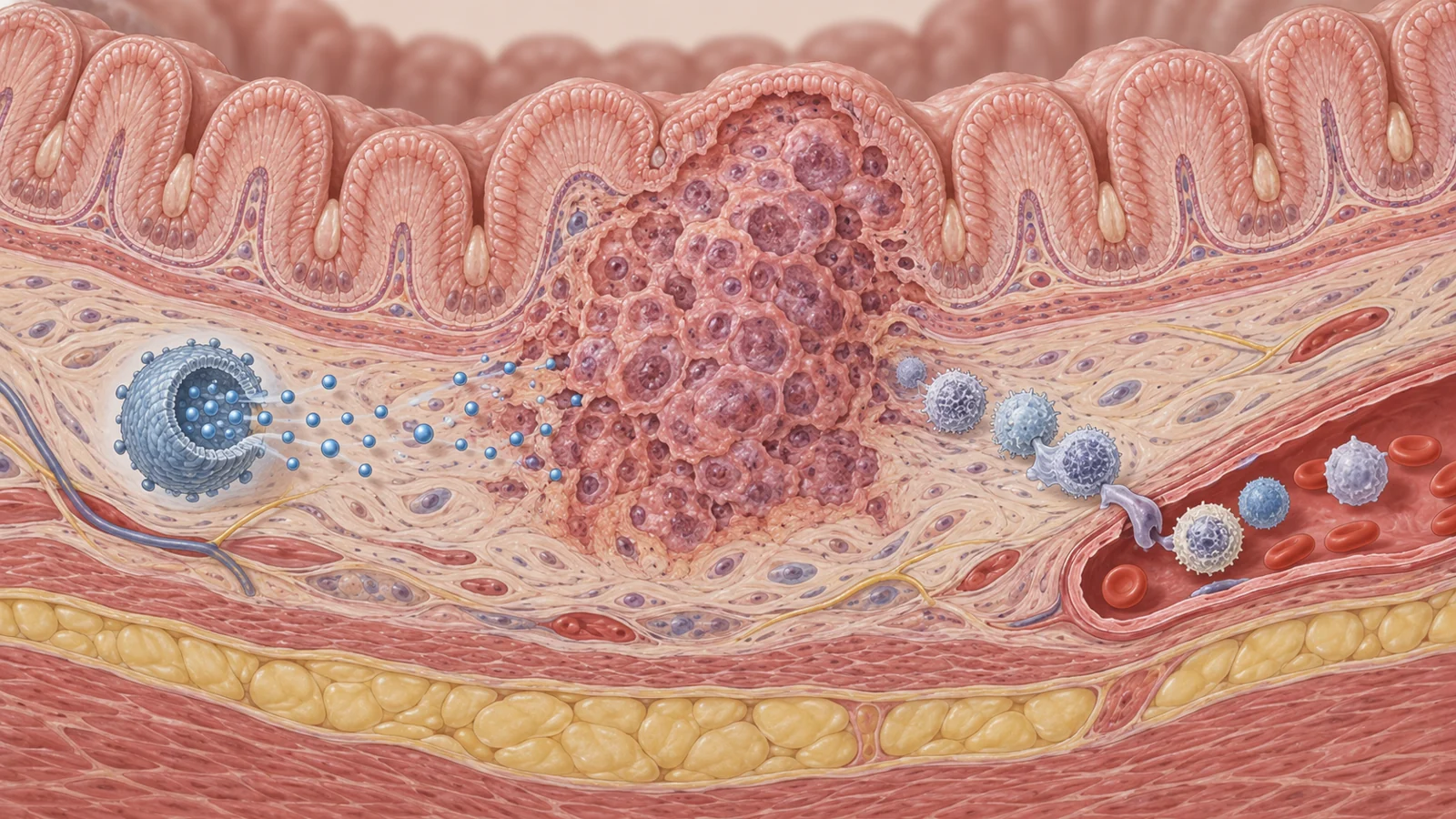
Gastrointestinal cancers, including cancers of the stomach, remain difficult to treat in part because many patients are diagnosed late and some cancers resist conventional therapy. A 2025 review considers several ways researchers are trying to address those problems: changing how anticancer drugs are carried to tumors, and using the immune system to recognize or attack cancer cells.
These approaches target different parts of the challenge. A carrier may change a drug’s stability, solubility, or release. An immune treatment aims to direct or enable a response against cancer. The review’s PubMed abstract describes their potential and the barriers to clinical use; it does not provide comparative patient outcomes that would show which approach works best.
The delivery problem begins with the drug
A medicine must reach its intended site in a useful form. The review discusses polymeric and metallic nanoparticles as potential carriers that could improve drug stability and solubility, help direct drugs, and reduce exposure elsewhere in the body. These are related but distinct aims: keeping a drug usable, helping it reach a target, and limiting systemic toxicity are not the same achievement.
Liposomes and micelles are also covered as delivery systems. The review describes their potential to improve pharmacokinetics and support controlled, site-specific release of anticancer agents. In plain terms, the goal is to influence how a treatment moves through the body and where or when it is released. A plausible delivery design, however, is only useful if it can work reliably in clinical care and achieve an acceptable balance of benefit and harm.
Immune treatments take different routes
Checkpoint inhibitors, CAR-T cell therapy, and cancer vaccines all involve the immune system, but they are not interchangeable strategies. The review covers checkpoint inhibitors and CAR-T therapy as approaches to treating cancer through immune activity. It also describes cancer vaccines as a way to reorient the immune system so it can act against cancer cells.
The abstract places these approaches in the wider field of gastrointestinal cancer treatment; it does not establish that they are equally developed or effective across stomach and other digestive cancers. Their inclusion signals research interest, not a shared level of readiness for patients.
Combining approaches raises a separate question
The review also considers oncolytic viral therapy and bacteria-based treatments as non-conventional approaches that might be used alongside traditional methods. It raises the possibility that these approaches could have a synergistic effect when combined with conventional treatment.
That possibility is not the same as evidence for a tested combination regimen. Pairing treatments would need to show that their interaction is useful and acceptably safe in clinical use. More generally, combining a delivery platform with an immune treatment may address more than one obstacle in principle, but the abstract does not report comparative results that establish a patient benefit from such combinations.
From promising platform to usable treatment
The review identifies bioavailability, toxicity, and clinical translation as central challenges. A drug that is difficult to make available where it is needed may not deliver its intended effect. A carrier or immune approach also has to avoid unacceptable toxicity. And a promising platform must be translated into a treatment that can be evaluated and used in clinical settings.
Those hurdles help explain why proposed mechanisms alone cannot settle the clinical question. The supplied abstract does not establish improved survival or quality of life for a specific patient group, rank the approaches by effectiveness or safety, or show that a result applies across all gastrointestinal cancers. It offers a view of approaches under consideration and the practical questions they still face.
What more precise treatment could mean for patients
For people with stomach or other digestive cancers, especially when disease resists conventional therapy, these approaches could eventually widen the range of usable treatment options. That benefit depends on delivery systems and immune treatments proving effective with acceptable toxicity in clinical use; the review’s abstract describes the rationale and challenges, not that patient-level outcome.
Key Sources
- Primary source: A Comprehensive Review on Novel Therapies for Gastrointestinal Cancers using Translational Platforms.
DOI or Journal Page · Review or Meta-Analysis · 2025-01-01
Keep exploring