
Research Signal – Source date 2024-02-01
Cancer treatment does not act in an empty space. Conditions inside and around a tumor can influence how a treatment reaches its target, how cells respond and how resistance develops. A review published on February 1, 2024, examines whether those conditions can guide the design of albumin-based nanosystems.
Albumin is a protein used to build tiny treatment carriers. The review’s central design idea is to consider the tumor microenvironment as part of the treatment problem: not simply something surrounding a tumor, but a set of local conditions that nanosystems might be designed to recognize or exploit.
Why the tumor’s surroundings matter
Solid tumors can contain areas with low oxygen and acidic conditions. They may also show chemical features such as elevated hydrogen peroxide, excess glutathione and high glucose. These are not interchangeable problems, and the review treats them as different design cues for therapeutic platforms.
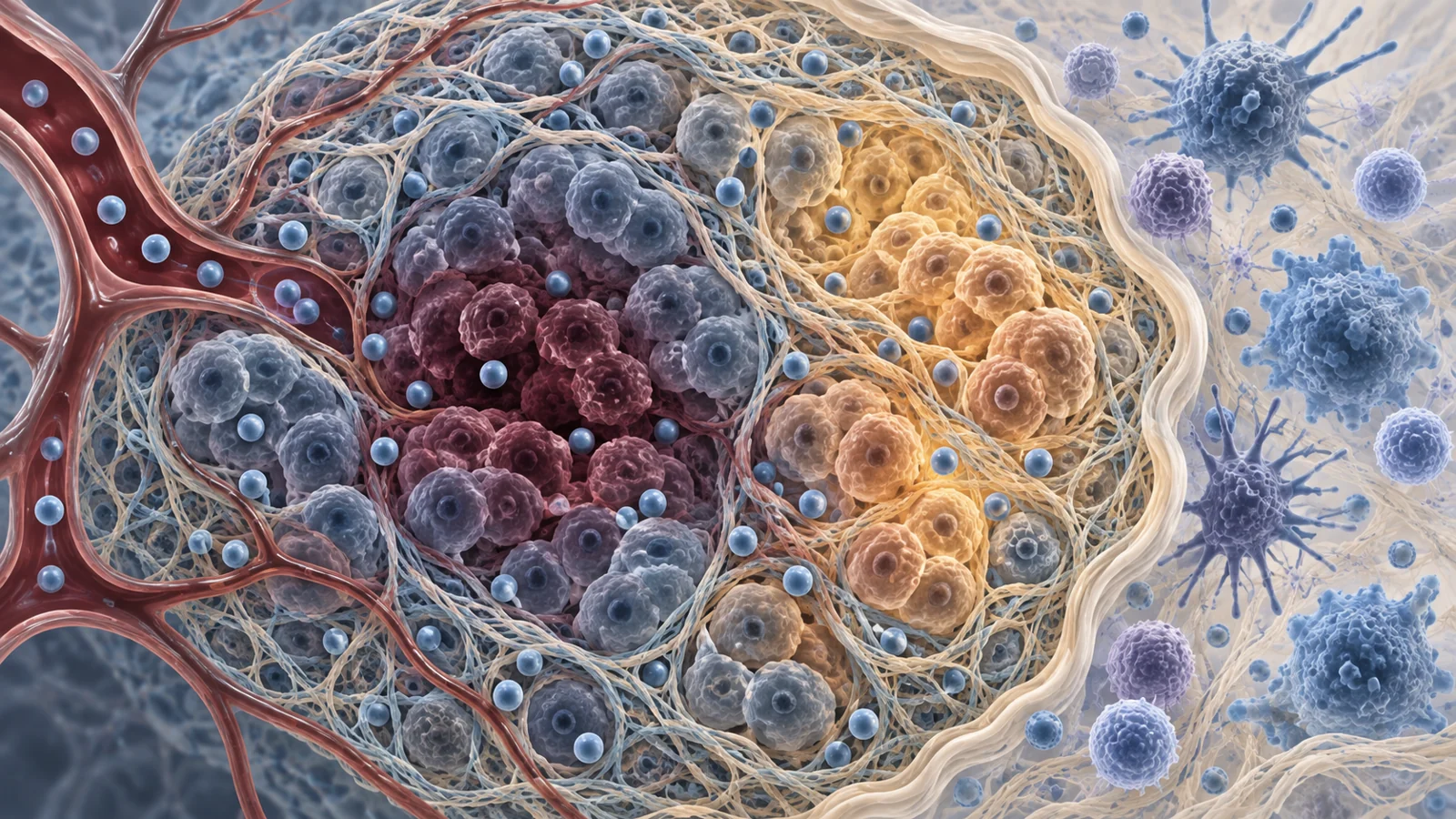
The surrounding tissue matters too. A dense extracellular-matrix network can affect the physical environment around tumor cells, while the immune microenvironment adds a different layer of biological complexity. The review considers how albumin-based platforms could exploit these local features in cancer treatment. It does not, by itself, show that the treatment will work better in patients.
From local conditions to carrier design
A useful way to understand the designs discussed in the review is to separate three parts of the problem. First is the tumor feature being addressed, such as acidity, low oxygen or a chemical imbalance. Second is the albumin-based carrier that forms the delivery platform. Third is the treatment approach connected to that platform.
Keeping these parts separate helps clarify what the review is describing. An albumin nanosystem is not the same thing as chemotherapy, phototherapy, radiotherapy or immunotherapy. The review covers representative albumin-based designs across those approaches and other tumor therapies, showing the breadth of the field rather than presenting one combined treatment.
Albumin’s stated biocompatibility is a rationale for exploring it as a functional material in therapeutic platforms. That rationale is useful for understanding why albumin appears repeatedly in nanosystem design. It is not a safety verdict for every finished carrier, since the properties of a complete platform depend on its particular construction and intended use.
What the review establishes
This publication provides a dated synthesis of design strategies for responding to features of the tumor microenvironment. It places treatment response and acquired resistance within a larger setting that includes chemical conditions, tissue structure and immune context. The abstract also identifies practical challenges and future prospects for moving albumin-based nanosystems toward application.
The available evidence here does not identify a best-performing design, a preferred cancer type or a validated comparator. It does not quantify an improvement in patient outcomes or support recommending a particular carrier or therapy. Details such as specific carrier mechanisms, experimental protocols and safety estimates require evidence beyond the supplied abstract and publication record. Those boundaries matter because a review of design possibilities is different from evidence sufficient to select a treatment.
How albumin carriers could improve cancer treatment
For people with solid tumors, the potential benefit is a treatment platform designed to function more effectively under the local conditions that influence response. If particular albumin-based systems demonstrate useful performance and acceptable safety in their intended settings, designing around acidity, oxygen, tissue structure or immune context could eventually make some treatments better suited to the environments where they must act.
The February 2024 review presents that outcome as a possibility arising from a design direction, not as an established patient benefit or an available therapy. Its value is in showing how albumin-based carriers, tumor conditions and several treatment approaches can be considered together while leaving the harder questions of performance, safety and clinical usefulness open.
Key Sources
- Primary source: Design strategies for enhancing antitumor efficacy through tumor microenvironment exploitation using albumin-based nanosystems: A review.
DOI or Journal Page · Review or Meta-Analysis · 2024-02-01
Keep exploring