
Evidence date · 2026-05-27 · Research note 2 of 2
1 2
See current Track status →
Since the previous research note · Earlier expectation not tested
Track continuity
Since the previous research note: How a soft sensor’s support and coating were designed to heal together
Previous expectation: Repairing a soft sensor's support and sensing coating together could extend its usefulness if accurate strain measurement and durability survive repair.
What this study adds: This review organizes design approaches for stretchable and self-healing polymer semiconductor charge-transport layers, giving the track a distinct account of another functional material role. The supplied abstract does not establish a test of the earlier sensor system or its forecast.
What changed in this study
Wearable electronics need materials that can move with the body while continuing to carry electrical signals. The review identifies intrinsic flexibility as a reason polymer semiconductors are being investigated for charge transport in wearables. Yet flexibility alone does not prevent trouble. Repeated deformation can degrade electrical performance, while repeated wear or accidental cutting can damage a device.
A review published on May 27, 2026, considers how these materials might be designed to tolerate stretching and recover from damage without compromising their electronic function. Its focus is not a single finished device, but the material layer responsible for charge transport.
Flexibility solves only part of the problem
A charge-transport layer has to handle two demands at once. It must withstand mechanical change, and it must continue performing its electrical role. The review describes mechanical robustness and self-healing as related design goals because wearable materials may be exposed to repeated wear and tear as well as sudden damage.
That does not make every flexible polymer semiconductor self-healing, nor does it show that restoring a material’s structure automatically restores a device’s full operation. The central challenge is to improve the material’s mechanical and healing behavior while preserving electronic performance.
The material has more than one design lever
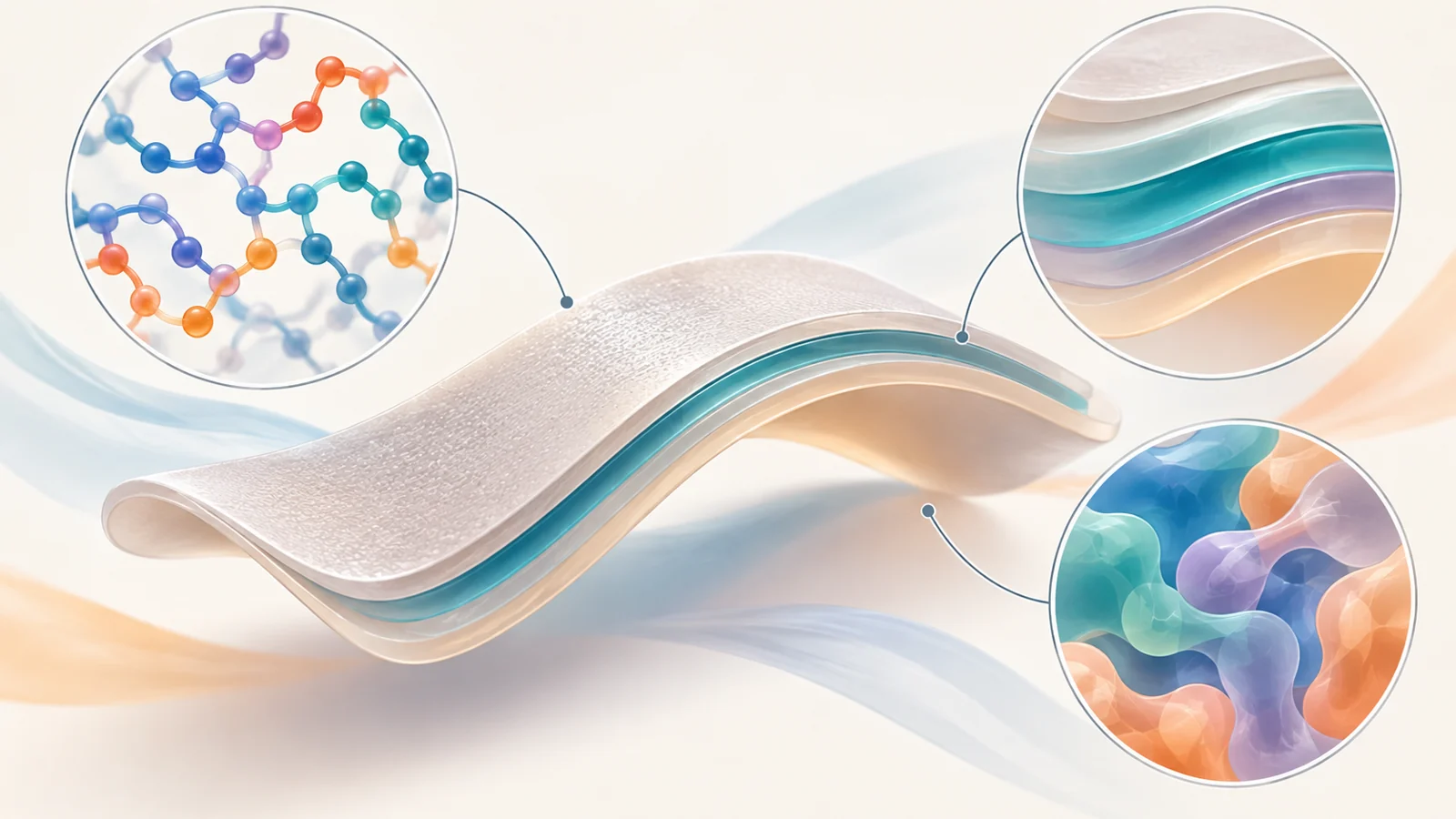
The review organizes recent progress around three broad approaches. Chemical molecular design changes the material at the level of its molecular structure and the functional chemical bonds that can influence its behavior. Physical geometry engineering works through the form or arrangement of the material, including microstructure in a thin film. Physical blending changes the material through the way components are combined.
These are different places to intervene rather than a ranked list of solutions. The abstract links the approaches to control over mechanical and self-healing properties through functional chemical bonds or thin-film microstructure. That gives readers a useful way to understand the field: researchers can work with the material’s chemistry, its physical form, or its blended composition, depending on the demands of the wearable application.
The review also places these strategies in the context of wearable electronics and discusses challenges and future research perspectives. Its contribution, at the evidence level available here, is to bring these design choices into one account of how charge-carrying polymer layers might become more mechanically resilient and capable of healing.
What this review can and cannot establish
The supplied abstract supports a qualitative explanation of the design problem and the three approaches. It does not establish a particular stretch limit, electrical recovery value, healing time, or repeat-repair lifetime. It also does not provide a basis for saying that chemical design, geometry engineering, or physical blending outperforms the others.
Those limits matter because a material-level strategy is not the same as a demonstrated, everyday wearable. The available evidence does not establish whole-device repair, performance under ordinary use, commercial readiness, or lower replacement rates. More broadly, improving one charge-transport layer would still be only one part of making an entire wearable durable.
Toward wearable electronics that stay useful after damage
The practical promise is longer useful service for people who rely on wearable electronics. Recovering the charge-transport material could help a device remain useful after damage, provided its electrical function is preserved or restored under the demands of use. Whether that promise becomes real depends on how the material behaves in a complete device and through the stresses of everyday wear.
Key Sources
- Primary source: Intrinsically Stretchable and Self-Healing Polymer Semiconductor Materials for Wearable Electronics.
DOI or Journal Page · Review or Meta-Analysis · 2026-05-27