
Evidence date · 2024-01-31 · Research note 1 of 2
1 2
See current Track status →
Soft sensors are built from more than the layer that detects strain. They also need a supporting material to hold that sensing layer in place. If the support repairs but the coating does not remain connected, the sensor’s usefulness may not return in the same way. An experimental materials study published on January 31, 2024, examined how those two parts might be designed to repair in coordination.
The researchers evaluated several self-healing polymer substrates and graphene ink-based strain-sensing coatings. Their reported optimum combined a poly(vinyl alcohol) support containing tannic acid, a superabsorbent polymer and graphene oxide with a coating made from electrochemically exfoliated graphene and silver nanoparticles. The study’s central engineering question was how to make the polymer and conductive coating work together during healing.
A repairable support needs a compatible sensing surface
Poly(vinyl alcohol) formed the base of the self-healing composite. On top of it, the graphene-based coating supplied the strain-sensing layer. Graphene is an ultrathin carbon material that can form conductive coatings, while electrochemical exfoliation is the process used here to produce the graphene ink material. Silver nanoparticles were part of the reported coating combination, but the supplied abstract does not isolate an independent contribution from the silver itself.
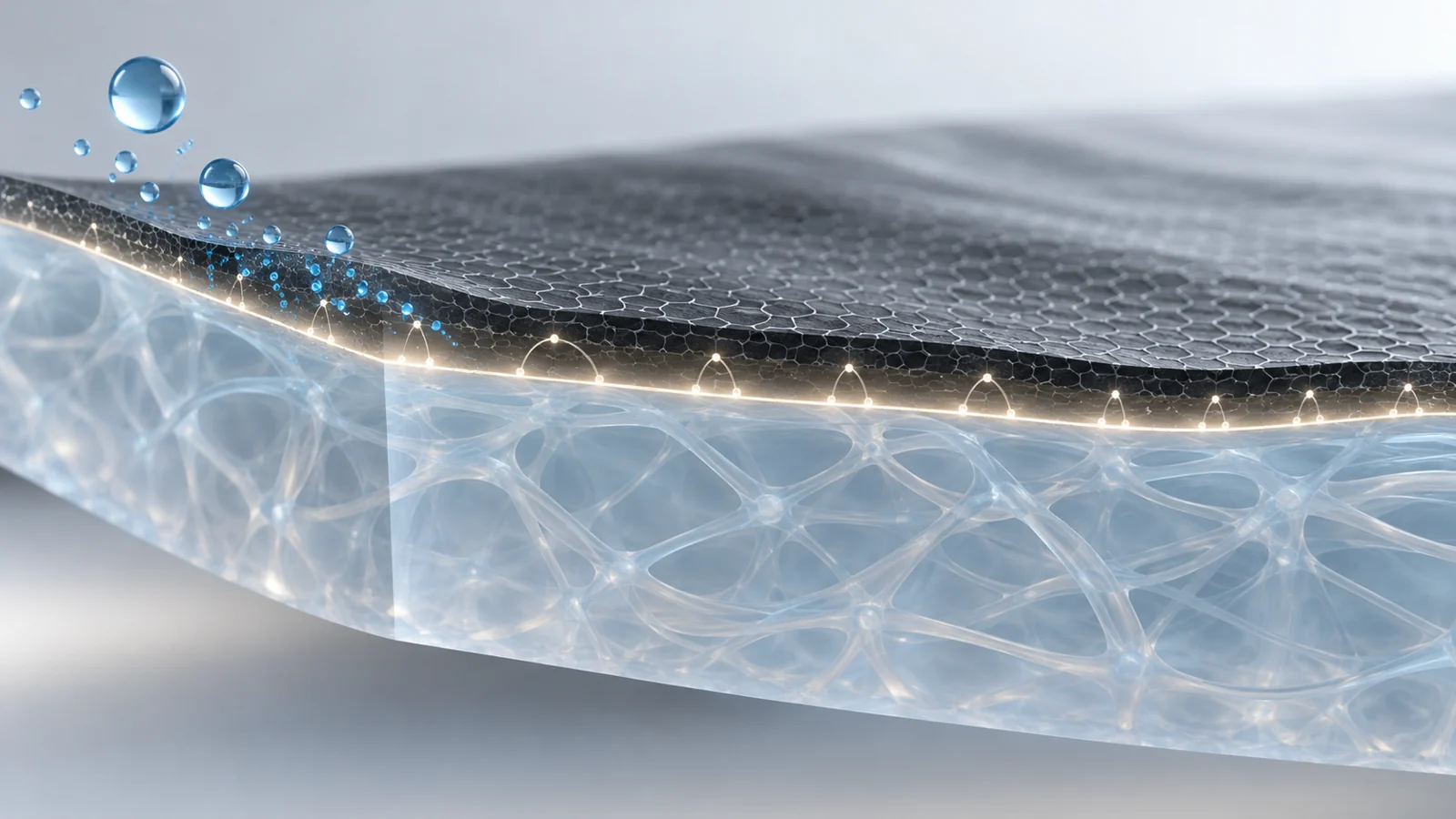
The ingredients in the polymer support were assigned different jobs. Tannic acid was associated with the boundary between the coating and the polymer. The authors reported that it improved healing at the coating surface by forming hydrogen bonds between the sensing and polymer layers. Graphene oxide was described as acting within the polymer matrix, where its bonding ability helped heal the polymer surface.
These roles address different parts of the same interface. Tannic acid was linked to adhesion between layers, while graphene oxide was linked to bonding within the support. The proposed arrangement therefore treats the contact between the coating and polymer as part of the repair problem, rather than assuming that healing the material underneath automatically restores the sensing layer.
Water management shapes the coating process
The superabsorbent polymer had a separate function. According to the abstract, it absorbed excess water in the electrochemically exfoliated graphene dispersion through a host–guest interaction and also reduced the coating thickness. That is a processing and structure-control role, distinct from the hydrogen bonding attributed to tannic acid and the matrix bonding attributed to graphene oxide.
Keeping this role separate matters because a thinner or better-managed coating is not, by itself, evidence that the sensing function has been restored after damage. The study’s reported formulation combines water management with interface and matrix chemistry, but each ingredient is being connected to a different materials problem.
What the two healing improvements measure
For the reported optimum combination, the abstract gives two healing-efficiency improvements. The improvement in the substrate crack area was 47.1%. The improvement in the graphene-based sensing layer was 39.2%. These figures describe reported improvements in healing efficiency; they are not absolute statements that 47.1% or 39.2% of either layer recovered.
The supplied abstract does not identify the comparator or calculation behind those percentages, nor does it provide the measurement definitions, healing conditions or replication details needed to interpret the numbers more fully. It also does not establish recovery of conductivity, strain-sensing accuracy or complete device function. Healing time, repeated-damage performance and long-term durability remain outside what can be characterized from this evidence package.
The result is therefore best understood as a materials-level demonstration of two related but distinct healing measurements. The polymer crack area and the graphene-based sensing layer were both evaluated, and the authors connected their behavior to different chemical and interfacial functions. That is useful for designing the material combination, but it does not by itself show that a working sensor would continue to measure strain accurately after repair.
Toward soft sensors that stay useful after repair
A support and sensing coating that can be repaired together could help soft-electronic devices remain useful after physical damage and reduce the need for replacement. Reaching that practical benefit would require more than healing visible cracks: the sensor would need to keep producing accurate strain measurements and withstand the environmental and mechanical demands of its intended use.
The January 2024 study points to one route toward that capability by coordinating interlayer adhesion, bonding within the polymer and water management during coating formation. Whether the approach can support durable, repeatedly accurate soft sensors remains a question for further validation.
Key Sources
- Primary source: Silver Nanoparticle-Assisted Electrochemically Exfoliated Graphene Inks Coated on PVA-Based Self-Healing Polymer Composites for Soft Electronics.
DOI or Journal Page · Peer-Reviewed Paper · 2024-01-31