
Research Signal – Source date 2023-10-13
CAR T-cell therapy is often introduced through its success against certain blood cancers. That experience matters, but it does not settle whether the same strategy will work in breast cancer. A breast tumor can present an uneven set of molecular targets, share some of those targets with healthy tissue, and create local conditions that restrain incoming immune cells.
A review published on October 13, 2023, brings these problems together by examining how CAR T-cell therapy is being studied in breast cancer, including metastatic, triple-negative and HER2-positive disease. Its central question is practical: how can researchers direct living immune cells toward a tumor while keeping that attack effective and selective?
The receptor turns recognition into an attack
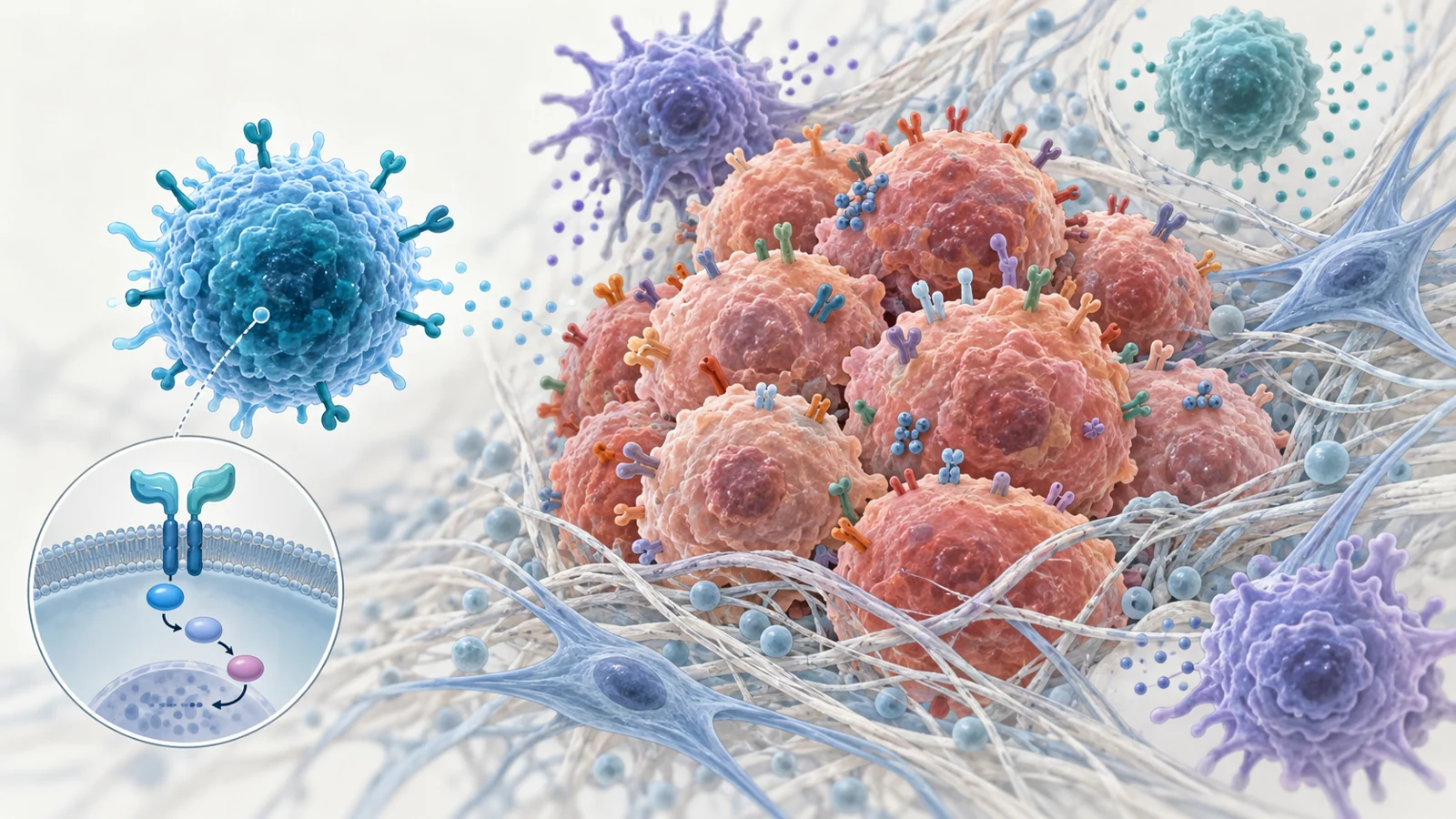
CAR stands for chimeric antigen receptor. The receptor is built into a T cell through genetic engineering after T cells have been collected from the blood. Its outer portion is designed to recognize an antigen, meaning a molecular feature that can be identified on a cell. Its inner portion connects that recognition event to T-cell activation through signaling and co-stimulatory domains.
This arrangement gives the engineered cell a direct route from finding a target to launching an immune response. When a CAR binds its target on a cancer cell, the T cell can become activated, release perforin and granzymes, and trigger programmed death in the target cell. It can also stimulate other immune cells, including natural killer cells and macrophages. Some engineered T cells may persist after treatment, although persistence is not the same as demonstrated protection against recurrence in breast cancer.
The reviewed mechanism is important because it explains both the attraction and the difficulty of the approach. CARs can recognize surface targets without relying on the same antigen-presentation route used by native T-cell receptors. That broadens the kinds of molecular features researchers can consider, but it does not guarantee that one chosen feature will identify every breast-tumor cell or spare every healthy cell.
One target creates two problems
Target selection has to solve two related but different problems. First, breast-tumor cells may not all display the same marker at the same level. A CAR aimed at one antigen may remove cells that carry it while leaving cells with little or none of that antigen. Those surviving cells can become the basis of antigen escape, in which the engineered cells lose effectiveness because the tumor no longer presents the feature they were designed to recognize.
Second, a marker that appears on tumor cells may also be present on nonmalignant tissue. The review discusses on-target, off-tumor toxicity as a consequence of recognizing the intended antigen in the wrong place. In breast cancer, even low expression in vital organs can complicate the choice of a usable target. The challenge is therefore not simply to find a molecule that cancer cells carry. It is to find a pattern that offers enough tumor coverage without directing the attack toward essential healthy tissue.
One response being explored is to recognize more than one marker. The review describes tandem CAR designs aimed at HER2 and MUC1, with enhanced antitumor effects reported in preclinical breast-cancer models. This example shows why researchers are testing broader recognition strategies: two markers may cover more of a heterogeneous tumor than one. It does not show that dual targeting automatically improves selectivity, resolves antigen escape, or makes the approach safe for patients.
A tumor can resist even after it is found
Recognition is only the first part of the problem. A solid tumor is surrounded by a local environment that can interfere with T-cell movement, activation and persistence. The review identifies suppressive cells such as regulatory T cells, myeloid-derived suppressor cells, cancer-associated fibroblasts and tumor-associated macrophages. It also describes signaling molecules and extracellular components that can support tumor growth while restraining immune activity.
This means a correctly targeted CAR T cell may still face conditions that prevent it from working effectively once it reaches the tumor. The obstacle is not only whether the receptor binds. It is also whether the surrounding tissue permits the engineered cell to remain active in a difficult environment.
Researchers have responded with designs sometimes called armored CARs or TRUCKs. These constructs can be equipped to produce cytokines such as IL-12 or to use chemokine-related features intended to support infiltration and activity. The review also describes an HER2-related finding in transgenic mice in which blocking PD-1 was associated with an enhanced immune response involving HER2-directed CAR T cells. Such approaches are attempts to alter the conditions around the engineered cell; they are not evidence that local suppression has been solved in human breast cancer.
Evidence depends on where it was generated
The review brings together several kinds of evidence, and their conclusions should remain separate. Cell experiments can show that a receptor recognizes a target and activates cytotoxic behavior in a controlled setting. Mouse studies can test tumor growth or immune responses in a living model. Clinical studies address how a strategy behaves in people, where target distribution, safety and treatment response are more complex.
The review includes clinical studies of CAR T-cell therapy in breast cancer. The material considered here establishes that these studies are part of the field’s investigation, but it does not provide enough study-specific detail to state patient counts, response estimates, survival effects or comparative benefit. Findings from blood-cancer treatment cannot fill that gap. They show that engineered T cells can be clinically useful in some settings, not that the same effectiveness or safety profile has been demonstrated in breast cancer.
The same caution applies to CAR generations. Later designs may add co-stimulatory or other functional elements, and the review describes stronger cytokine secretion or expansion in some experimental comparisons. It also notes that second-generation approaches have outperformed later generations in some antitumor comparisons. A higher generation number is therefore a design label, not a reliable ranking of clinical effectiveness.
Safety asks a different question from targeting
The targeting problem concerns where the engineered cell recognizes its antigen. Toxicity can also arise from how strongly the immune system is activated after treatment. Cytokine release syndrome, or CRS, is an inflammatory response involving activated immune and supporting cells. The review describes CRS in the context of CAR T-cell therapy and other immune treatments, with severity influenced by factors such as tumor burden in some blood-cancer settings.
CRS is not the same as recognizing a target on healthy tissue. A receptor can be selective enough to avoid one off-tumor problem and still provoke a systemic inflammatory reaction. Conversely, a strategy designed to improve activity inside a suppressive tumor may raise a separate question about controlling that activity if toxicity develops. The review discusses possible safety measures, including suicide genes that could deactivate engineered cells, but the supplied evidence does not show that safety controls and enhanced antitumor activity have been jointly solved in a breast-cancer treatment.
What this could mean for breast cancer treatment
For people with breast cancer, including those with triple-negative disease, the potential benefit is an additional treatment option made from living immune cells that can be directed toward tumor cells despite variable targets and local immune suppression. That capability would be meaningful because it addresses problems that ordinary target selection alone cannot solve: coverage across a changing tumor, access to a hostile tissue environment and control of unintended immune effects.
The prospect remains conditional. These approaches would need to produce meaningful tumor control with acceptable toxicity in human breast-cancer studies before they could be considered a dependable treatment option. The October 2023 review shows how researchers were trying to close the gap between the CAR T-cell experience in blood cancers and the biological demands of breast tumors; it does not establish a cure, a replacement for existing care or a timetable for clinical availability.
Key Sources
- Primary source: Journey of CAR T‑cells: Emphasising the concepts and advancements in breast cancer (Review).
DOI or Journal Page · Review or Meta-Analysis · 2023-10-13
Keep exploring