
Research Signal – Source date 2023-06-14
CAR T cells are immune cells engineered with a synthetic receptor that recognizes a target on another cell. When that target is present on a cancer cell, the receptor can help redirect the T cell toward killing it. This strategy has shown clear effects in some blood cancers, especially diseases involving the B-cell marker CD19.
Solid tumors pose a different problem. Recognition matters, but it cannot help much if the cells do not reach the tumor, enter its interior or remain functional after arrival. A review published on June 14, 2023, examines those linked obstacles and asks how design, delivery and the tumor environment shape what CAR T cells can do.
Reaching the tumor changes the treatment problem
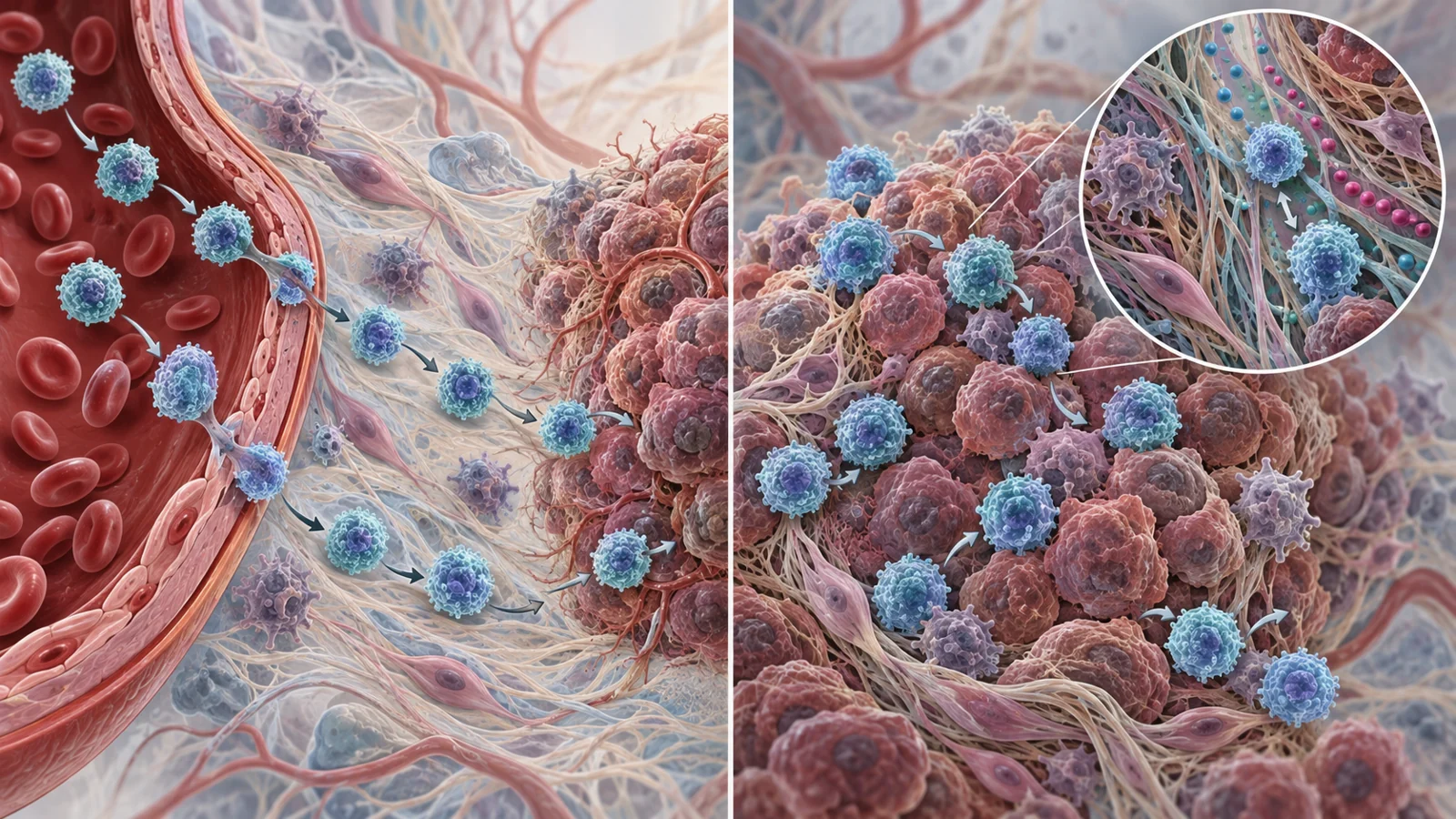
For a tumor in the blood or lymphatic system, engineered cells may encounter their targets more directly. A solid tumor is a physical destination. CAR T cells have to be transported toward it, accumulate there and move through tissue rather than merely recognize an antigen once they arrive.
The review compares intravenous, intratumoral and other regional approaches as different ways of solving that transport problem. Intravenous delivery sends the cells through the circulation, potentially giving them access to disease sites throughout the body. It also exposes them to the challenges of finding the relevant tumor and to broader immune effects. Intratumoral delivery places cells at a selected lesion, which may increase local contact but says less about disease elsewhere. Regional delivery can narrow the distance to a particular anatomical site, although the route remains tied to where the tumor is located.
A mouse experiment described in the review compared B7-H3.BB.z-CAR T cells delivered directly into a tumor, into a brain ventricle or through the caudal vein. The review reports differences in tumor response between delivery routes. It also reports increased systemic inflammatory cytokines after intravenous administration, whereas intratumoral and intraventricular administration did not produce the same elevation in that experiment.
The comparison is useful because it shows that route can change both observed tumor response and the body’s inflammatory exposure. It is not a reliable ranking of routes, however. The review’s prose and its table summarize the two regional routes differently, including a table entry that describes intratumoral treatment as curing all tumors. Those conflicting descriptions prevent a precise winner from being assigned even within this example. The animals, tumor models and delivery conditions also cannot establish response rates, survival benefits or safety outcomes for people.
Proximity can help one lesion while missing another
Intratumoral injection and intraventricular delivery are both regional, but they solve different spatial problems. Intratumoral treatment puts cells near or inside the lesion selected for injection. For a separate tumor site, the benefit may be much weaker because the cells have not been placed there. Intraventricular delivery puts cells into a fluid-filled space in the brain. In the study discussed by the review, this approach was also described as reaching tumor cells in the spine, illustrating how a regional fluid compartment can provide a different reach from an injection directly into one tumor.
That reach comes with procedural demands. Intravenous administration requires access to a vein. Intraventricular administration requires ventricular puncture. Regional delivery may involve managing pressure, and injecting into a tumor can be difficult when the lesion’s blood vessels and location make access complicated. These are not minor details: an approach that looks advantageous in a model may be impractical or unsuitable for a tumor in a different part of the body.
The central question is therefore not simply whether cells can be placed closer to cancer. It is whether the route can deliver enough cells to the relevant disease sites, under conditions clinicians can safely and feasibly control. The review presents regional delivery as a potentially useful direction for some tumors, but the supplied comparisons do not support treating direct injection as a universal shortcut.
Chemical guidance depends on the tumor’s own signals
Once a delivery route has placed CAR T cells in circulation or near a disease site, movement still depends partly on chemical instructions. Chemokines are signaling molecules that help guide cells. Their receptors are proteins on the cell surface that let a cell respond to particular chemokine signals. Engineering a CAR T cell with a receptor matched to signals produced by a tumor may improve its ability to move toward that tumor after administration.
The review describes this as a matching problem rather than a universal navigation system. Malignant pleural mesothelioma, for example, can produce the chemokine CCL2. MesoCAR T cells engineered to express the receptor CCR2b showed greater accumulation at tumor sites and stronger antitumor activity in the mesothelin-expressing tumor model discussed by the review.
A second example involves IL-8, which the review associates with pancreatic and ovarian cancer models. CAR T cells co-expressing CXCR1 and CXCR2 were described as moving more efficiently toward IL-8 while retaining cytolytic activity in xenograft models. The implication is specific: a receptor can help when its matching signal is present in the disease environment. It does not make every tumor equally accessible, and it does not replace the need to consider the route by which the cells are administered.
Inside the tumor the problem becomes sustained activity
Arrival is only part of the challenge. The tumor microenvironment can suppress CAR T cells after they have accumulated. The review discusses inhibitory cytokines such as TGF-β and IL-10, regulatory T cells, myeloid suppressive cells, PD-L1 expression and a metabolic environment that can impair immune-cell function.
Several strategies in the review aim at different parts of this problem. One approach is to counter inhibitory conditions directly, such as by engineering cytotoxic T cells to express IL-15. Another is to support the metabolic requirements of T cells, including access to amino acids such as arginine and glutamine. Pretreatment with combinations including oxaliplatin and cyclophosphamide is also discussed as a way to alter the local environment and promote CAR T-cell accumulation in experimental settings.
The review also considers ways to make a local CAR T-cell response broader. Engineered cells may be designed to express cytokines or chemokines such as IL-7, CCL19, CCL21, IL-12 and CXCL11, helping recruit other immune cells into the tumor. The proposed goal is cooperation among CAR T cells, dendritic cells and other T cells rather than relying on the initially delivered cells to eliminate every cancer cell alone.
That goal introduces a time dimension. A temporary treatment effect or short-term tumor reduction is different from sustained immune activity. The review discusses research on immune memory, including approaches involving immunostimulants such as RN7SL1 and STING that may promote CAR T-cell proliferation and effector-memory differentiation. These are research directions described in the review, not a validated combination regimen. Their value depends on whether they can preserve useful activity without creating unacceptable harm.
What better delivery could mean for patients with solid tumors.
Better delivery could eventually make engineered immune-cell treatment relevant to more solid tumors by helping cells reach the disease sites that currently remain difficult to access. The potential benefit is not just a larger number of cells at an injection point. It is a treatment capability in which the route, chemical guidance and support for activity work together closely enough for CAR T cells to find the relevant tissue and continue killing cancer cells there.
That possibility remains conditional. Delivery procedures would need to be feasible for the tumor’s location, and the engineered cells would need to function in the surrounding environment long enough to produce a durable benefit. The strategies discussed in this June 2023 review were separate solutions under investigation, not proof that one integrated approach already works in people. If those biological and practical barriers can be solved with acceptable safety, solid-tumor patients could gain access to engineered immune cells that reach the right places and sustain useful cancer-fighting activity.
Key Sources
- Primary source: CAR T Cell Therapy: Remedies of Current Challenges in Design, Injection, Infiltration and Working.
DOI or Journal Page · Review or Meta-Analysis · 2023-06-14
Keep exploring