
Research Signal – Source date 2022-11-21
Major depression is often discussed through mood, motivation, sleep, and concentration. Its burden can also extend into physical health. The November 21, 2022 review Major depression and the biological hallmarks of aging examined evidence connecting major depressive disorder with cardiovascular and metabolic disease, frailty, cognitive impairment, dementia, and higher mortality risk.
The review’s central question was whether some of the biology associated with aging could help explain that wider vulnerability. It does not present depression as a uniform form of premature aging, and it does not establish one direction of cause. Instead, it brings together findings across several biological processes and proposes a model in which depression-related changes might accumulate, reduce resilience, and make later stress harder to absorb.
Why depression appears in an aging conversation
Biological aging is not simply the number of years a person has lived. It describes interconnected changes in cells and tissues that can gradually increase damage and reduce the capacity to maintain stable function. The review considered whether people with major depression show abnormalities in some of these processes, including cellular senescence, mitochondrial function, nutrient sensing, inflammation-related signaling, and telomere biology.
The interest in this overlap comes from the pattern of health outcomes associated with depression. Across the lifespan, major depression has been linked in the reviewed literature with higher rates of cardiovascular and cerebrovascular disease, metabolic disorders, frailty, Alzheimer’s disease and related dementias, and reduced health span. These conditions are also commonly associated with advancing chronological age.
A shared biological feature could therefore help explain why depression sometimes travels with health problems outside psychiatry. But a shared marker is not the same as a complete explanation. The same biological finding may reflect several influences, and the relationship between depression, physical illness, behavior, and social circumstances can differ from one person to another.
When a cell stops dividing, its signals still travel
One process the review discusses is cellular senescence. A senescent cell has entered an effectively irreversible halt in cell division after stresses such as replicative exhaustion, genomic instability, or other cellular damage. These cells can show changes in structure and molecular markers, including DNA damage, telomere shortening, and increased expression of cell-cycle regulators.
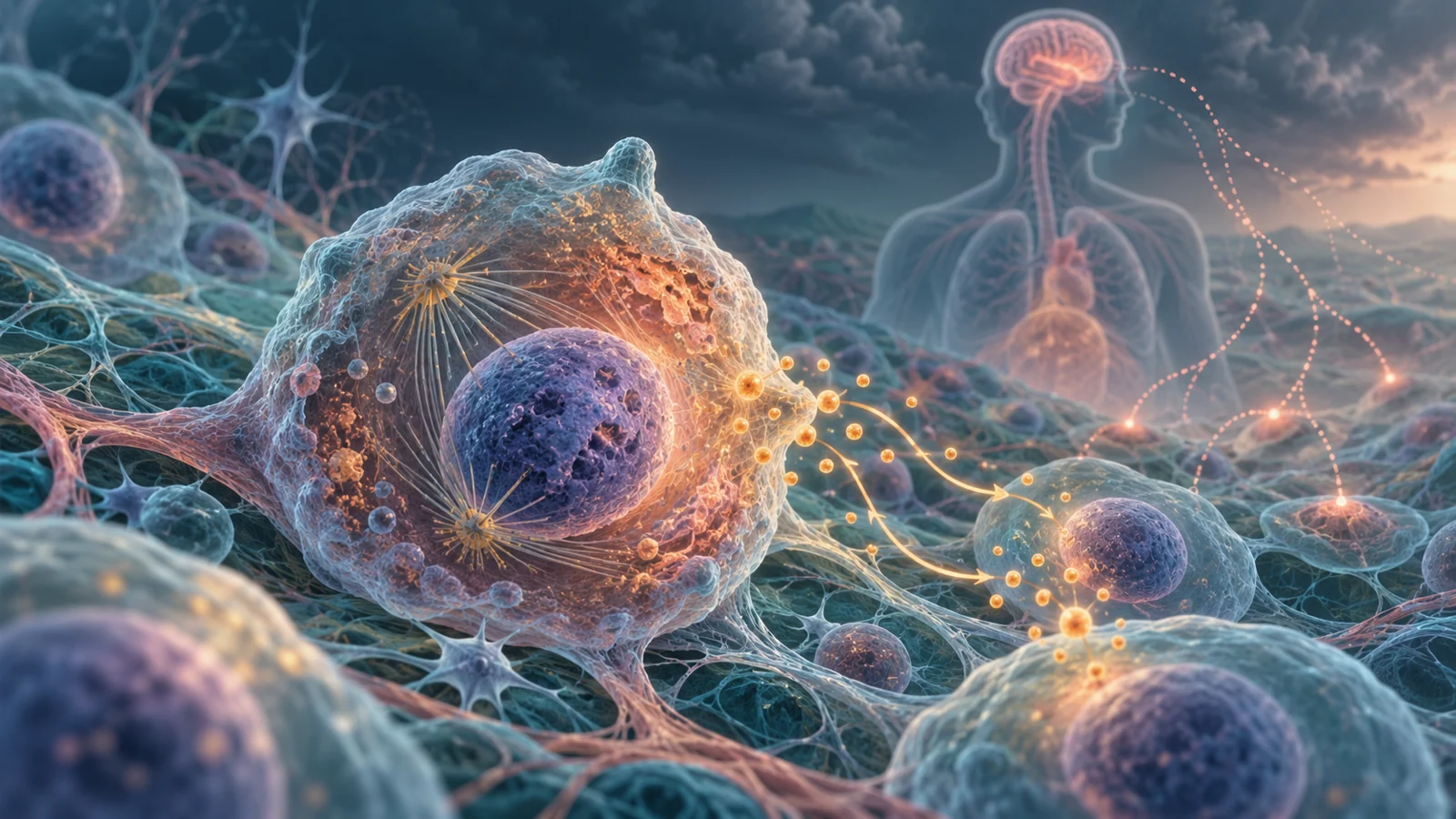
The important point for the depression question is that senescence is not only a story about what happens inside one cell. Senescent cells can alter their secretome, releasing a collection of signaling molecules known as the senescence-associated secretory phenotype, or SASP. These signals include inflammatory cytokines, chemokines, tissue-remodeling proteins, growth factors, and factors involved in metabolic regulation. When senescent cells are not effectively cleared, the resulting signals may influence neighboring cells and travel through the circulation to affect more distant tissues.
The review places this process alongside other connected changes. Mitochondria are involved in energy production and cellular maintenance, and mitochondrial dysfunction has been implicated in depression, diabetes, Alzheimer’s disease, and aging. Problems in mitochondrial biogenesis, electron transport, or mitochondrial clearance can also affect other aging-related processes, including nutrient sensing and the handling of damaged proteins.
Nutrient sensing provides another link. In the reviewed human evidence, insulin resistance was associated with major depression, depressive symptom severity, and metabolic syndrome. Older adults with depression also had lower levels of adiponectin, a hormone involved in insulin sensitivity. These findings do not reduce depression to metabolism, but they show why the review treats aging biology as an interacting system rather than a collection of isolated defects.
Measurements can answer different questions
The evidence becomes more informative when the measurements are kept distinct. The review describes a composite index built from several SASP-related signaling proteins. Older adults with major depression had higher index scores than never-depressed, age-matched adults, suggesting a greater cellular-senescence burden. Independent cohorts also linked higher scores with global cognitive impairment, executive dysfunction, and slower information processing. Young and middle-aged adults with major depression also had higher index scores than never-depressed individuals.
In an analysis of older adults participating in a clinical trial, a higher SASP index predicted lower treatment-remission rates even after adjustment for established predictors of remission. None of the individual proteins in the index significantly predicted remission on its own. Combining related signals may therefore capture a complex biological state more effectively than relying on one marker. It still remains a prognostic association, not an individual treatment-selection rule.
Telomere findings illustrate a different measurement problem. Telomeres help maintain chromosome stability and shorten as cells divide. Several community-based studies reviewed in the paper found shorter leukocyte telomere length in people with major depression than in never-depressed controls. Longer depressive episodes, more severe symptoms, and medical comorbidity were associated with shorter leukocyte telomeres in some studies.
Those group differences do not automatically show that telomere length changes in step with symptoms over time. One longitudinal study found that changes in depressive symptoms over six years were not associated with different rates of leukocyte telomere attrition. Another study found greater attrition among young people who experienced a major depressive episode during follow-up than among those who did not, independent of baseline telomere length. The review also notes that blood-cell telomere length is not a direct readout of telomere length in brain cells, and the functional meaning of neuronal telomeres remains uncertain.
The broader lesson is straightforward: a difference between groups, a prediction of treatment remission, and a change measured across time are different kinds of evidence. They can fit into the same scientific picture without answering the same causal question.
A possible loop of lower resilience
The review considers two broad explanations for the overlap between depression and aging-related biology. One possibility is that abnormalities in aging-related processes help cause depression. The authors say the human evidence does not currently establish that explanation. Inflammatory markers and immune challenges have been associated with depressive symptoms in some settings, but the findings are not universal, and aging-related abnormalities have not been shown to be a single upstream cause of major depression.
The review’s alternative model begins with depression and its consequences. Regardless of the factors that originally lead to an episode, depression may be accompanied by biological changes involving several cellular systems. If those changes persist through recurrent episodes, treatment resistance, ongoing stress, or other conditions, they could gradually reduce the body’s ability to adapt to new demands. The authors describe this reduced adaptive capacity as a form of homeoestenosis.
In that model, lower resilience can create a feedback process. A system with less capacity to restore balance may respond less effectively to biological or psychological stressors. Accumulating abnormalities could then help connect depression with recurrence, more severe disability, poorer treatment response, multimorbidity, frailty, cognitive impairment, or dementia. The model offers a way to organize the associations; it does not prove that every link in the loop occurs in every person or that depression is the sole driver.
The life course changes the biology too
The review also emphasizes behavioral and social pathways. When major depression occurs during the transition from adolescence to adulthood, it can interfere with education, work, income, wealth, social connection, and physical activity. These experiences can influence long-term health and may also interact with inflammatory and other aging-related biological processes.
This perspective matters because biology does not develop apart from a person’s circumstances. It avoids assigning responsibility to patients for the conditions associated with depression while recognizing that illness can alter the opportunities and resources that support health. It also cautions against treating findings concentrated in older adults as a complete description of a disorder that commonly begins earlier in life.
More research in young adults with major depression could clarify how age at onset, duration, recurrence, comorbid illness, social conditions, and biological measures relate to one another. The question is not whether one age group is the correct model. It is whether different life courses produce different combinations of exposure and resilience.
From plausible target to proven care
The review points toward interventions that might influence aging-related processes alongside standard depression treatment, but its proposals remain a research agenda. Physical exercise is discussed as an adjunct that can benefit depression treatment and has been associated with improvements in cellular-senescence markers. Lithium, a long-used treatment for recurrent and treatment-resistant depressive episodes, is described as having potential effects on senescence markers and SASP-related factors.
The authors also propose investigating senolytic drugs, which are designed to clear senescent cells. That proposal follows from the biological model; it is not evidence that senolytics safely treat major depression or prevent later disease in people with depression. A treatment can improve symptoms and alter a biological marker without the marker change being the reason for the clinical benefit.
Future trials would need to measure both mental-health outcomes and relevant aging-related processes, while accounting for the substantial differences among people with depression. The key test would be whether safely changing a modifiable biological process improves outcomes that matter to patients, rather than whether a marker moves in the expected direction.
What aging biology could add to depression care
From the review’s 2022 perspective, the long-term promise is a form of depression care that supports recovery while also helping preserve physical and cognitive health. That possibility depends on identifying pathways that can be changed safely and showing that targeting them improves patient outcomes, not merely laboratory measurements.
People with similar diagnoses may have different biological profiles, health conditions, exposures, and capacities for recovery. Aging biology could eventually help explain some of that variation and guide additional treatments for those most likely to benefit. For now, the value of the framework is that it connects mental and physical health while keeping the central scientific question open: which changes are modifiable, for whom, and with what measurable benefit?
Key Sources
- Primary source: Major depression and the biological hallmarks of aging.
DOI or Journal Page · Review or Meta-Analysis · 2022-11-21
Keep exploring