
Research Signal – Source date 2021-12-23
Creatine is a compound that helps cells buffer energy when demand changes quickly. That role matters especially in tissues with high and fluctuating energy needs, including the brain. When brain creatine availability is reduced, supplying more creatine seems like the obvious response. Yet the amount available outside a cell is only part of the problem. The compound also has to cross the cell membrane.
The December 23, 2021 publication Improving Brain Creatine Uptake by Klotho Protein Stimulation: Can Diet Hit the Big Time? proposes that improving this delivery step might make creatine supply more useful. Its idea connects Klotho, a protein that may influence the creatine transporter, with dietary observations involving vitamin D, curcumin, whole diets, and nut intake. The connection is biologically interesting, but it remained a proposal rather than a demonstrated dietary route into the human brain.
Why supplying creatine may not solve the shortage
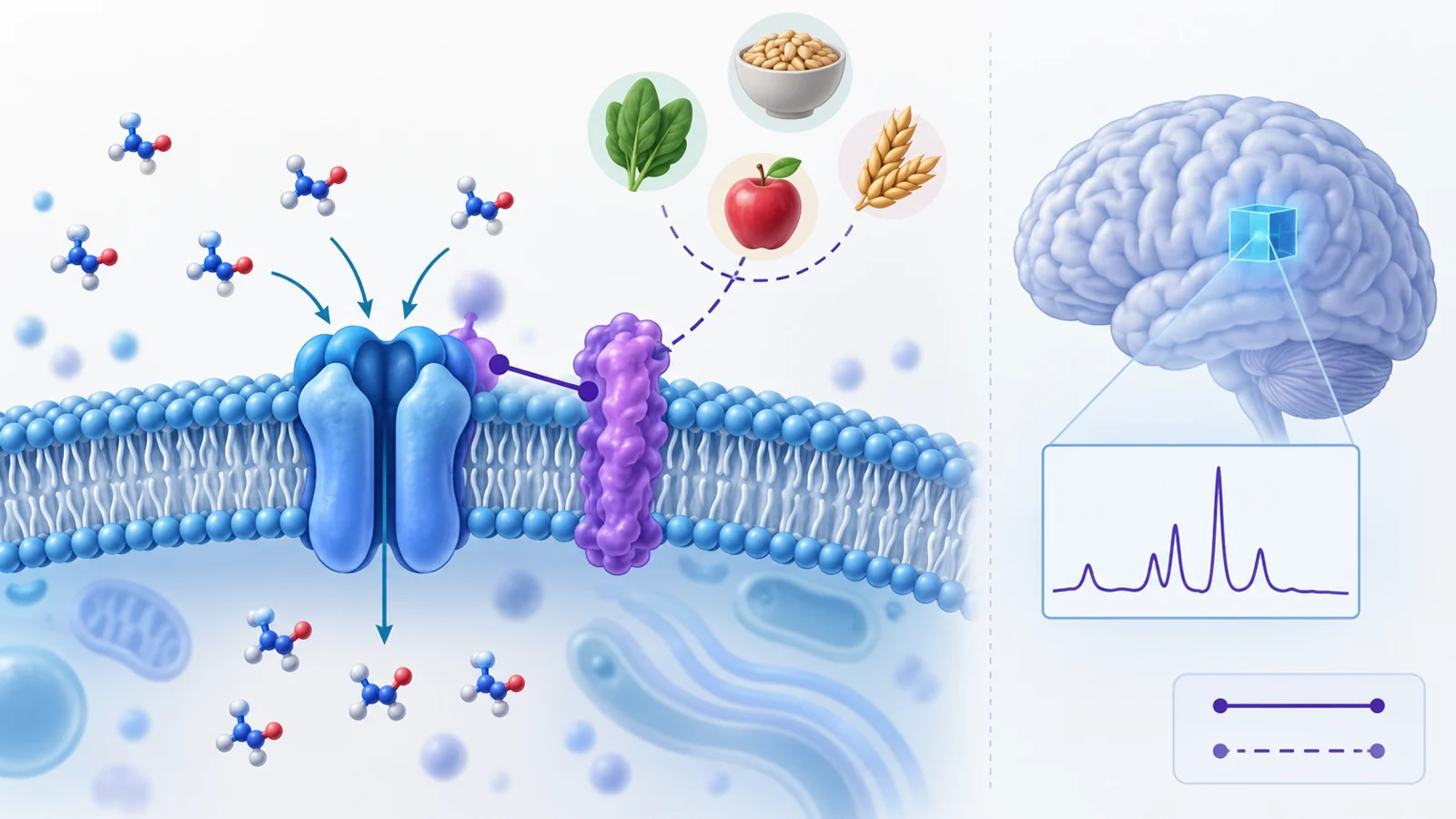
Creatine enters target cells through CT1, also called SLC6A8. CT1 is a membrane protein that uses sodium and chloride to transport creatine across the cell boundary. If the transporter has limited activity or is present at low density, increasing creatine outside the cell may not produce a matching increase inside it. This offers one possible explanation for why promising animal findings did not translate consistently into human trials involving neurological symptoms.
The paper therefore shifts attention from supply alone to the machinery that handles supply. In this view, a strategy that supports CT1 could complement creatine rather than simply adding more of the compound. That is the central reader-facing tension: the brain may need both adequate creatine and a workable route for getting it into cells.
Klotho changes what the transporter can do
Klotho is a membrane-bound protein with a circulating form and several reported roles in metabolism and cellular maintenance. It is expressed in neuronal areas including the cerebral cortex, cerebellum, and spinal cord. The proposal rests partly on an experiment in cells engineered to express CT1. When Klotho was co-expressed with CT1, the maximum creatine-induced electrical current was 29.5 nA, compared with 20.2 nA with CT1 alone.
That result makes Klotho a plausible regulator of the transporter. One interpretation offered by the paper is that Klotho may help stabilize the carrier in the cell membrane, allowing CT1 to handle more creatine under the experimental conditions. The measured current is important because it shows a stronger transporter response in a controlled cell model. It is not a measurement of creatine concentration in the brain, and it does not show that people would experience a treatment benefit.
The dietary clues come from different settings
Several observations make dietary stimulation of Klotho worth investigating, but they do not all describe the same biological situation. In mice, a vitamin D-enriched diet increased Klotho expression, with expression reaching its reported maximum after administration of 1,25-dihydroxyvitamin D3. Vitamin D also increased Klotho messenger RNA in mouse kidney-cell lines and in human proximal kidney cells. Curcumin, a compound found in turmeric, increased Klotho expression in a human proximal tubule cell line.
Other findings involved complete dietary patterns rather than a single nutrient. A low-calorie, high-protein diet increased Klotho levels in the brains of rats. A phosphate-restricted diet improved kidney Klotho expression in a mouse model of polycystic kidney disease. In middle-aged sedentary adults, greater nut intake was associated with higher circulating Klotho levels. An association in people can help identify a relationship to test, but it cannot by itself show that eating nuts caused greater Klotho activity or improved brain creatine uptake.
These findings also differ in species, tissue, exposure, and measured endpoint. A change in Klotho messenger RNA in kidney cells is not equivalent to a change in brain creatine. Likewise, an animal brain measurement and a human blood association answer different questions. A creatine–vitamin D multi-component supplement trial in older adults reported favorable functional outcomes and changes in energy-metabolism-related kinases, but Klotho activation and brain creatine were not evaluated there.
The missing link is brain uptake
The unresolved pathway has several steps: a dietary intervention would need to change Klotho, that change would need to affect CT1, and the transporter response would then need to increase creatine inside the brain. The supplied evidence does not establish that sequence in humans or show that stimulating Klotho can overcome inherited creatine-transporter dysfunction.
Future studies would need measurements that separate these steps. Circulating Klotho could serve as a practical proxy for whether an intervention is stimulating the protein, while magnetic resonance spectroscopy could assess changes in brain creatine more directly. Neither measurement substitutes for the other. Researchers would also need to account for creatine already consumed in food, the duration and level of exposure, nutritional status such as vitamin D deficiency or a creatine-free diet, age, physical activity, education, and accompanying conditions. These factors could change CT1 or Klotho function and make a dietary effect easier or harder to interpret.
The paper also identifies possible influences beyond diet, including sex-related differences observed in mice and effects from some medicines, uremia-related compounds, or demethylation agents. Those considerations reinforce the need for carefully controlled studies rather than a general nutrition recommendation. One author disclosed service on a scientific advisory board on creatine, creatine-related patents and patent applications, and speaking, consulting, and research-funding relationships in nutrition and supplement fields. The other author reported no commercial or financial relationships of that kind.
What better creatine delivery could mean for brain care
The potential payoff is a more effective way to pair creatine supply with the brain’s ability to use it. For people whose neurological conditions involve reduced brain creatine availability, a dietary approach that reliably increases uptake could eventually make delivery part of the therapeutic problem being addressed, alongside the amount supplied. That would be a meaningful shift from asking only how much creatine reaches the body to asking whether enough reaches the relevant brain cells.
This possibility depends on several conditions. A dietary intervention would need to produce a reproducible Klotho–CT1 effect, measurably increase brain creatine, and do so safely. Most importantly, the change in brain creatine would need to lead to a clinically meaningful benefit. The 2021 proposal points toward that possibility, but the experiments required to connect dietary Klotho stimulation with better brain care were still ahead.
Key Sources
- Primary source: Improving Brain Creatine Uptake by Klotho Protein Stimulation: Can Diet Hit the Big Time?
DOI or Journal Page · Peer-Reviewed Paper · 2021-12-23
Keep exploring