
Research Signal – Source date 2021-10-01
Aging can leave tissues with more cells that have entered a lasting state of growth arrest. These senescent cells no longer divide normally and can contribute to tissue inflammation. Senolytics are drugs intended to target and clear such cells, but lowering a senescence-related measurement is not the same as showing that an old organ has been restored.
A paper published on October 1, 2021, tested the combination of dasatinib and quercetin in aged mice. The treatment was associated with lower intestinal gene markers linked to senescence and inflammation, along with changes in bacterial composition that varied across the gut. The findings are useful because they measured tissue and microbes together. They still stop short of showing that the intestine functioned better, that bacteria caused the tissue response, or that the combination would help people.
A senolytic test in old female mice
The experiment used 3-month-old and 18-month-old BALB/c mice; the aged animals were female. The central comparison for aging was between 18-month-old mice given dasatinib plus quercetin and age-matched mice given a placebo solution. The aged animals were maintained on standard chow and housed under controlled conditions.
The treatment schedule was intermittent rather than continuous. Mice received dasatinib at 5 mg per kilogram plus quercetin at 50 mg per kilogram by oral gavage on three consecutive days every two weeks for ten weeks. The control animals received the same volume of placebo solution. Young control and young treatment groups were included as a separate comparison, so the study was not limited to old animals.
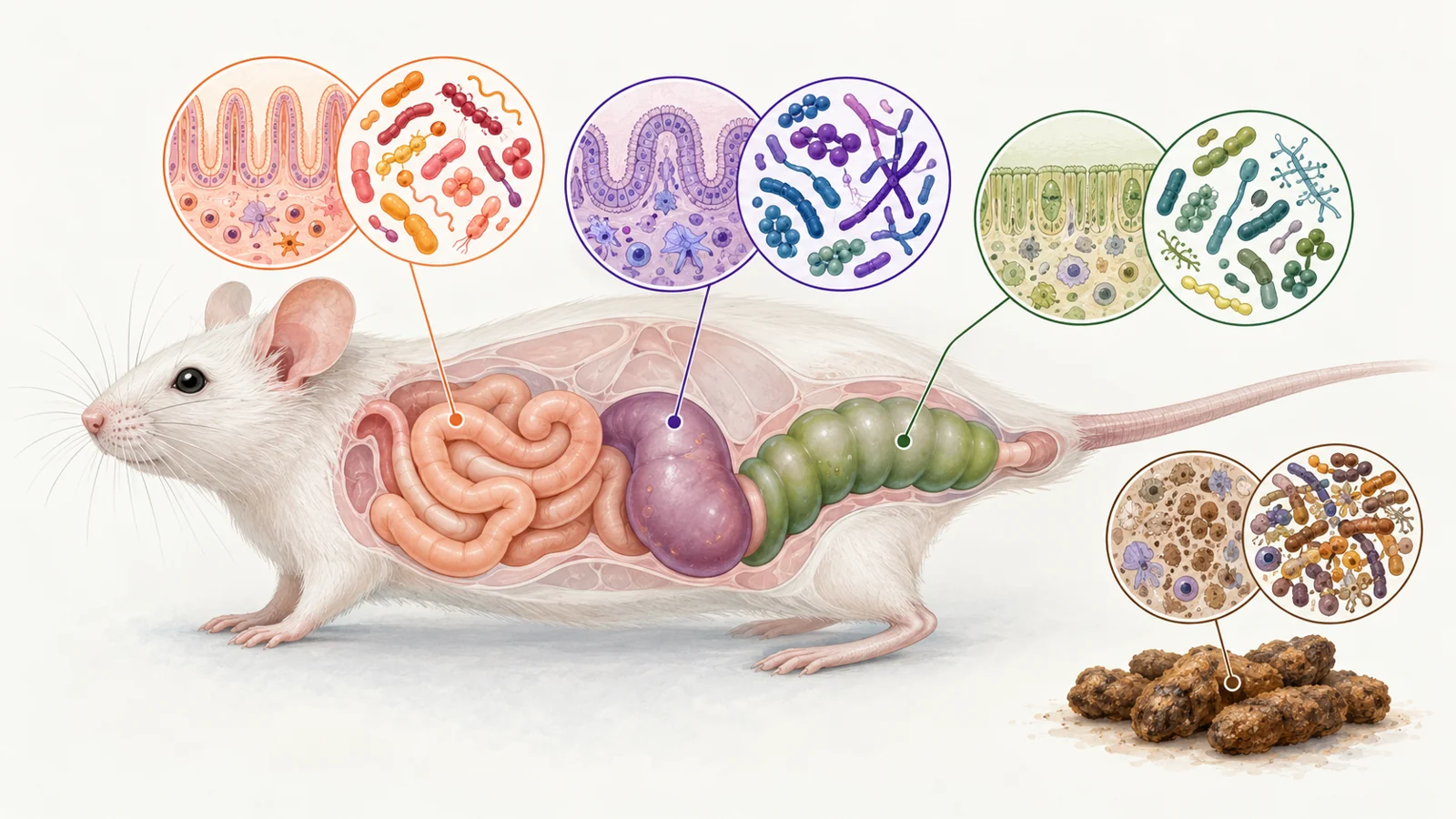
At the end of the intervention, the researchers sampled several parts of the gastrointestinal tract: the ileum, the final part of the small intestine; the caecum, a pouch at the start of the large intestine; and the colon. They also collected fecal material. This regional design matters because material measured in stool represents what reaches the end of the digestive tract, not necessarily what is happening in every intestinal compartment.
The tissue measurements pointed in one direction
To estimate the intestinal senescence and inflammatory burden, the researchers measured messenger RNA, or mRNA, from tissue samples. mRNA is a temporary molecular readout of which genes are being expressed; it is not a direct count of cells. The senescence-related markers were p16 Ink4a and p21 Cip1. The inflammation-related measurements included Cxcl1, Il1β, Il6, Mcp1, and Tnfα, along with Lmnb1 as another senescence-associated tissue marker.
Across the ileum, caecum, and colon, aged mice treated with dasatinib plus quercetin had significantly lower expression of p16 and p21 than aged placebo-treated mice. The measured inflammatory transcripts were also markedly lower in all three intestinal regions. The effect was not presented as a single uniform intestinal value: the researchers reported results separately for the small and large intestine, allowing the regional pattern to be seen.
The intervention description lists ten aged mice in each of the treatment and placebo groups. Figure 1 identifies five mice per aged group for the displayed tissue gene-expression measurements, while the microbiota figures identify ten aged mice per group. The reason for this discrepancy remains unclear, leaving uncertainty about how the tissue measurements relate to the full intervention groups.
The young comparison provides another boundary. For the measured p16, p21, inflammatory, and Lmnb1 genes, the treated and untreated young mice did not differ significantly. That result shows that the same measured pattern was not detected in the young comparison under this design. It does not prove that dasatinib plus quercetin acts only in aged tissue, because the study was small and these were marker measurements rather than a complete test of age-selective action.
Bacterial changes were strongest in the ileum
The microbiome analysis used bacterial DNA profiling to compare communities in the ileum, caecum, colon, and feces. The researchers looked at both the overall structure of each community and the relative representation of particular bacterial groups.
The broad community measures did not show remarkable differences in alpha-diversity or beta-diversity between treated and placebo-treated aged mice. In ordinary terms, the study did not show a striking change in the overall variety within a sample or in the overall pattern of difference between samples. That finding can coexist with changes in individual groups. A community may retain a broadly similar structure while some of its members become more or less prominent.
The most noticeable compositional patterns appeared in the ileum. Treated aged mice had a higher relative abundance of Verrucomicrobia and a lower relative abundance of Firmicutes there, with less prominent trends in the caecum, colon, and feces. The highlighted phylum-level differences did not reach statistical significance, so they are best treated as observed directional patterns rather than confirmed treatment effects. The analysis also distinguished major bacterial groups at finer taxonomic levels, including a higher representation of Akkermansia in the treated aged group.
The direction and strength of these patterns changed by location. The ratio of gram-positive to gram-negative taxa was higher in the ileum of treated aged mice, but that pattern was not seen in the caecum or colon; in feces, the ratio was slightly lower. This uneven distribution is a central part of the result. A stool sample cannot automatically stand in for the microbial environment of the ileum or another intestinal region, and a named bacterial shift does not by itself establish that the whole community became healthier or that dysbiosis was reversed.
Correlations connect the measurements without proving a cause
The researchers next compared microbial signatures with the intestinal senescence and inflammation markers. They found region-specific patterns of positive and negative correlation. For example, Akkermansia was negatively correlated with the measured senescence and inflammation markers across the intestinal tissues examined. Other bacterial groups showed positive associations, and some associations changed depending on whether the sample came from the ileum, caecum, or colon.
A correlation means that two measurements varied together in the observed animals. It does not show which one came first. The bacterial changes could have influenced the tissue environment, the tissue changes could have altered the conditions experienced by bacteria, or both could have reflected another effect of the treatment. The study therefore provides a combined view of tissue markers and microbial composition, not proof that the microbiome mediated the intestinal response.
There are limits beyond the direction of causality. This was a small, single-strain study of female mice, and the main endpoints were gene expression and bacterial DNA profiles. Lower mRNA levels do not directly demonstrate that senescent cells were cleared. The supplied findings also do not establish restored gut function, a universally improved microbial community, direct human benefit, or longer survival. The paper itself describes possible health-span and survival benefits as speculation requiring considerable further testing.
The authors reported financial interests for several contributors related to the research, including patents on senolytic drugs and their applications held by Mayo Clinic and the University of Minnesota. They also reported review by a conflict-of-interest board and compliance with the relevant institutional policies. This disclosure does not determine the result, but it is part of the context readers should retain when weighing an early preclinical study.
What this could mean for treating the aging gut
The possible downstream value is an intestinal treatment strategy aimed at reducing persistent inflammation associated with aging. If the lower tissue markers in mice ultimately correspond to meaningful functional improvement, and if an intermittent dasatinib-plus-quercetin regimen can be shown to be safe and effective in people, treatments that act on the aging gut could one day help older adults retain intestinal health.
That possibility depends on several links that this experiment did not establish. The measured gene changes would need to translate into better intestinal function, the regional microbial shifts would need to be understood rather than assumed to be beneficial, and the treatment would need to work safely in humans. The study offers a reason to investigate those questions, not a recommendation to take the combination or a promise of a longer life.
Key Sources
- Primary source: Senolytic Combination of Dasatinib and Quercetin Alleviates Intestinal Senescence and Inflammation and Modulates the Gut Microbiome in Aged Mice.
DOI or Journal Page · Peer-Reviewed Paper · 2021-10-01
Keep exploring