
Evidence date · 2022-10-11 · Research note 3 of 3
1 2 3
See current Track status →
Since the previous research note · Earlier expectation not tested
Track continuity
Since the previous research note: How carbon-fiber skins and aluminum supports share a panel’s load
Previous expectation: A calculation method accounting for component bending and connection movement could help engineers compare lighter load-bearing panels if it proved applicable at service scale.
What this study adds: The October 2022 review brings a broader set of core geometries, face materials, joining approaches and responsive-material examples into view. It supplies design context without testing that particular method or establishing its scale-up.
What changed in this study
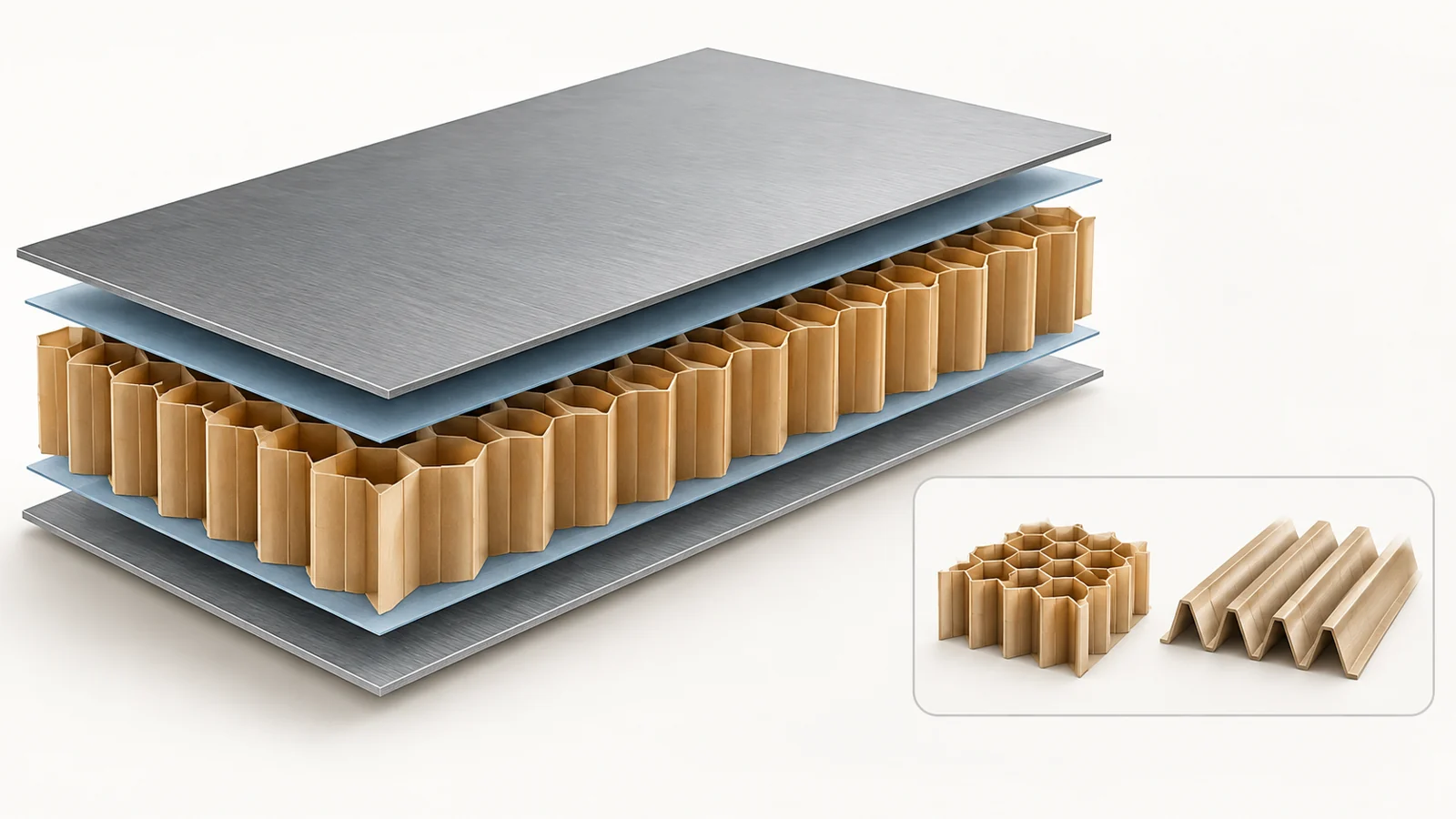
A lightweight panel can look deceptively simple. Two stiff outer sheets surround a much lighter interior, yet the way those parts are shaped, joined and tested determines how the panel behaves. The core adds thickness without adding as much mass as a solid block would, while also carrying compression and shear loads. The face sheets help resist bending and protect the structure from damage.
A review published on October 11, 2022, examined how researchers were designing these sandwich structures with different cores, face materials and joining methods. It is useful for a practical reason: it shows why a panel cannot be judged by naming its strongest material or most elaborate internal geometry. The assembled structure has to transfer loads across several different materials, in particular when it is bent, struck or manufactured in a complicated form.
The inside changes what the panel can do
The core is not merely filler. By separating the two face sheets, it increases the panel’s thickness and changes how the structure carries loads. The review groups examples into familiar forms such as honeycomb, foam, corrugated, truss and lattice cores, alongside more elaborate designs including hybrid, hollow, hierarchical, folded, graded and responsive cores.
Each arrangement changes the path through which forces travel. A honeycomb is made from repeating cells, and its response depends on direction. The review describes honeycomb cells that can be triangular, square or hexagonal, with materials including aluminum, thermoplastic polyurethane, Nomex and carbon fiber. The same cellular idea can provide different resistance depending on whether the structure is loaded through one direction or another. Directional behavior is therefore part of the design rather than a minor detail.
A graded core changes density through the structure instead of keeping it uniform. The review discusses staged and continuously graded honeycomb structures made with thermoplastic polyurethane filament through 3D printing. In the summarized compression tests, graded designs showed a wider energy-absorption range than uniform structures, associated with greater strain before densification and a nonlinear relationship between density and energy absorption. Other reviewed work placed graded honeycomb inside a graded-thickness tube and reported improved global bending resistance under oblique loading. These are findings from particular designs and loading conditions, not a universal ranking of graded cores.
Hybrid cores alter the interior again by filling spaces within a monolithic core with another material. In examples summarized by the review, polyurethane, alumina or aramid fiber was added to a truss core for ballistic performance. A metallic corrugated core filled with aluminum foam showed greater bending strength and stiffness than the empty version in a three-point bending test. Filling an aluminum honeycomb-corrugation structure also improved its reported compressive strength, shear strength and energy absorption. The added material changes the structure’s response, but it also adds another interface and another fabrication task that must work reliably.
A panel is more than its strongest ingredient
The face sheets have their own job. They must help resist in-plane shearing and out-of-plane compression while avoiding bending and fracture. The review describes fiber-reinforced, metal-matrix and polymer-matrix composites as possible skin materials, alongside thin sheets made from metals and other structural materials. Toughness, hardness and impact resistance matter because the skin is exposed to loads that the core alone cannot handle.
The connection between skin and core is just as important. Joining methods discussed in the review include heated pressing, vacuum bagging, Z-pinning, J-hooking, stitching, bolting and adhesives. These methods are not interchangeable labels. They determine how forces move from the face sheet into the core and how the two parts remain attached when the panel bends or is struck.
An example summarized in the review makes the interface visible in the results. Aluminum honeycomb was paired with a carbon-fiber-reinforced plastic face sheet, with short aramid fiber tissues and carbon-fiber belts used for interfacial toughening. In three-point bending tests, the review reports increases in average peak load of 39.8%, 26.8% and 18.1% for toughened samples compared with samples without toughening. The result does not turn one joining detail into a general solution. It shows that interfacial toughening can affect bending performance and why the connection must be considered as part of the panel rather than as an afterthought.
Different tests answer different questions
Compression, bending and impact do not measure the same capability. A compression test asks how much compressive stress a specimen can withstand and how stiff it is in that loading arrangement. A bending test shows how the faces and core work together as the panel curves. An impact test adds a rapid event in which the direction and shape of the loading can change the deformation pattern.
The review summarizes low-velocity impact tests on 3D-printed acrylonitrile-butadiene-styrene re-entrant honeycomb cores with carbon-fiber-reinforced plastic face sheets. At impact energies of 20, 40 and 70 joules, the specimens were tested in both in-plane and out-of-plane orientations. The in-plane arrangement showed better impact-energy dissipation than the out-of-plane arrangement in that study. The finding is meaningful precisely because the orientation is stated alongside the result.
A higher peak load and more absorbed energy are not interchangeable achievements. Peak load describes the largest force reached in a test; absorbed energy describes the mechanical work taken up as the structure deforms. A panel can perform differently on those measures, and results from different specimens, directions or test speeds cannot be combined into one score without losing the conditions that give them meaning. The review’s examples are best read as evidence that geometry and loading setup must travel together when designs are compared.
Some cores could respond as conditions change
The review also describes a different kind of design: a core whose mechanical response can change when an external stimulus is applied. Shape-memory polymers and shape-memory alloys can recover their shape after stimulation. In one summarized example, controlled heating of a shape-memory polymer core with an aluminum face sheet enabled damping over a range of frequencies. The heating rate was part of the reported control of the structure’s damping behavior.
Magnetorheological elastomers offer another route. These materials contain magnetic particles in an elastomeric matrix and can change properties such as stiffness and vibration behavior when exposed to a magnetic field. The review describes magnetorheological elastomer cores used in sandwich structures for small-scale vibration suppression under different support motions, as well as studies of field-dependent stiffening and frequency-dependent mechanical behavior.
These examples point toward adjustability rather than a fixed response. They do not by themselves demonstrate a deployed adaptive transport panel, nor do they show autonomous repair of structural damage. The practical promise depends on whether the responsive material, its face sheets, its control conditions and its joining method can remain reliable in the environment where the panel would operate.
Making an intricate core is part of the engineering problem
A promising geometry still has to be built. The review identifies difficulties in conventional corrugation, expansion and forming routes, including higher fabrication cost, limited ability to produce complex cores, difficulty supporting mass production and problems combining multiple materials. A design that is attractive in a diagram may be difficult to make consistently across a large panel.
Additive manufacturing can help create three-dimensional parts directly from computer-aided design data and may make more complex core shapes accessible. It introduces its own problems, however. The review highlights structural rigidity and warpage as major setbacks, with infill density and environmental control affecting the result. A printed core that differs from its intended geometry can change how it contacts the face sheets and how the finished panel transfers load.
The mismatch between core and skin properties adds another layer of uncertainty. The materials may differ in stiffness, deformation and failure behavior, while the interface has to connect them through manufacturing and service loads. Mechanical testing must then distinguish whether a weakness came from the core, the face sheet, the joint or the way the specimen was loaded. This is why material selection, geometry, joining and fabrication cannot be evaluated as isolated upgrades.
What this could mean for lighter transport panels
For transport designers, the long-term possibility is a panel that carries the required loads with less structural mass while also helping manage vibration. Passengers, operators and other users could benefit indirectly if lighter structures can be made dependable without giving up the mechanical functions they need.
That prospect remains conditional. It depends on coordinating the core geometry, outer skins and connection so that the complete panel performs under actual service loads, and on manufacturing methods that can reproduce the intended structure reliably. Responsive materials may eventually add controllable damping or stiffness, but the reviewed examples are design evidence and research directions, not proof that every advanced sandwich concept is ready for vehicles in service. The useful lesson from the 2022 review is narrower and more practical: lighter panels will be credible only when their internal shape, outer layers, interfaces and production route work as one structure.
Key Sources
- Primary source: A Brief Review on Advanced Sandwich Structures with Customized Design Core and Composite Face Sheet.
DOI or Journal Page · Review or Meta-Analysis · 2022-10-11