
Research Signal – Source date 2021-01-01
A January 2021 review describes CAR-modified T cells as a promising approach to cancer immunotherapy. Its discussion spans two different levels of possibility: the authors state that these cells can eliminate B-cell malignancies, while also describing broader therapeutic potential for solid tumors. The second claim is an ambition discussed by the review, not evidence that CAR T-cell treatment works broadly across those cancers.
A therapeutic idea with two scopes
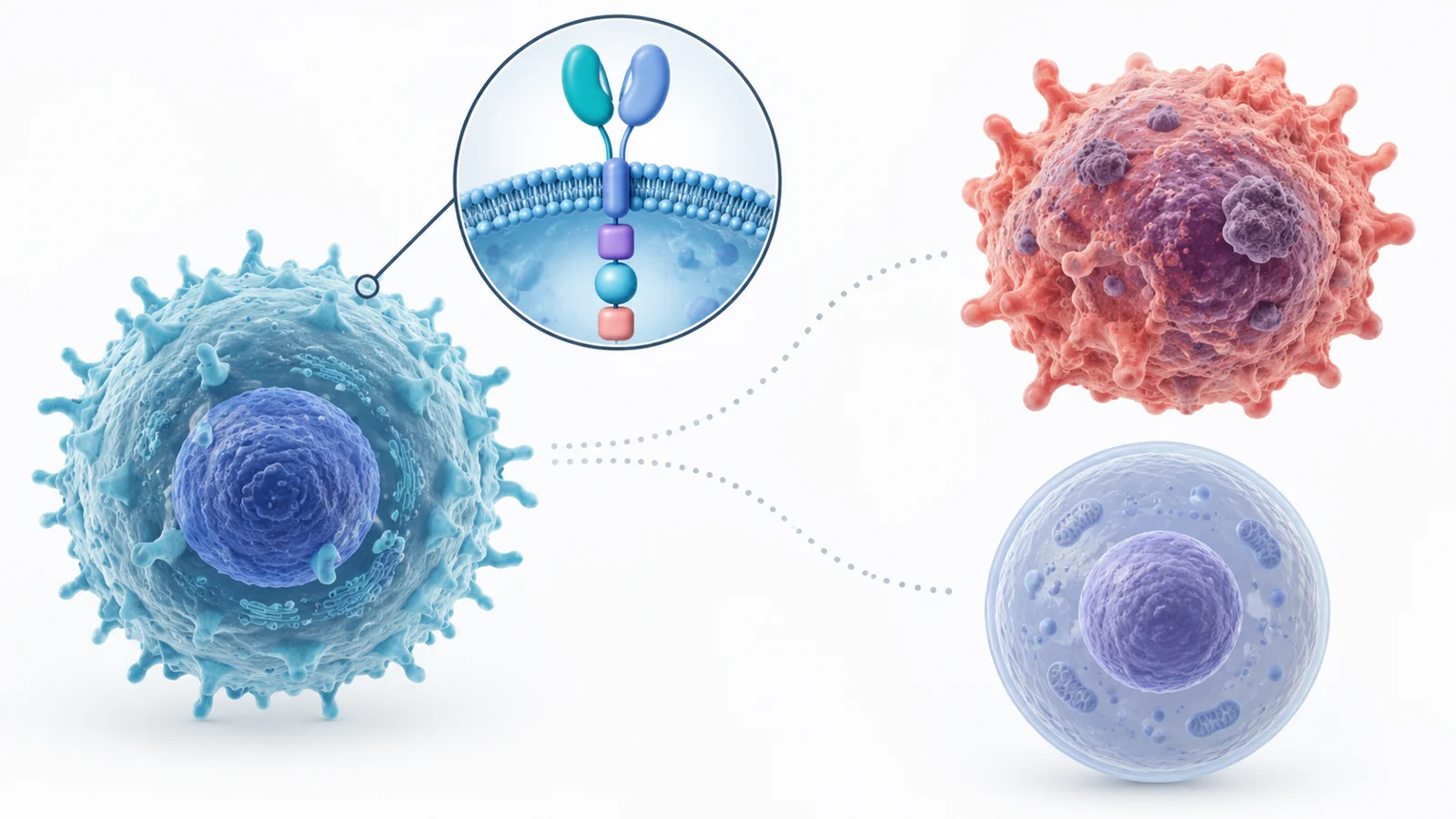
CAR T-cell therapy begins by changing how a T cell recognizes a target. The review describes a chimeric antigen receptor as a recombinant protein that combines an antibody-based targeting structure with a signaling component. One part gives the engineered cell a way to recognize the intended cancer-related target; the other helps activate the T cell.
That combination is important because recognition and activation perform different jobs. A receptor must help direct the immune cell toward a target, but the cell must also receive a signal that turns recognition into an immune response. The review presents this design as the basis for the reported ability of CAR-modified T cells to eliminate B-cell malignancies.
The authors extend the idea to solid tumors as a potential area for cancer treatment. The supplied abstract does not establish a new trial or other single experiment, and it provides no response rates, survival estimates, durability measurements, or comparative patient outcomes. The solid-tumor claim therefore remains a statement of therapeutic potential rather than a demonstrated result across different cancers.
Why the target boundary matters
An engineered immune cell does not face only the question of whether it can attack cancer. It also matters where the effects of that attack occur. In this context, an off-tumor effect means an effect outside the intended tumor target. The review places investigation of these risks alongside efforts to improve the therapy itself, including strategies intended to reduce or neutralize possible off-tumor consequences.
That concern makes the design problem more demanding than simply increasing immune activity. The desired result is cancer-directed action that remains sufficiently controlled around other tissues. The abstract highlights the importance of risk assessment and mitigation, but it does not identify or rank particular approaches. It also does not support numerical comparisons of safety or effectiveness.
The distinction matters especially for the review’s discussion of solid tumors. Broader use would require more than a receptor that can be designed to recognize a cancer-related target. It would require evidence that the approach can produce useful cancer-directed activity while maintaining an acceptable safety boundary in those cancers. The available material does not show that this broader effectiveness has been established or that off-tumor effects have been resolved.
What safer targeting could mean for cancer treatment
Safer targeting could make CAR T-cell therapy more useful to patients by preserving its intended cancer-directed activity while reducing effects outside the tumor. That benefit remains conditional on solving both sides of the problem: engineered cells would need to act effectively against the cancer and do so with acceptable control.
From the January 2021 perspective of this review, the same condition shapes the prospect of treating solid tumors. If researchers can demonstrate effective targeting together with manageable off-tumor risk, CAR T-cell therapy could become a more broadly useful cancer-treatment strategy. The review identifies that possibility and the need for optimization; the supplied evidence does not establish the patient outcomes or comparative safety needed to claim that the possibility has been achieved.
Key Sources
- Primary source: CAR T-cells profiling in carcinogenesis and tumorigenesis: An overview of CAR T-cells cancer therapy.
DOI or Journal Page · Review or Meta-Analysis · 2021-01-01
Keep exploring