
Research Signal – Source date 2026-04-08
The immune system is supposed to protect the lungs while limiting unnecessary damage. With age, those jobs can pull apart. Defense against infections and tumors may become less adaptable, yet inflammatory activity can remain high or become poorly controlled. This combination is central to immunosenescence, a term for age-related changes in immune function that extend beyond individual immune cells simply becoming senescent.
A review published on April 8, 2026, brings together the mechanisms linking immunosenescence with lung diseases and the interventions being studied to address them. Its subject is not a single treatment or newly reported trial. It is a cross-disease account of how aging immunity may contribute to lung injury, and of what different therapeutic strategies are trying to change.
The immune system can lose precision as it grows more inflammatory
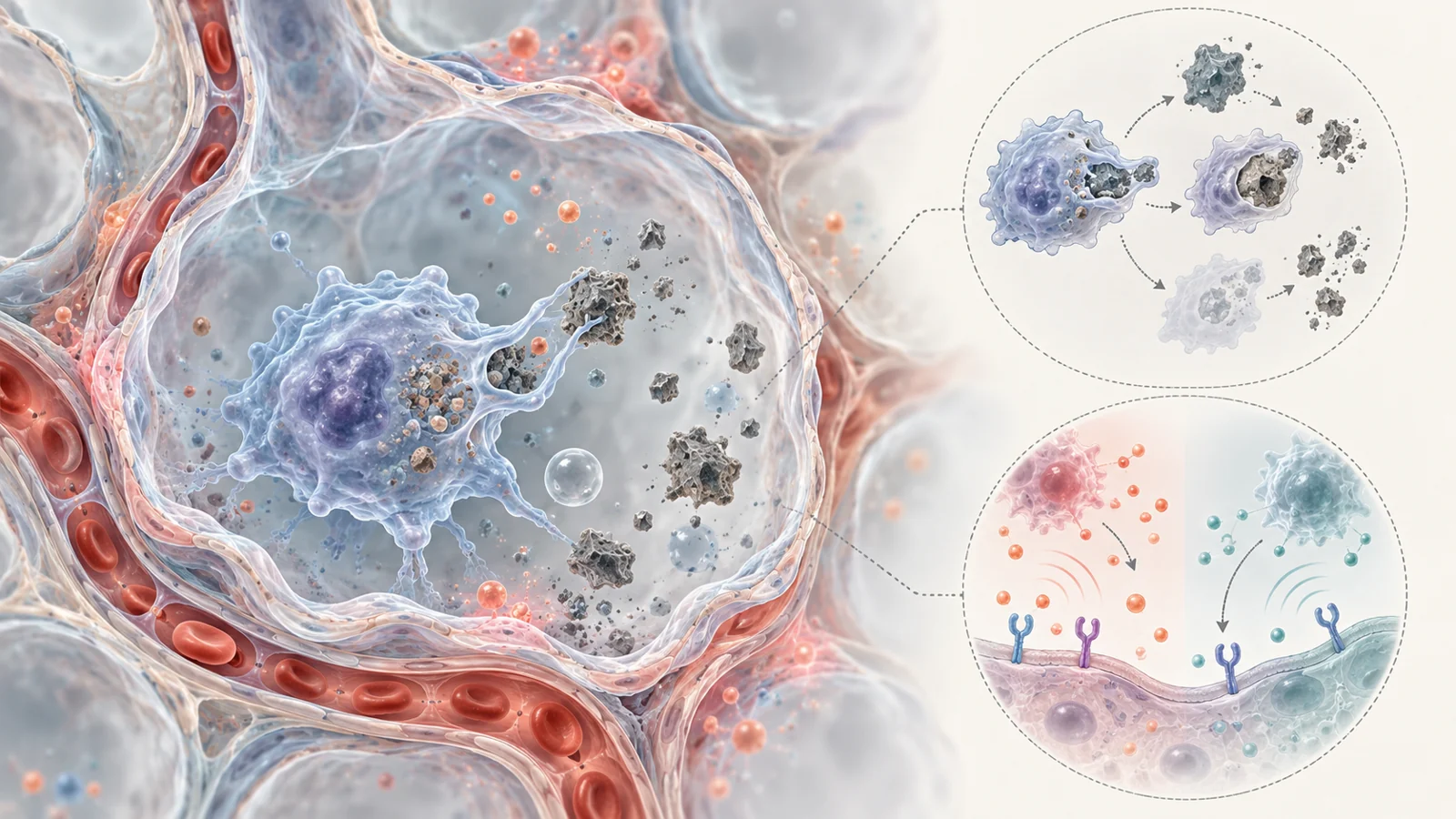
Macrophages offer a useful way to see the problem. In the lungs, alveolar macrophages help maintain the air-blood barrier and clear surfactant, while interstitial macrophages work between the lung epithelium and capillaries alongside other immune cells. They are part of the lung’s everyday cleanup and defense system.
Aging changes how these cells behave. The review describes increased production of inflammatory cytokines such as IL-1, TNF-α, and IL-6, along with greater release of reactive oxygen species. At the same time, macrophages show weaker phagocytic activity, including reduced efferocytosis, the process of clearing cells that have undergone programmed cell death. Their ability to clear bacteria after infection can also be impaired, and age-related changes in antigen presentation may make it harder to activate an effective adaptive response.
The result is not simply an immune system that is switched off. A macrophage may produce inflammatory signals while performing less efficiently at the practical work of clearance and defense. When senescent or damaged cells are not removed effectively, cellular debris and inflammatory signals can continue to stimulate the tissue. Senescent cells can also release a collection of cytokines, chemokines, growth factors, and matrix metalloproteinases known as the senescence-associated secretory phenotype, or SASP. The review connects this inflammatory environment with activation of the NLRP3 inflammasome, another route through which inflammation can become self-reinforcing.
Adaptive immunity changes in parallel. Aging is associated with more myeloid-biased blood-cell production and a reduced supply and diversity of naïve lymphocytes. Lymphocyte generation is suppressed, regulatory T-cell populations expand, and B cells become less adaptable, with weaker antibody affinity maturation. These changes can reduce the ability to respond to unfamiliar pathogens and vaccines and can weaken tumor surveillance.
This is why immunosenescence is better understood as a loss of immune balance than as a single defective cell type. Protective responses can become less flexible at the same time that inflammatory activity becomes more persistent.
Why lung disease and immune aging can reinforce each other
The relationship becomes more complicated once disease is already present. Age-related immune changes may help create conditions for lung pathology, but lung disease itself can reshape immune cells. External pressures, including pathogen exposure and oxidative stress, may add to intrinsic aging. An immune-aging signature in a diseased lung therefore does not identify which process came first.
Chronic obstructive pulmonary disease illustrates this reciprocal relationship. Persistent airway inflammation is a defining feature of COPD, and the disease can directly produce immune alterations. The review also describes increased senescence markers in immune cells from people with COPD. Age-related immune remodeling, disease-associated inflammation, and immune-cell senescence may therefore form a mutually reinforcing network rather than a one-way chain from age to disease.
Pulmonary fibrosis presents a related but distinct picture. Changes in macrophages, natural killer cells, leukocytes, and T cells can shift the lung environment toward fibrosis by disrupting immune surveillance and regulation. The review describes senescent macrophages with altered cell survival, cell-cycle, mitochondrial, and inflammatory features, as well as senescent T-cell and natural-killer-cell patterns associated with impaired function. Yet it explicitly leaves open whether immunosenescence initiates pulmonary fibrosis or develops in response to the fibrotic environment. The more likely interpretation is reciprocal interaction.
That uncertainty matters for treatment. Chronological age alone cannot identify the relevant biological target. A person’s immune state may reflect age, lung disease, previous exposures, or some combination. A therapy aimed at senescent cells might be useful in one setting but poorly matched to another if the dominant problem is a different form of immune dysfunction.
Proposed treatments act on different parts of the problem
The intervention landscape described by the review is easier to understand when the targets are kept separate. Senolytics aim to eliminate senescent cells. Senomorphics aim to alter the signaling programs associated with senescence, particularly inflammatory signals, without necessarily removing the cells themselves. Engineered immune-cell therapies attempt to recognize and attack cells carrying particular surface markers.
In pulmonary fibrosis, venetoclax is one example of the first strategy in a preclinical setting. The review describes Bcl-2 family inhibition inducing apoptosis in monocyte-derived macrophages and reversing established fibrosis in a mouse model of idiopathic pulmonary fibrosis. A clinical trial evaluating venetoclax in people with IPF was described as underway, with results not yet available in the review’s account. The mouse result and the human trial are therefore different kinds of evidence: one concerns an experimental disease model, while the other concerns an attempt to test safety and efficacy in patients.
Senomorphic approaches work through signaling. The review discusses preclinical work in which salvianolic acid B reduced senescence-related activity in macrophages and alveolar type II epithelial cells by interfering with SP1-associated regulation of SASP factors, with a resulting reduction in activated lung fibroblasts in an idiopathic pulmonary fibrosis model. It also identifies pathways and mediators being considered for modulation, including mTOR and NF-κB signaling and inflammatory factors such as IL-6, IL-33, and TGF-β. These approaches seek to change the inflammatory environment rather than simply remove every cell showing a senescence-associated feature.
Engineered cell therapies introduce a third logic. Senescent cells can display surface molecules such as uPAR or ligands recognized by NKG2D. In the studies summarized by the review, uPAR-directed CAR-T cells eliminated senescent cells in laboratory and animal settings, and extended survival in mouse models of lung adenocarcinoma treated with senescence-inducing drug combinations. NKG2D-directed CAR-T cells also showed senolytic activity in cultured systems, mice, and non-human primates. Related CAR-T and CAR-NK approaches have shown antitumor effects in preclinical lung-cancer work, although the contribution of senescent-cell removal to those effects remains unclear.
The clinical history is already cautionary. A phase Ib/II study combining the anti-CSF1R antibody AMG 820 with pembrolizumab included people with solid tumors, including a subgroup with non-small-cell lung cancer. The combination had an acceptable safety profile, but its antitumor activity was insufficient to justify further evaluation in the studied populations. That result informs this particular combination and setting. It does not test every way of targeting senescent cells, nor does it show that all strategies aimed at senescent macrophages will fail.
Human studies separate biological signals from clinical proof
The review describes a different type of human signal from a randomized, placebo-controlled study of recombinant human IL-7 in 109 people with severe COVID-19 and lymphopenia. Participants receiving IL-7 had higher lymphocyte counts than those receiving placebo, and the review reports fewer hospital-acquired infections among those treated with IL-7, with favorable tolerability in the described study.
Those findings are relevant to immune restoration, but they require careful interpretation. An increase in lymphocyte counts is a biomarker change. Fewer hospital-acquired infections are a clinical observation in a defined population and illness context. Neither finding alone demonstrates that IL-7 reversed immunosenescence, or that the same intervention would improve chronic obstructive pulmonary disease, pulmonary fibrosis, asthma, or lung cancer. The study’s population, immune problem, and acute clinical setting remain part of what the result means.
The AMG 820 experience provides a contrasting human study signal: an intervention with acceptable safety but insufficient antitumor activity for continued evaluation in the populations studied. Comparing the two examples helps separate several claims that are often compressed into the word rejuvenation. A treatment can alter an immune measurement without restoring the full range of immune function. It can be tolerated without improving the disease outcome that matters. It can show activity in one biological setting without proving that the same target is useful across lung diseases.
The review’s larger message is that mechanistic plausibility must be connected to meaningful outcomes in appropriately selected patients. Animal fibrosis models, cancer models, and acute infection studies can clarify targets and possible actions. They cannot by themselves establish durable benefit for older people living with chronic lung disease.
The design challenge is preserving useful defense
The central therapeutic tradeoff is difficult. Reducing inflammatory activity may limit tissue injury, but broad suppression could also weaken protection against infection. Removing senescent immune cells may reduce harmful signaling in one tissue while affecting functions that remain useful elsewhere. Changes in immune regulation may also raise concern about autoimmunity.
Individual variation makes a single treatment strategy even less plausible. People of the same chronological age can have different immune histories, inflammatory environments, disease burdens, and degrees of immune-cell dysfunction. The review therefore points toward combinations of genomic, epigenomic, and proteomic data with artificial intelligence to identify biomarkers of immunosenescence severity and treatment response.
Such profiling would be useful if it helped identify which biological process matters in a particular patient and whether an intervention changes it without eroding essential defense. The review calls for robust clinical trials in relevant older populations with lung diseases. Useful tests would assess lung function and disease outcomes alongside infections and immune safety.
What targeting immune aging could mean for lung health
The practical possibility is a more precise way to treat lung disease in older adults: reduce immune-driven tissue injury while retaining the immune functions needed to clear infections and recognize abnormal cells. That capability would be meaningful if it translated into preserved respiratory function, fewer damaging inflammatory episodes, or better quality of life for people living with chronic lung disease.
Reaching that point depends on matching the intervention to the underlying immune problem. A senolytic, a signaling modulator, an immune-cell therapy, or a thymus-directed approach would need to produce meaningful benefits in relevant patients without unacceptable disruption of protective immunity. The April 2026 review describes the biological routes toward that goal, but the human path remains one of targeted validation rather than assumed rejuvenation.
For older people with lung disease, the long-term promise is not simply a younger immune system. It is the possibility of maintaining useful defense while limiting the inflammatory processes that damage lung tissue, allowing respiratory function and quality of life to last longer.
Key Sources
- Primary source: Targeting immunosenescence in lung diseases: mechanistic insights and clinical interventions.
DOI or Journal Page · Review or Meta-Analysis · 2026-04-08
Keep exploring