
Research Signal – Source date 2026-03-16
When people exercise hard in hot conditions, a change in a thinking task and a change in a kidney-related measurement are not the same kind of result. A ClinicalTrials.gov record describes a human experiment designed to examine both after a short period of creatine monohydrate supplementation.
The study asks whether creatine changes cognitive performance during exertional heat stress while researchers also examine inflammation and markers associated with acute kidney injury risk. A cognitive result would not, by itself, show that the kidneys are safer. The value of the experiment is in seeing how these different responses behave under the same controlled challenge.
One experiment asks two different questions
The cognitive question is practical but narrowly defined: after strenuous exercise in the heat, do participants perform differently on specified cognitive tasks depending on whether they took creatine or placebo? The protocol names the NIH Toolbox Fluid Cognition Battery and the Color Word Stroop Test. The summary specifies NIH Toolbox testing before and after exercise, allowing the researchers to compare performance around the heat exposure.
The kidney-related question uses a different type of evidence. Urine is collected before exercise, after exercise, and again one hour later. The planned measurements include urinary markers of inflammation and markers associated with acute kidney injury risk. Those measurements may indicate how the body responds to the challenge, but a change in a marker is not the same as preventing a diagnosed kidney injury.
The record describes active, young, healthy volunteers. That population and the short experimental exposure define the immediate scope of the question. The trial is not designed, on the supplied evidence, to establish long-term effects, outcomes for people with kidney disease, or protection from heat illness and workplace accidents.
The comparison follows each participant through both conditions
This is a crossover study. Participants are intended to complete both the creatine and placebo conditions, with one baseline visit followed by two experimental exercise visits. The second condition is scheduled at least 21 days after the first. Comparing the same participant under both assignments gives researchers a within-person way to examine whether the measured responses differ between conditions.
The supplementation period is part of the experiment, not a dosing recommendation. For seven consecutive days before each exercise visit, participants are assigned 20 grams per day of creatine monohydrate or maltodextrin placebo, divided into four 5-gram doses. On the exercise-visit day, after hydration has been checked, the assigned supplement is also taken with a standardized breakfast, followed by a one-hour wait before exercise.
The administration is blinded, so the comparison is intended to separate the assigned supplement from expectations about which condition a participant received. The design still establishes only what the researchers planned to compare; it does not establish which condition produced better results.
The heat challenge is a laboratory simulation of demanding work
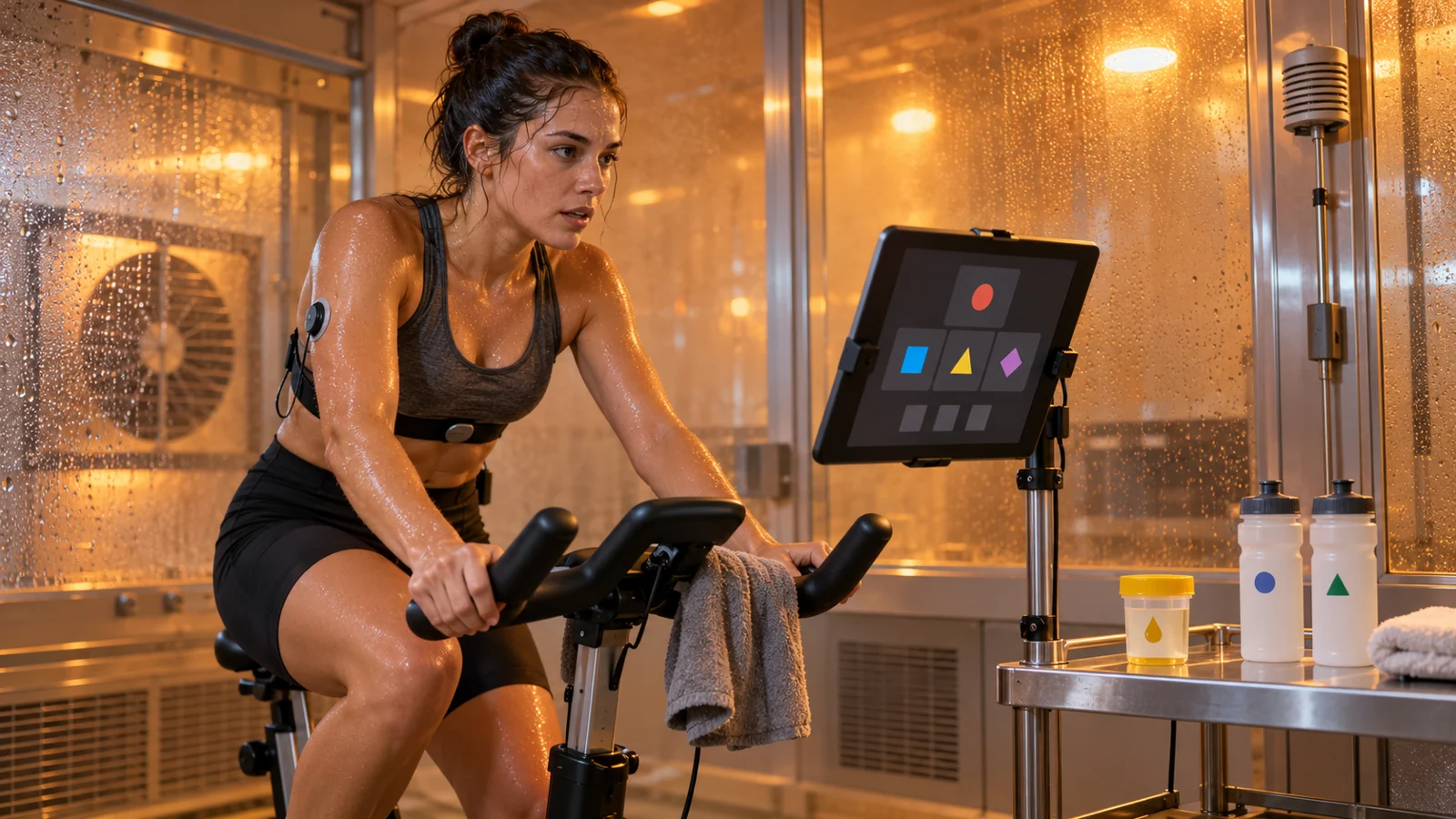
Each experimental visit involves 90 minutes of cycling in a controlled chamber maintained at 38°C and approximately 40% relative humidity. The exercise alternates between lower- and higher-intensity periods. Core temperature is monitored with a rectal thermistor, and urine is collected around the session. The setting gives the researchers a repeatable way to expose participants to exertional heat stress.
Before the experimental visits, participants complete a graded cycling test to measure aerobic capacity. Additional submaximal stages are then used to identify the workloads for the heat trials. The protocol describes targets of approximately 4 and 8 watts per kilogram, but here those figures refer to estimated metabolic rates calculated from gas exchange, not simply to bicycle mechanical power.
The workload choices were informed by observed metabolic demands among construction workers during summer work. That makes physically demanding work in the heat a relevant eventual context, but the experiment itself remains a controlled laboratory simulation rather than a construction-site or workplace test.
Cognitive scores and urine measurements reveal different parts of the response
The cognitive assessments take place in a quiet setting using an iPad. The planned NIH Toolbox testing examines whether performance changes from before to after the exercise challenge and whether that change differs between creatine and placebo. They do not directly measure workplace judgment, accident risk, or every form of thinking that matters during a real shift.
The urine measurements address another layer of the experiment. A pre-exercise sample helps confirm hydration using urine specific gravity. Samples taken after exercise and one hour later are used alongside the planned laboratory analyses of inflammation and kidney-injury risk markers. A result in this part of the protocol could show that a biological response differs between conditions, but it would not establish fewer kidney injuries in daily life.
The two streams of measurement therefore should be read together without being collapsed into one claim. Better task performance would not prove kidney protection. A favorable kidney-related marker would not prove that participants could work more safely or maintain complex decision-making in the field. The supplied evidence also does not establish that creatine could replace hydration, cooling, rest, or other heat-management practices.
The registry record offers a testable plan rather than an outcome
The supplied ClinicalTrials.gov record lists the study as recruiting, with an estimated enrollment of 20, and does not include posted results. Those are attributes of the record provided for this signal, not proof that the same recruitment status or wording applied on March 16, 2026, and not a reconstruction of the registry’s initial historical revision.
What is available is the planned comparison: active healthy volunteers, seven days of assigned supplementation, a controlled hot-cycling exposure, cognitive testing, and measurements related to inflammation and acute kidney injury risk. The record does not establish whether creatine improves, worsens, or leaves unchanged any of those responses. It also cannot show whether an effect would persist over longer periods or carry into older populations and actual workplaces.
What this could mean for people working in the heat
People performing physically demanding work in hot conditions are a plausible eventual beneficiary because their observed metabolic demands helped inform the laboratory workload targets. If the experiment finds better cognitive performance alongside acceptable kidney-related and safety findings, and later research shows that those effects carry into real working conditions, creatine supplementation could become one additional way to help people maintain thinking performance during strenuous activity in the heat.
That possibility depends on evidence still beyond this registry record. Any practical use would need to fit alongside established heat-management measures rather than substitute for hydration, cooling, or other protections.
Key Sources
- Primary source: Effects of Creatine Supplementation on Cognitive Measures and Markers of Acute Kidney Injury After Exercise in the Heat
Government or Regulator · Clinical Trial · 2026-03-16
Keep exploring