
Research Signal – Source date 2026-03-12
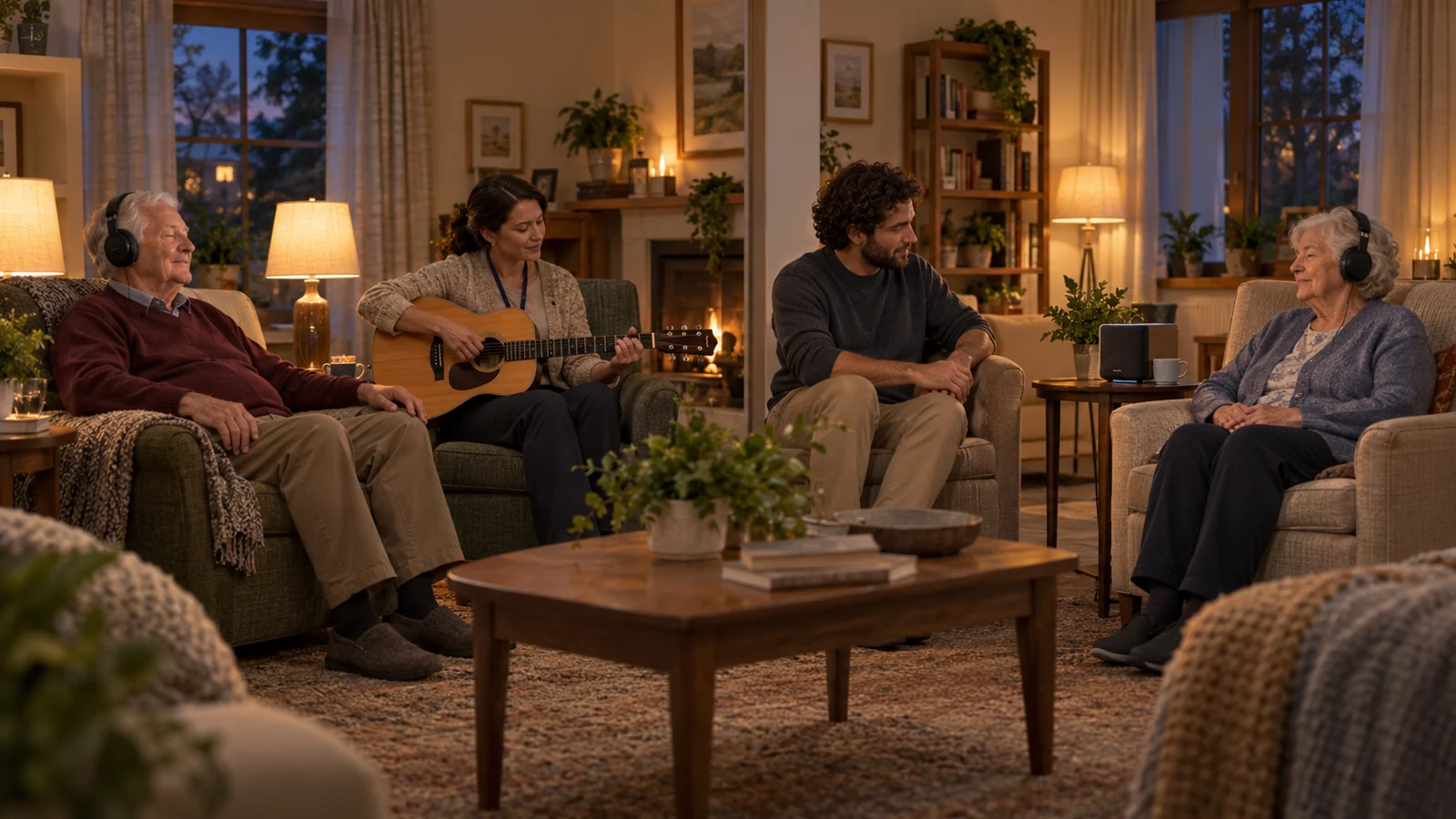
An evening listening session can be part of life in a protected care unit, but the scientific question is narrower than whether music is generally helpful. Does therapist-delivered music affect sleep or daytime behavior differently from another therapist-delivered listening activity, such as an audiobook?
Clinical trial NCT07465783 is designed to investigate that question in adults with Alzheimer’s disease or related disorders. The supplied record is anchored to March 12, 2026. The current registry record separately lists the study as recruiting and gives February 2, 2026 as its actual start date. It estimates primary completion in July 2027 and overall completion in September 2027. The supplied registry snapshot contains no posted results, so the study currently describes a planned comparison rather than an observed benefit.
The question is about evenings in protected care
The study focuses on people aged 60 or older living in protected care units. A therapist will provide an evening music intervention in the residents’ living environment. The target is sundowning syndrome in people with Alzheimer’s disease or related disorders, with measurements covering both nighttime sleep and daytime behavior.
This setting matters. The trial is not testing a general music habit at home, and it is not designed to establish that music changes the course of dementia. Its narrower purpose is to examine whether one structured evening listening routine is associated with different sleep and behavioral measurements than another routine delivered in the same broad care context.
Why the audiobook comparator matters
The study compares the music condition with audiobook listening. Both conditions involve therapist-delivered listening over ten evening sessions per intervention period. That makes the comparator more informative than a design in which residents receive music on one side and no listening activity on the other.
An audiobook condition can help the researchers ask whether any difference is associated with the musical content rather than with the wider experience of an organized evening session with a therapist. It does not make every influence identical: the material, sensory experience and residents’ responses may still differ. The design nevertheless addresses a more specific practical question for care settings: does music offer something beyond another supported way to listen?
Each participant is intended to experience both routines
The registry describes a prospective, multicenter, randomized crossover study with an estimated enrollment of 48 people. The number is an estimate, not a report of how many participants have actually been recruited. Each participant is intended to experience both the music and audiobook conditions, allowing the comparison to be made within the same person as well as across participants.
The order is randomized at the cluster level within participating protected care units. In plain language, some clusters may receive the music period first, while others may begin with the audiobook period. The timetable includes baseline measurement, a ten-evening intervention period, follow-up, a second intervention period and further follow-up. Because the order can vary, the schedule should not be read as though every participant follows a music-first sequence.
A crossover design can make person-to-person differences less central because each participant serves as their own comparison. It also requires careful interpretation of treatment order. For example, the meaning of a later-period measurement may depend partly on what came before it, including whether an earlier routine had effects that persisted into the next period. The supplied description establishes the comparison structure, but not the protocol’s detailed handling of every order-related issue.
Sleep, behavior and falls answer different questions
The primary outcome is change in sleep duration assessed by actigraphy. In practical terms, this asks whether participants spend more or less time asleep during the study periods. It is not the same question as how quickly sleep begins.
Sleep onset latency is listed as a secondary outcome and addresses the time between trying to sleep and falling asleep. The number of nocturnal awakenings asks how often sleep is interrupted. Looking at these measures separately matters because a person might fall asleep more quickly without sleeping longer overall, or sleep for a similar total duration while waking more or less often.
The researchers will also assess daytime disruptive behavior using the Cohen-Mansfield Agitation Inventory, a measure intended to capture changes in agitation and disruptive behavior. Falls are another secondary outcome, recorded throughout the study periods. Together, these measures connect the evening intervention with several concrete experiences: the length of nighttime sleep, the transition into sleep, interruptions during the night, behavior during the day and recorded falls.
What the registry entry can establish today
The current record provides a study plan, eligibility information and a description of the planned measurements. It lists recruiting status, an actual start date and future estimated completion dates. Those details help locate the trial in time, but they are not completed observations. The record does not provide an effect estimate showing that music improves sleep, reduces agitation or lowers the number of falls compared with audiobook listening.
That boundary is especially important for interpretation. Even a future difference between the conditions would first apply to the studied population and setting: older adults with Alzheimer’s disease or related disorders in protected care units, receiving therapist-supported listening. It would not by itself establish benefit outside that context, medication reduction, staffing savings or slower disease progression. For now, the meaningful advance is that the comparison has been specified clearly enough to test a focused care question.
What better evenings could mean for dementia care.
If the completed trial shows that therapist-delivered music produces a meaningful advantage over audiobook listening on sleep or behavioral outcomes, and if the routine proves workable in protected care units, it could support a practical evening option for residents and caregivers. The potential benefit would be a structured listening routine that helps residents sleep or makes daily care more manageable because music contributes something beyond another therapist-supported audio activity.
That possibility remains conditional on the eventual observations and on whether the approach fits real care environments. It is a modest but concrete form of promise: better-supported evenings for residents, with a routine that can be evaluated in the setting where it would actually be used.
Key Sources
- Primary source: Effects of Musical Intervention by a Therapist (IMT) on Falling Asleep and Behavioral Regulation in a Secure Care Unit (SCU)
Government or Regulator · Clinical Trial · 2026-03-12
Keep exploring