
Research Signal – Source date 2025-11-18
Healthy aging is lived across ordinary days, not only during clinic visits. Sleep timing, movement, light exposure, medication routines, and mood can change gradually, making important shifts difficult to capture with occasional assessments. A registered study in rural Yunlin County, Taiwan, is designed to examine whether everyday digital measurements can be connected with changes in function and biological markers among older adults.
ClinicalTrials.gov carried the study record titled “Digital Technology for Active and Healthy Ageing in Taiwan” on November 18, 2025. The current record describes a prospective observational cohort with an estimated enrollment of 140 adults aged 60 and older. It records an actual start date of April 22, 2026, lists the study as recruiting, and states that results have not been posted. The November 2025 registry date therefore anchors the study’s appearance in the record; it should not be read as the date when human participation began.
A study built around daily routines
The study focuses on rural older adults in Yunlin County, an area the registry describes as facing substantial needs related to chronic disease, frailty, dementia, and limited digital health literacy. The study description also points to local screening experience: from 2022 to 2024, health screenings at CMU Beigang Hospital recorded abnormalities in 36.1% of 12,222 visits, while thousands of assessments through the county’s ICOPE program showed similarly high levels of concern.
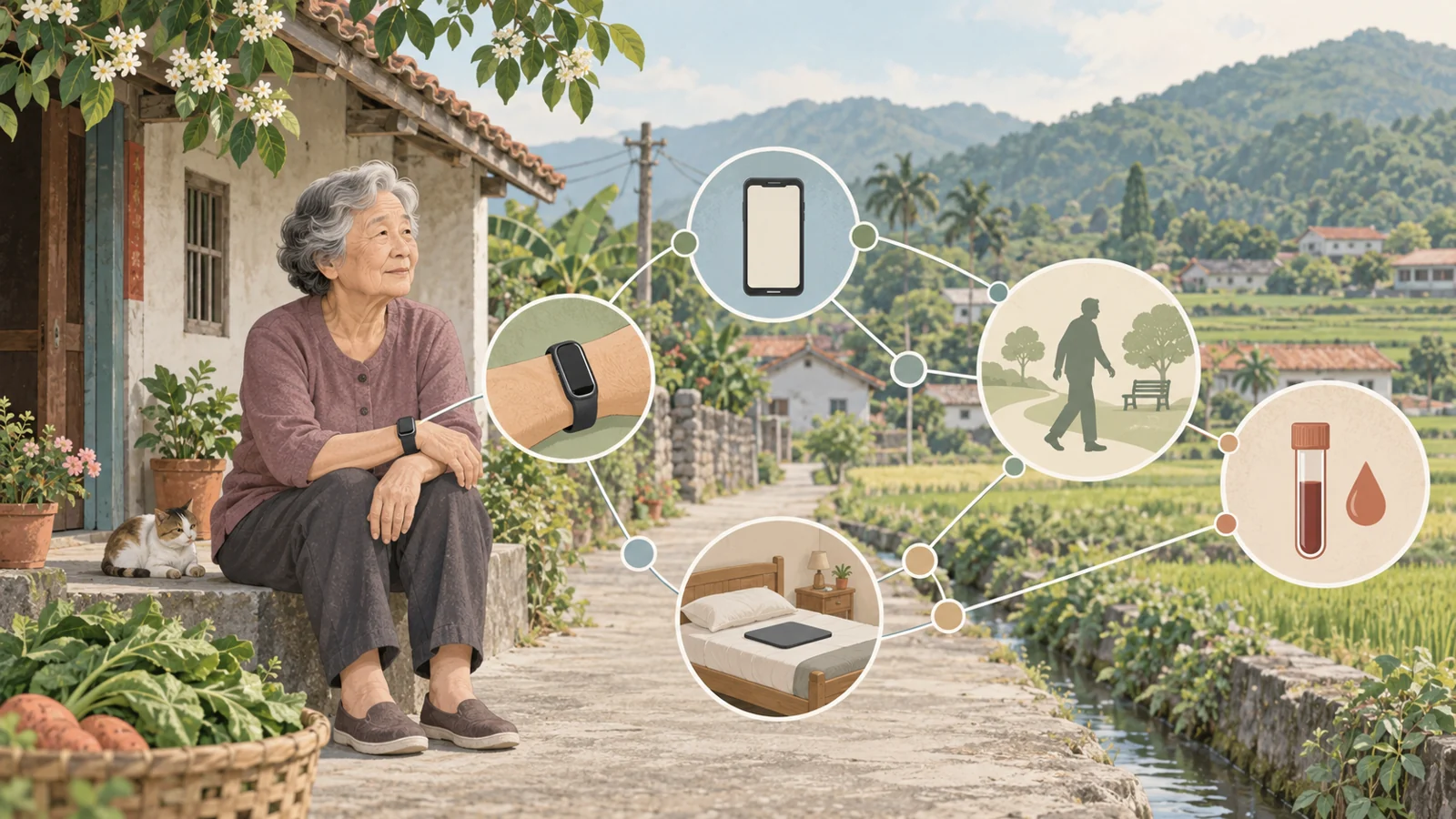
The planned participation is practical and data-heavy. Adults will wear a GeneActiv research-grade actigraphy device on the non-dominant wrist for at least two consecutive weeks. Actigraphy uses movement and light measurements to characterize activity and sleep-wake patterns over time. The record says the results will be visualized for participants as part of efforts to support behavioral change.
Participants will also use iMED, a mobile health platform developed by Taiwan’s National Health Research Institutes. The registry describes functions including health education, medication reminders, feedback on wearable data, and links to National Health Insurance records. The app is therefore presented as a support and feedback tool within the study, not as a proven treatment.
For participants with limited mobility, the record describes a separate option: iCue, an under-mattress sensor that monitors respiration, movement, and sleep-related parameters. Participants are also expected to attend Aging Well Taiwan sessions covering areas such as physical activity, diet, cognitive health, and digital literacy, with assessments informed by the World Health Organization’s ICOPE framework. Blood samples are planned at baseline and later follow-up, with APOE genotyping at baseline and measurements including tau, phosphorylated tau, amyloid beta, and neurofilament light chain.
From wrist movements to functional change
The central research question is not simply how much data a wearable can collect. It is whether patterns in daily activity and sleep can be related to changes that matter in later life.
The registry lists measures such as daily activity counts, sleep duration, sleep efficiency, wake after sleep onset, daytime napping, and the amount and timing of light exposure. It also includes measures of rhythm regularity. In ordinary terms, these ask whether a person’s day-night pattern is stable from one day to the next, whether activity is concentrated at consistent times, and whether the highest and lowest activity periods shift over time. The data are planned for analysis with the open-source GGIR algorithm and R software.
Those digital records will be considered alongside ICOPE functional assessments covering cognition, mobility, nutrition, vision, hearing, and mood. The study also plans to compare device-derived measures with blood measurements related to cognitive and functional decline. Follow-up outcomes are described across periods extending to 36 months, allowing the investigators to examine whether changes in sleep, activity, medication use, mental well-being, or behavior occur alongside changes in functional assessments or biological measurements.
For example, a pattern of increasingly irregular sleep could be examined alongside a change in mobility or mood assessment. A shift in daily activity could be considered with cognitive measures and blood results collected at the protocol’s specified time points. Such comparisons may reveal associations across different kinds of information that would be difficult to see from one questionnaire or one clinical visit alone. They would still be associations: the study design does not by itself show that a device, app, or education session caused a later change.
Why usability belongs in the evidence
Digital monitoring only works as a long-term research approach if participants can use it consistently and understand what they are being asked to do. The registry’s description of limited digital health literacy makes usability part of the scientific question, rather than a minor implementation detail.
The study includes semi-structured interviews and focus groups with participants and caregivers. These conversations are intended to explore how people experience the GeneActiv wearable, the iCue bed sensor, and the iMED platform over time. The planned analysis will look for facilitators, barriers, satisfaction, perceived benefits, and behavioral effects related to continued use.
That matters because the devices do not all ask the same thing of participants. A wrist monitor must be worn during daily life. An app requires people to interact with a phone and interpret feedback. An under-mattress sensor may be less intrusive for someone with limited mobility, but it represents a different way of collecting information. Community sessions add a social and educational component. Interviews can help show which parts of the overall arrangement fit people’s routines and which create friction for participants or caregivers.
A technically detailed dataset would be less informative if participation became inconsistent, if the tools were difficult to use, or if the feedback did not make sense to the people receiving it. The study’s qualitative work is intended to examine those practical conditions directly.
What this registry record can support
The supplied record supports an account of the study’s aims, measurements, and planned relationships. It does not provide evidence that participation has improved sleep, physical function, digital literacy, cognition, or general health. Nor does it validate the listed digital measures as predictors of cognitive decline, establish diagnostic performance, or show that the approach can prevent dementia.
The observational design is important here. If people with more stable sleep rhythms also show better-maintained function, that would be a relationship to investigate. It would not establish that more regular sleep produced the functional outcome, that the monitoring caused the pattern, or that the app and educational sessions were responsible. Predictive usefulness would require validation beyond an initial correlation, and applicability outside this rural cohort would also need to be tested.
The enrollment figure of 140 is an estimate, not a count of people known to have joined or completed follow-up. The current record gives an estimated primary completion date of December 31, 2028, and an estimated study completion date of December 31, 2029. Those dates are planned milestones, not achieved results. The investigators’ ambition to create an integrated digital aging database is likewise a future research aim; the record does not establish a completed national resource or national representativeness.
What better monitoring could mean for rural aging care
If the planned relationships prove useful and the tools remain acceptable to older adults and caregivers, rural care teams could gain a more informative picture of changes between formal assessments. Daily activity and sleep records might help show when an older adult’s routine is shifting, while functional and biological measurements could provide additional context for deciding who may need closer evaluation or support.
That possibility depends on several links holding together: the digital measures must relate meaningfully to function, the biological measurements must add useful information, and participants must be able to use the system over time. The current registry record describes an investigation of that capability, not an achieved care service or demonstrated health benefit.
Key Sources
- Primary source: Digital Technology for Active and Healthy Ageing in Taiwan
Government or Regulator · Clinical Trial · 2025-11-18
Keep exploring