
Research Signal – Source date 2025-08-18
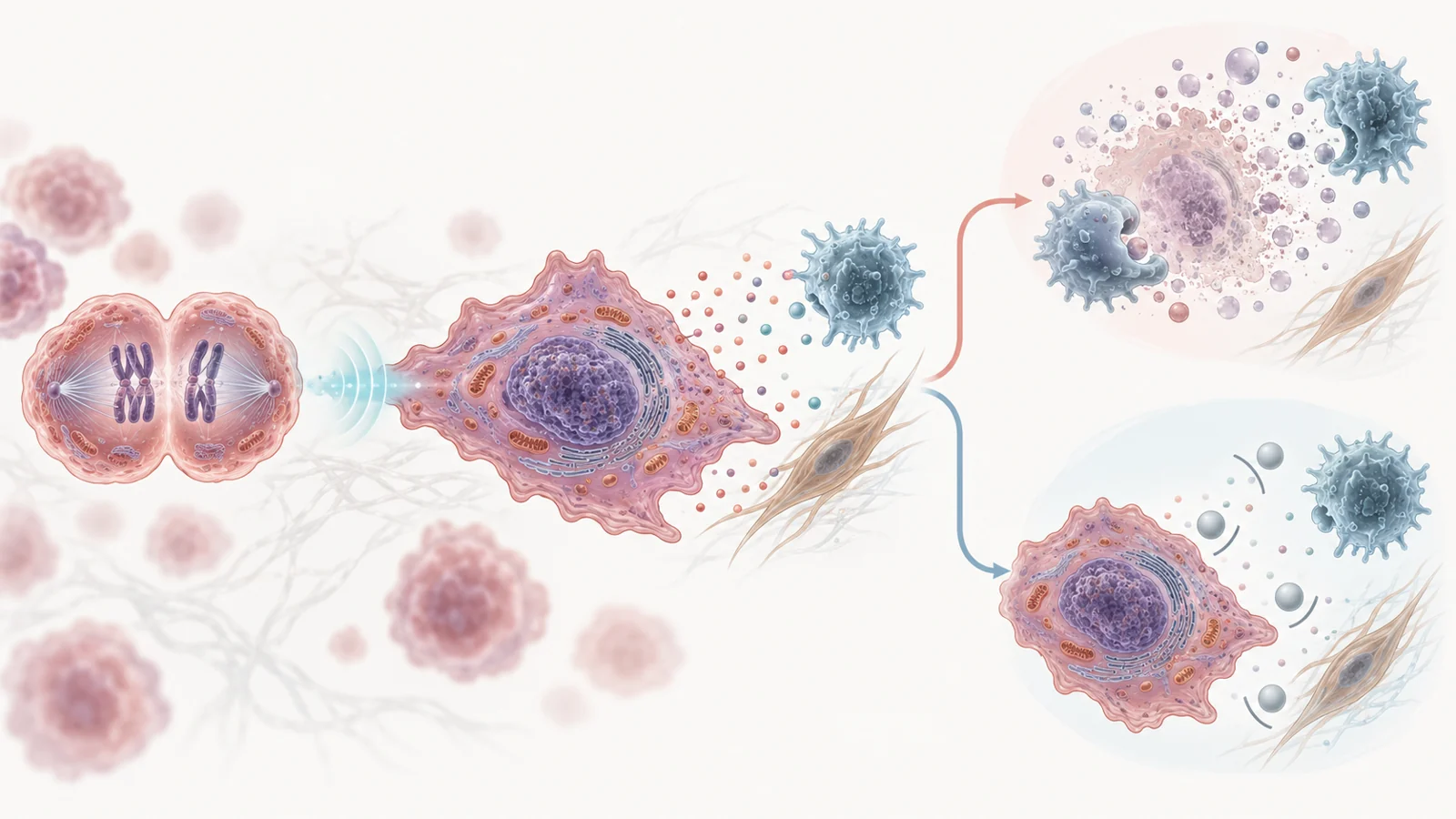
Cancer treatment is usually described as an effort to destroy malignant cells or stop them from multiplying. Cellular senescence complicates that picture. A senescent cell has stopped dividing because of stress, but it remains metabolically active. It can also change the tissue around it by releasing a mixture of inflammatory and growth-related signals.
That creates an apparent contradiction in the emerging idea of senescence-targeting cancer therapy. A treatment may deliberately push cancer cells into senescence to halt their growth. Researchers may then try to remove those cells or quiet the signals they release. The logic is not that senescence is always harmful. It is that stopping cancer cells from dividing and leaving those cells in place may have different consequences.
A review published on 18 August 2025, Targeting Senescence in Oncology: An Emerging Therapeutic Avenue for Cancer, brings together mechanistic, preclinical and clinical-trial evidence around that problem. Its account shows why the treatment concept is attracting attention while also leaving its clinical value unresolved.
A growth arrest that still changes its surroundings
Senescence is commonly associated with a stable halt to the cell cycle. The review describes p21 and p16 as important regulators of this arrest. Their activity reduces signals that normally allow a cell to progress through division, while the cell remains alive and metabolically active. Senescent cells may also show increased senescence-associated beta-galactosidase activity, loss of lamin-B1, altered mitochondria and enlarged cell or nuclear structures.
The most important feature for cancer biology may be what happens beyond the senescent cell itself. Senescent cells can develop a senescence-associated secretory phenotype, or SASP. This involves the release of cytokines, chemokines, growth factors and proteases. Signals such as interleukins, chemokines and transforming growth factor beta can affect stromal cells, immune cells and nearby premalignant or malignant cells.
The SASP is not a fixed recipe. Its composition can vary with the tissue, the cause of senescence and the time since the state began. Early senescence may therefore have different effects from a more persistent state. Location matters as well: senescence in a cancer cell is not biologically identical to senescence in a fibroblast, endothelial cell or immune cell.
The surrounding tissue can turn a protective response into a liability
Some senescence-associated signals can help the immune system identify and remove stressed or malignant cells. In examples discussed by the review, senescent cells recruited natural killer cells, neutrophils, macrophages and T cells. One p21-linked secretory response involving CXCL14 attracted macrophages to stressed cells. When the stress persisted, those macrophages could recruit cytotoxic T cells. The review also describes immune clearance of oncogene-induced or p53-reactivated senescent cells, limiting tumor formation in the liver.
Other signals can make the environment more protective of cancer. The review describes IL-6 and CCL2-associated recruitment of myeloid-derived suppressor cells, which can weaken natural-killer-cell monitoring and support regulatory T-cell activity. In a prostate-cancer context involving loss of PTEN, SASP-related signaling through JAK2 and STAT3 was associated with an immunosuppressive environment, tumor growth and resistance to treatment.
The same question extends beyond immune cells. Senescent cancer-associated fibroblasts can alter the physical and chemical environment surrounding a tumor. In pancreatic ductal adenocarcinoma, the review reports that senescent fibroblasts contributed to fibrosis, immunosuppressive macrophage behavior and impaired T-cell function. In bladder cancer, senescent fibroblasts producing CXCL12 were associated with cancer progression. In breast cancer, senescent fibroblasts were reported to alter the extracellular matrix in ways that suppressed natural-killer-cell activity; their presence was also associated with poorer clinical outcomes in patients.
These examples explain why the identity of the senescent cell matters. A senescent malignant cell, a senescent fibroblast and a senescent immune cell may expose different therapeutic opportunities and risks. Removing or modifying one population could affect neighboring tissue differently from targeting another.
Why treatment may create the next target
Cancer therapy itself can produce senescence. The review calls this therapy-induced senescence, or TIS, a relatively rapid response to treatment-related stress. DNA-damaging chemotherapy and radiation can trigger it, but the review also describes senescence after several molecularly targeted approaches, including some HDAC, MEK, CDK, EGFR and VEGF inhibitors.
This creates the proposed treatment sequence. A first intervention could force malignant cells into a durable non-dividing state. A later intervention could target the cells that remain alive after that arrest, either by eliminating them or by reducing the harmful effects of their secretions. Researchers often describe this general idea as a one-two punch. It is a treatment rationale, not an established schedule that has been shown to improve survival for people with cancer.
The reason for considering the second step is that persistent TIS may not remain neutral. The review describes reports in which radiation-induced senescence increased PD-L1 on melanoma cells and reduced their susceptibility to attack by T cells. In breast-cancer models, prolonged TIS was associated with inflammatory and immunosuppressive conditions, drug resistance and tumor promotion. Other reported examples linked cisplatin- or doxorubicin-induced senescence with signals that supported tumor-cell growth or relapse in experimental settings.
The therapeutic challenge is therefore temporal as well as biological. A treatment-induced arrest may be useful early, while the continued presence of the arrested cells may become problematic later. Any practical combination would need to distinguish those phases, reach the relevant cells and avoid damaging healthy tissues that also contain senescent cells.
Removal and modification are different strategies
Senotherapeutics is a broad term for treatments aimed at senescent cells or their effects. Senolytics are intended to eliminate senescent cells. Senomorphics leave the cells in place but alter senescence-associated behavior, such as inflammatory signaling.
The review discusses dasatinib plus quercetin as an early senolytic combination and identifies navitoclax, also known as ABT-263, as a BCL-2-family inhibitor reported to selectively eliminate senescent cells in experimental systems. In cancer models, these approaches have been studied alone or after treatments intended to induce senescence. The relevant evidence remains context-dependent: a compound that affects senescent cells in one tissue or model may not provide the same selectivity in another.
Senomorphics pursue a different balance. The review describes experimental work in which blocking a stromal p38 MAPK/MK2 pathway reduced breast-cancer metastasis and treatment-related bone loss in mouse models. It also reports that rapamycin reduced inflammatory components of the SASP and suppressed prostate-cancer growth in mice. These approaches aim to reduce harmful communication without requiring the complete removal of every senescent cell.
Removal does not have to come only from a small-molecule drug. Immune cells can potentially serve as the second intervention when senescence changes the surface features of a cancer cell or makes it more visible to immune attack. In the example reported by the review, MEK and CDK4/6 inhibitors induced senescence features, after which a senolytic CAR-T-cell approach targeting the urokinase-type plasminogen activator receptor selectively ablated senescent cells and extended survival in mice with lung adenocarcinoma. That finding illustrates experimental reach in a mouse model; it is not evidence of a comparable patient benefit.
Clinical activity has not settled the question
By the review’s contemporaneous account, clinical studies of candidate senotherapeutics were active or completed across several cancer settings. It describes trials involving dasatinib and quercetin with chemotherapy or immunotherapy, planned or ongoing work involving CAR-T therapy for relapsed or refractory multiple myeloma, and more than 20 studies of navitoclax across cancers. Some studies combined a candidate senolytic with treatment intended to induce senescence.
Those trial categories show that the idea has entered clinical investigation. They do not by themselves show that a patient’s outcome improved because senescent cells were selectively removed. A drug may affect several pathways or cell populations, and a combination may have activity without revealing which part of the proposed sequence was responsible.
Toxicity is another central obstacle. The review reports adverse events associated with navitoclax-containing studies, including low platelet counts, low neutrophil counts, anemia, gastrointestinal symptoms and reduced appetite. Panobinostat studies were also associated with events such as low platelet counts, low neutrophil counts and fatigue. The clinical discussion describes some responses but also emphasizes that older studies require further optimization of dose or scheduling.
Translation is difficult because senescence differs across cancer types, organs, tissues and cell populations. A treatment that removes a harmful senescent population could also interfere with a senescence response that is helping immune surveillance or limiting tumor growth. The aim is not simply to eliminate every senescent cell. It is to identify when a particular senescent population has become a therapeutic liability and to target it with enough selectivity that the benefit outweighs the harm.
How targeting senescent cells could make cancer control last longer
For patients whose treated tumors retain senescent cells that support inflammation, immune suppression, resistance or regrowth, a tailored follow-up intervention could one day reduce that cellular support and make cancer control more durable. The route might involve selective removal, immune-mediated clearance or suppression of harmful secreted signals, depending on the cancer and the cells involved.
That possibility remains conditional. The August 2025 review describes a promising treatment logic supported by mechanistic and preclinical findings, alongside clinical activity that has not yet produced a satisfactory application. Durable benefit would require reliable identification of the relevant senescent cells, selective targeting and a clinical advantage large enough to justify toxicity in the particular cancer setting. The unresolved question is not whether senescence matters, but when changing its fate will help a patient more than it harms them.
Key Sources
- Primary source: Targeting Senescence in Oncology: An Emerging Therapeutic Avenue for Cancer.
DOI or Journal Page · Review or Meta-Analysis · 2025-08-18
Keep exploring