
Evidence date · 2025-04-22 · Research note 1 of 2
1 2
See current Track status →
Could changing brain activity before an afternoon nap alter what happens during sleep—and how well someone thinks afterward? A ClinicalTrials.gov record, NCT06938672, describes a randomized study designed to test that question in healthy adults aged 60 and older.
The record was first posted on April 22, 2025. It establishes the historical starting point for the study entry, not what had already been tested or learned at that moment. The current registry record later records an actual start date of July 1, 2025, an actual enrollment of 12 participants and completion on May 6, 2026. The supplied snapshot does not include treatment-effect results, so the study is useful here for understanding its test design rather than for estimating whether the intervention worked.
Why stimulate the brain before a nap
The intervention is transcranial direct current stimulation, or tDCS: weak electrical stimulation applied through the scalp. In this study, the stimulation is delivered before a daytime nap rather than during sleep. The investigators’ rationale is that this timing could be easier to arrange than stimulation delivered while someone is asleep. A daytime nap may also reduce the burden of asking older participants to alter or monitor a full night of sleep.
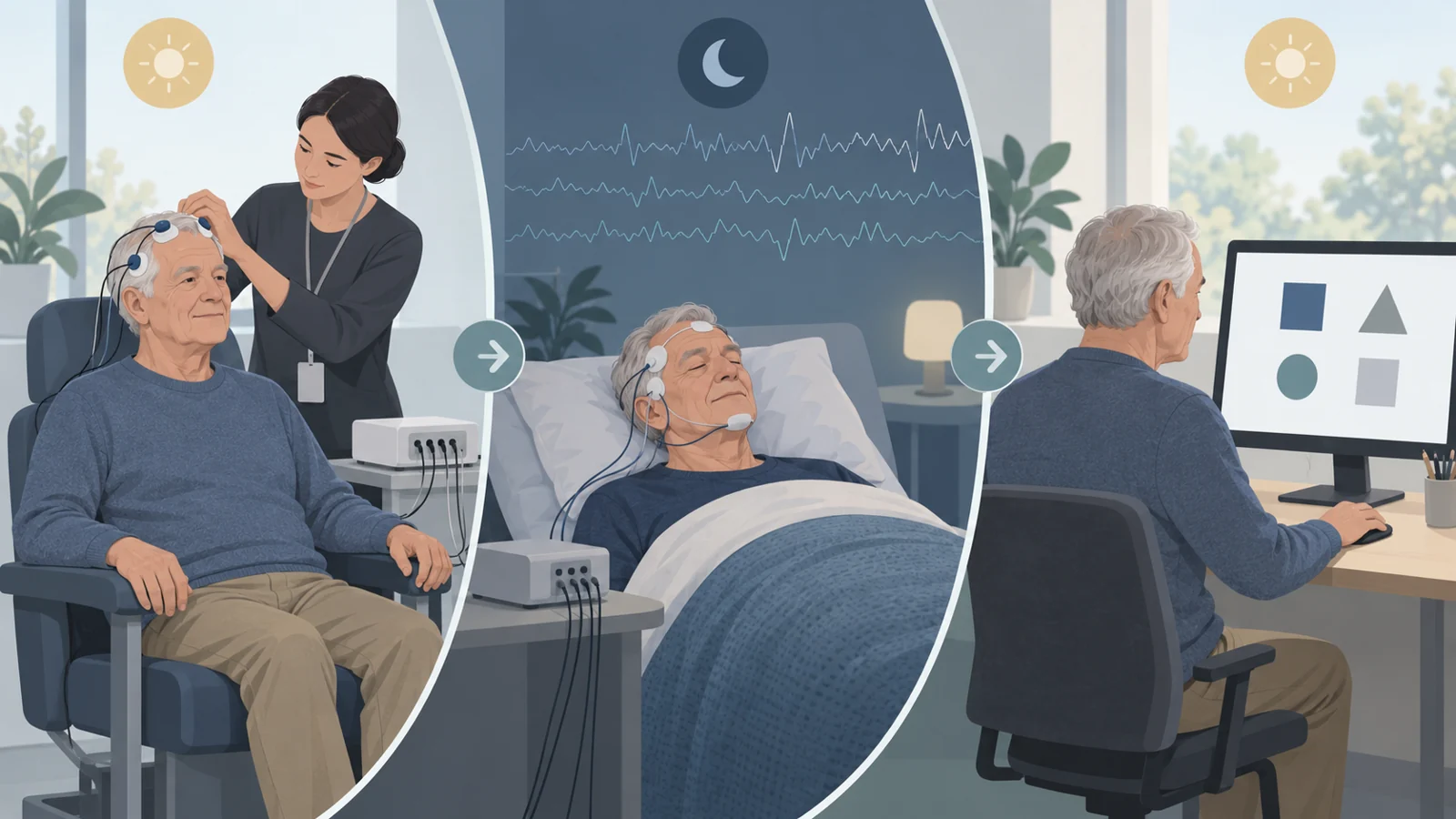
The timing creates a practical separation between the intervention and the sleep it is meant to influence. Participants receive a 20-minute session, then take a supervised nap while researchers record brain activity with polysomnography, a laboratory method for measuring sleep. The setup therefore tests whether stimulation beforehand is followed by measurable changes during the nap, without requiring the device to remain active while the participant sleeps.
The study description presents this as a question about linked outcomes. Sleep patterns are the immediate physiological target, while memory and attention tasks after the nap provide a separate test of whether any change in sleep is accompanied by a change in performance.
The trial compares each person with a placebo condition
The current record describes a randomized, placebo-controlled crossover design. In plain language, participants encounter both the active and placebo versions of the session, allowing the comparison to be made within the same overall group rather than between entirely different groups. The active condition is specified as 20 minutes of tDCS at 1.2 mA. The placebo condition is designed to provide the comparison session described in the registry.
The schedule also addresses whether repetition matters. The active and placebo conditions are each described as taking place over two consecutive days, and the study asks whether two sessions produce more change than one. That is a different question from whether a single pre-nap session has any measurable association with sleep or post-nap task performance. A second session could matter if the relevant effect depends on repeated exposure, but the registration only establishes that this possibility is being tested.
Across the study visits, participants complete computer-based memory and thinking tasks, receive active or placebo stimulation, take a monitored nap and complete additional sleep monitoring at home. A lightweight watch and daily sleep diaries are also part of the described study period. These procedures help place the short laboratory nap within a broader record of sleep and movement, while the central comparison remains the active-versus-placebo crossover.
Sleep recordings and memory tests answer different questions
The sleep outcomes are not simply a report of whether participants felt rested. The registry specifies measurements of sleep spindles and slow-wave activity during the nap. For a general reader, spindle density describes how frequently the specified spindle patterns occur during sleep, while spindle amplitude describes how large those recorded patterns are. Slow-wave density similarly concerns how often slow waves occur, and slow-wave amplitude concerns their measured size.
These recordings address what the sleeping brain is doing. The cognitive outcomes address what participants can do afterward. Verbal declarative memory is assessed by recall in a word-learning task. Attention is assessed through reaction time and accuracy. Additional measures cover picture memory and location memory, with performance compared before the stimulation and nap with performance 15 minutes after the nap.
That before-and-after structure matters because a post-nap score is interpreted relative to the participant’s own earlier performance. A change in a sleep recording could indicate that the nap’s physiology differed between conditions, while a change in recall, response speed or accuracy would indicate a behavioral difference on a specific task. The two types of observation are related, but they are not interchangeable. Better-looking sleep waves would not automatically show better memory, and a task-score change would not by itself identify which aspect of sleep produced it.
What the small study can and cannot establish
The current record reports 12 actual participants, all within the study’s healthy-adult, age-60-plus population. That scope is important when interpreting the design. It studies sleep and cognition in healthy older adults; it does not establish benefits for people living with dementia or for older adults generally.
The registered outcomes are measured during the nap or shortly afterward. This allows the researchers to examine immediate sleep physiology and near-term performance, but it is a limited timescale for questions about everyday cognitive function. Even a reproducible improvement on a task 15 minutes after a nap would not establish durable memory benefits, protection against dementia or a lasting change in brain health.
The completion date in the current record also should not be confused with a positive result. Completion means the registered study period is recorded as finished; it does not establish efficacy, safety, successful masking or an advantage for two sessions over one. The supplied material also does not establish the electrode montage, washout schedule, masking details, adverse-event findings or statistical analysis. Those are verification limits for this evidence package, not claims that the full protocol lacks such information.
The most defensible conclusion from the registration is therefore narrow. It defines a controlled way to ask whether stimulation before a daytime nap changes objective sleep measurements and whether those changes coincide with performance differences in memory and attention. It does not provide treatment-effect estimates.
What a simpler nap-based intervention could offer older adults
A successful version of this approach could eventually give older adults a relatively brief daytime way to support sleep-related memory processes without delivering stimulation during sleep. That possibility depends on several conditions: cognitive gains would need to be reproducible, the intervention would need acceptable safety, and the procedure would need to work outside the tightly supervised laboratory setting used for the trial.
The potential appeal is practical as well as scientific. A pre-nap session could fit around a monitored daytime rest rather than requiring stimulation throughout nighttime sleep. But the registry’s proposed convenience and low burden are still possibilities, not demonstrated implementation or economic outcomes. The completed study record supplied here provides no evidence that the proposed benefit was realized.
Key Sources
- Primary source: Evaluating the Effects of tDCS on Sleep and Cognition in Healthy Older Adults
Government or Regulator · Clinical Trial · 2025-04-22