
Evidence date · 2025-09-04 · Research note 2 of 2
1 2
See current Track status →
Since the previous research note · Earlier expectation not tested
Track continuity
Since the previous research note: What did a placebo comparison reveal about taking dasatinib and quercetin for lung scarring?
Previous expectation: Dasatinib and quercetin might help people with pulmonary fibrosis preserve breathing and everyday activity if larger, longer trials establish meaningful benefit and acceptable harm.
What this study adds: The September 2025 source introduces chemically optimized flavonols, including F-4N, with selective apoptosis findings in cultured lung fibroblasts and fibrosis-resolution findings in mice. It supplies a different candidate-development approach without testing the earlier forecast about patient outcomes from dasatinib and quercetin.
What changed in this study
Idiopathic pulmonary fibrosis is a progressive lung disease in which scar tissue accumulates between the air sacs and makes breathing increasingly difficult. Aging is the strongest known risk factor, and current treatments can slow decline without reliably reversing established fibrosis.
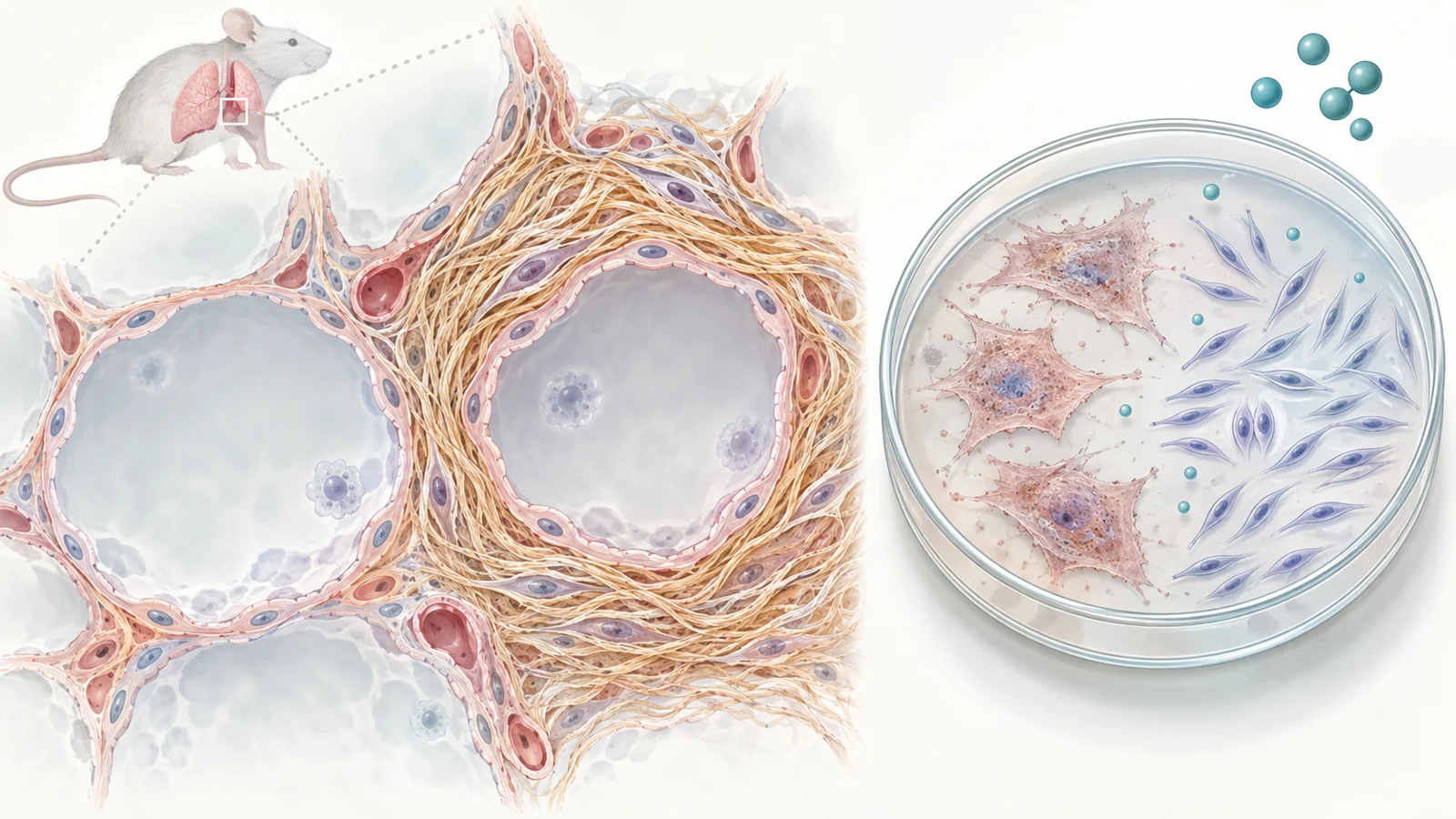
A study published on September 4, 2025, tested whether a redesigned, plant-inspired compound could do more than affect isolated cells. The researchers treated aged mice after lung injury had already produced persistent fibrosis. Their candidate, F-4N, reduced measured collagen burden and changed several markers associated with senescence and alveolar repair. The findings are important because treatment began after scarring was established, but they remain experimental results from cells and mice.
Senolytic compounds are drugs designed to kill senescent cells, which are cells in a persistent growth-arrested state. The central idea behind this study is that some senescent lung cells may continue sending signals that sustain fibrosis. Removing them could alter the environment around damaged tissue. The difficult question is whether a stronger cell assay translates into less scarring and genuinely useful lung recovery.
A mouse experiment that started after scarring took hold
The most direct test began in aged mice. Researchers first gave the animals bleomycin, a chemical injury used to produce chronic, nonresolving lung fibrosis in this experimental setting. They waited 14 days, allowing the injury and scarring process to become established, and then began daily intraperitoneal treatment with 10 mg/kg of F-4N or vehicle for another 14 days.
The endpoint measurements answered different parts of the question. Histology showed whether the overall lung architecture and visible collagen staining looked improved. Hydroxyproline measurement provided a quantitative assessment of lung collagen content. Survival indicated whether the intervention was associated with a whole-animal outcome rather than only a molecular change. Lung gene-expression measurements added information about the biological programs active in the tissue.
Compared with vehicle-treated mice, the F-4N group showed improved survival, better lung architecture and a marked reduction in collagen staining. The researchers reported a nearly complete resolution of the measured lung collagen burden in that experiment. Transcripts associated with extracellular-matrix production and senescence were lower, while markers associated with alveolar regeneration and repair were higher. A circulating senescence-associated marker, IL-6, also moved close to normalization.
The study included a separate young-mouse model in which bleomycin was administered repeatedly over six weeks. F-4N treatment began after the final injury and used the same general daily-treatment approach. The authors described improvements in body mass, lung architecture, collagen content and whole-lung gene expression in that model as well. Its schedule and animal context were different from the aged-mouse experiment, so the findings should be kept distinct rather than combined into one result.
Plant compounds became starting points for redesign
The researchers did not treat quercetin or fisetin as finished therapies. These naturally derived flavonols helped establish that certain plant compounds can selectively trigger apoptosis in senescent cells, but the paper describes important development problems. In cultured lung fibroblasts, the natural compounds showed senolytic activity only at concentrations above 30 micromolar. The authors also point to poor bioavailability and rapid metabolism as limitations for translation.
Medicinal chemistry therefore began with the useful features of these molecules and tried to improve their potency, selectivity and drug-like properties. An intermediate compound, F-19, was particularly informative. A para-ethoxy substitution on the flavonol’s B-ring was associated with strong senolytic activity, while a closely related para-methoxy version did not show observable activity in the same comparison. The researchers used these structure–activity patterns to refine the scaffold rather than reproduce a natural compound unchanged.
The final candidate highlighted in the study was F-4N. In the apoptosis assay, its reported EC50 in senescent human lung fibroblasts was 900 nanomolar. An EC50 is the concentration associated with half-maximal response in that assay; it is a laboratory potency measurement, not a dose for treating people. F-4N also produced a reported 61.1-fold senolytic window, meaning the concentration needed to trigger apoptosis in proliferating fibroblasts was much higher than the concentration needed in senescent fibroblasts.
The authors reported approximately 50-fold greater in vitro senolytic potency for F-4N than for fisetin or quercetin. That comparison describes performance in the tested assay. It does not establish a 50-fold increase in antifibrotic benefit, and the selectivity ratio is not a clinical safety margin. A compound can behave selectively in cultured fibroblasts while having different exposure, distribution and toxicity characteristics in a living organism.
Lung tissue added context to the cell assay
An isolated fibroblast culture cannot show how different lung cell populations interact inside organized tissue. To add that context, the study used precision-cut lung slices, which preserve native lung architecture for short experiments. F-19, the precursor compound rather than F-4N, was tested in slices from aged mouse lungs with or without bleomycin-induced fibrosis.
In those slices, F-19 reduced expression of Col1a1, one of the genes encoding type I collagen, compared with vehicle. The experiment also included nintedanib as a comparison for these molecular readouts. Relative to vehicle and nintedanib, F-19 reduced several senescence-associated markers, including Cdkn2a, Cdkn1a and Il6. It also increased Sftpc and Hopx, markers associated with mature alveolar epithelial cells.
These groups of measurements carry different information. Lower collagen-related transcripts suggest reduced activity of a matrix-producing program. Lower senescence-associated markers suggest a change in the abundance or state of cells expressing those markers. Higher mature alveolar epithelial markers suggest a shift toward a more differentiated air-sac lining program. They do not, by themselves, show that a complete air-sac structure has been rebuilt or that breathing has improved.
The researchers also separated fibroblast and epithelial populations from injured mouse lungs after F-19 treatment. In both populations, senescence-associated genes such as p16 and p21 were reduced. Other genes linked to extracellular matrix, inflammatory senescence-associated signals and abnormal epithelial populations found in fibrotic lungs also moved toward a less pathological pattern. Mature alveolar markers increased. Looking at separated cell populations helped show where these molecular changes appeared, but it still did not turn marker expression into a direct measurement of functional lung recovery.
The chemistry improved the test result before it answered the mechanism
The progression from natural flavonols to F-19 and then F-4N made the candidate-development story more specific. It showed that small structural changes could alter how strongly and selectively a compound induced apoptosis in senescent lung fibroblasts. The para-ethoxy feature appeared repeatedly in the authors’ analysis as a driver of potency and selectivity.
The biological target remained unresolved. The authors discuss the possibility that the substitution improves target selectivity rather than simply increasing nonspecific chemical activity. They also note that natural flavonols can affect multiple biological targets, making it important to identify which target or targets account for F-4N’s senolytic behavior. Until that work is done, the compound is best understood as a potent experimental probe and a starting scaffold for future candidates, not as a validated medicine with a defined mechanism.
The same caution applies to the repair-associated results. Removing senescent cells could reduce signals that interfere with alveolar stem or progenitor-cell activity. Clearing a senescent population might also open a local epithelial niche that permits nearby cells to begin a repair program. The authors additionally consider the possibility that flavonols could increase regenerative markers through an effect separate from senolysis. The current findings do not identify which explanation is correct.
What this could change
For people living with pulmonary fibrosis, the valuable future capability would be a tolerable treatment that reaches effective exposure, reduces established scar tissue and supports recovery of damaged air-sac lining. That would matter most if the tissue changes ultimately preserved or improved breathing and everyday function in patients.
F-4N does not yet provide that clinical capability. At the study’s September 4, 2025 publication, evidence for F-4N included selective apoptosis in cultured human lung fibroblasts and fibrosis studies in bleomycin-injured mice; the lung-slice and separated-cell-population experiments described above tested F-19. Translation to a human treatment would require evidence of suitable exposure, acceptable safety and meaningful functional benefit in people. Identifying F-4N’s molecular target and determining what drives the repair-associated marker changes remained research questions at publication.
Key Sources
- Primary source: Optimized Synthetic Flavonols Support Senescence Clearance and Lung Fibrosis Resolution.
DOI or Journal Page · Peer-Reviewed Paper · 2025-09-04