
Evidence date · 2023-03-20 · Research note 2 of 2
1 2
See current Track status →
Since the previous research note · Earlier expectation not tested
Track continuity
Since the previous research note: What six months of home light and sound therapy could reveal about Alzheimer’s disease
Previous expectation: Sustained home light and sound stimulation might become a practical treatment for people with Alzheimer's disease if it produced meaningful cognitive benefit with acceptable safety and manageable daily use.
What this study adds: The supplied registry description addresses a prevention question in people with normal memory, family history and cerebral amyloid deposits, using a described 12-month home regimen. It does not supply outcome evidence testing the earlier treatment forecast.
What changed in this study
The idea behind this study is straightforward but demanding: could repeated light and sound stimulation help address Alzheimer’s-related changes before memory problems appear?
The people being studied are at least 55 years old, have normal memory, and have a close family member who has or had Alzheimer’s disease. The study is therefore testing a prevention question in people who are cognitively well, not a treatment for people who already have dementia. The registry item is dated March 20, 2023. That date identifies the publication provenance of the item here; it does not establish when every detail in the mutable record was first entered, or mark a recruitment, study-start or results milestone.
The prevention question begins before memory loss
The study asks whether intervention before memory symptoms could help people who already have evidence of Alzheimer’s-related pathology. Participants must have normal memory and a close family member who has or had Alzheimer’s disease; screening then selects those with amyloid deposits in the brain to continue.
That focus matters because a preventive intervention would need to be used before everyday memory problems become obvious. The registry description does not present this as an established way to prevent dementia. It describes a test of whether a year of repeated stimulation can reduce Alzheimer’s-related pathology in a selected group.
What the 40-cycle rhythm is meant to test
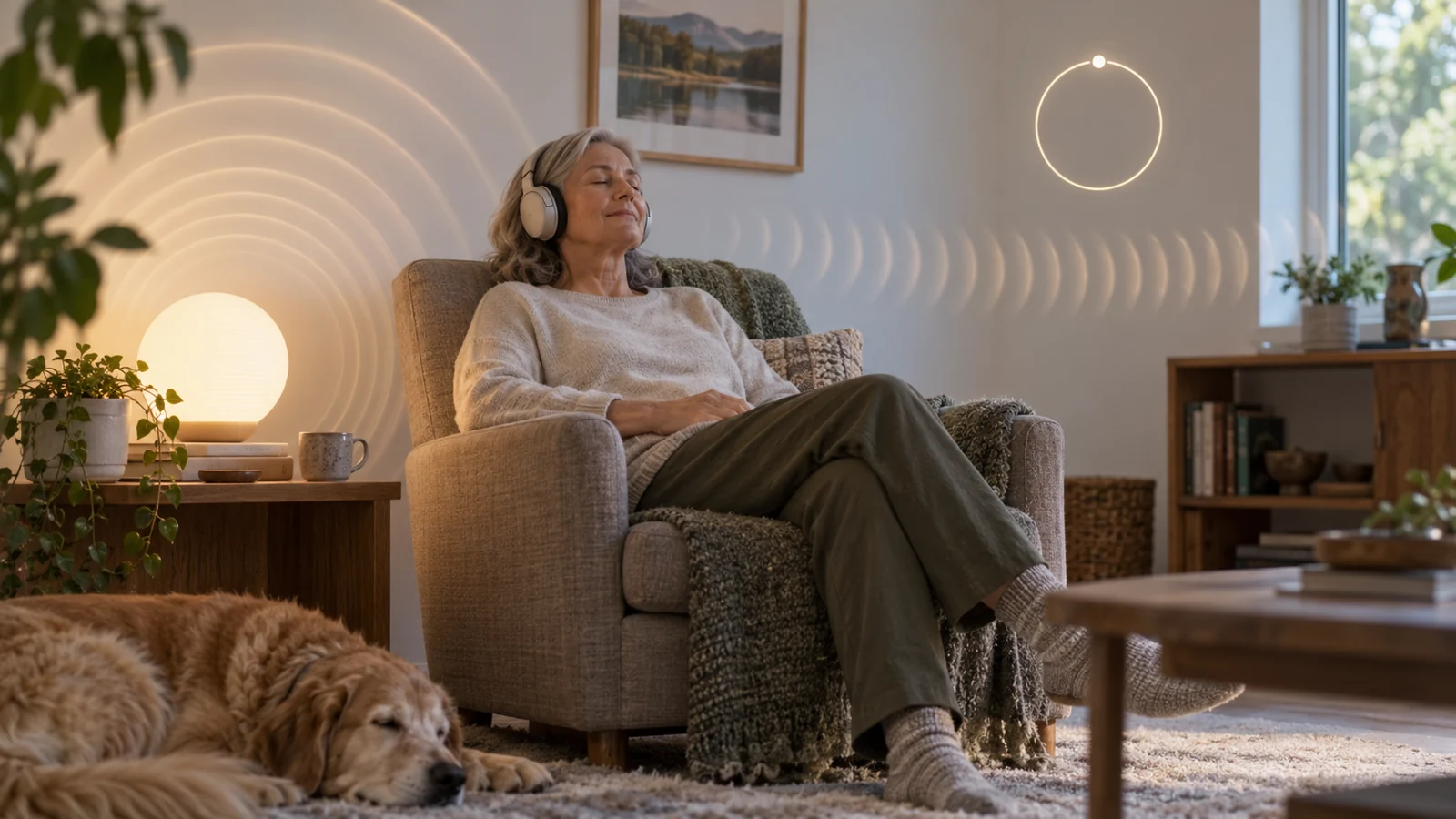
The light-and-sound setup is designed to stimulate the brain at 40 Hz, meaning 40 cycles per second. The investigators connect this frequency with gamma waves, a brain rhythm associated in their description with memory. They also state that people with Alzheimer’s disease have fewer gamma waves, and cite mouse-model findings of reduced amyloid and tau alongside improved memory after 40 Hz stimulation.
Those mouse findings are the study’s rationale, not human results. The human trial is intended to test whether the same general approach produces measurable changes in people at risk. The sensory stimulus is thus the intervention being evaluated; the biological explanation remains a proposition carried into the clinical study.
Screening narrows a broad risk group
Family history is the entry point, but it is not the final condition for continuing. The described plan begins with blood testing for 200 people. A subset then undergoes amyloid PET imaging, and only 50 people with cerebral amyloid deposits continue in the study.
This sequence creates a more specific study population than the initial eligibility description suggests. Normal memory and a close family history identify people who may be at risk, while the imaging step selects those who also have the particular brain finding the investigators want to follow. The planned numbers describe the intended pathway, not confirmed enrollment, adherence or completion.
A year of daily use creates the comparison
Participants are asked to use the device at home for 60 minutes each day while awake, over 12 months. They are expected to visit Massachusetts General Hospital four to six times, including visits before stimulation, around six months and after the year of use. The described assessments include PET scans, MRI, EEG, blood tests, memory tests and questionnaires. Participants also wear a watch that monitors sleep and activity, and may choose to provide cerebrospinal fluid for study.
The comparison depends on concealment. Neither participants nor investigators are described as knowing whether the device provides active or sham stimulation. That arrangement allows changes in the active group to be compared with changes under the sham condition without either side knowing which experience a participant received. The supplied description does not establish an allocation ratio, randomization subtype or sham design, so those details should not be inferred.
What the design can and cannot tell us
The planned comparison and 12-month exposure are capable of testing a question, but they are not themselves evidence that dementia was prevented. The registry description provides the study’s rationale, screening plan, regimen and intended measurements; it does not provide participant outcomes showing that memory improved, amyloid or tau changed, or dementia risk fell.
The investigators describe the device as suitable for safe home use, but that statement is not a safety result for this population. A meaningful interpretation would require actual information about who enrolled, who completed the schedule, how consistently the device was used, what the active-versus-sham results were, and whether any effects lasted beyond the intervention period. Until those findings are available, the study establishes an evaluation plan rather than a demonstrated preventive treatment.
What this could change
For people who still have normal memory but meet the study’s risk criteria, the practical promise is a home-based intervention that could help preserve cognition before symptoms emerge. The possibility depends on evidence of meaningful preventive benefit, acceptable safety and a schedule people can sustain. Even a positive result in this selected group would need careful interpretation before it could be extended to people with different risk profiles.
Key Sources
- Primary source: Gamma Light and Sound Stimulation to Prevent Dementia in Cognitively Normal People at Risk for Alzheimer's Disease
Government or Regulator · Clinical Trial · 2023-03-20