
Research Signal – Source date 2021-07-06
Kidney transplantation can be life-changing, but the supply of donated organs remains smaller than the number of people who need one. Expanding access often means considering kidneys from older donors or donors whose organs have endured periods without a normal blood supply. Those organs may be more vulnerable to injury after transplantation, including primary non-function, delayed graft function and poorer long-term performance.
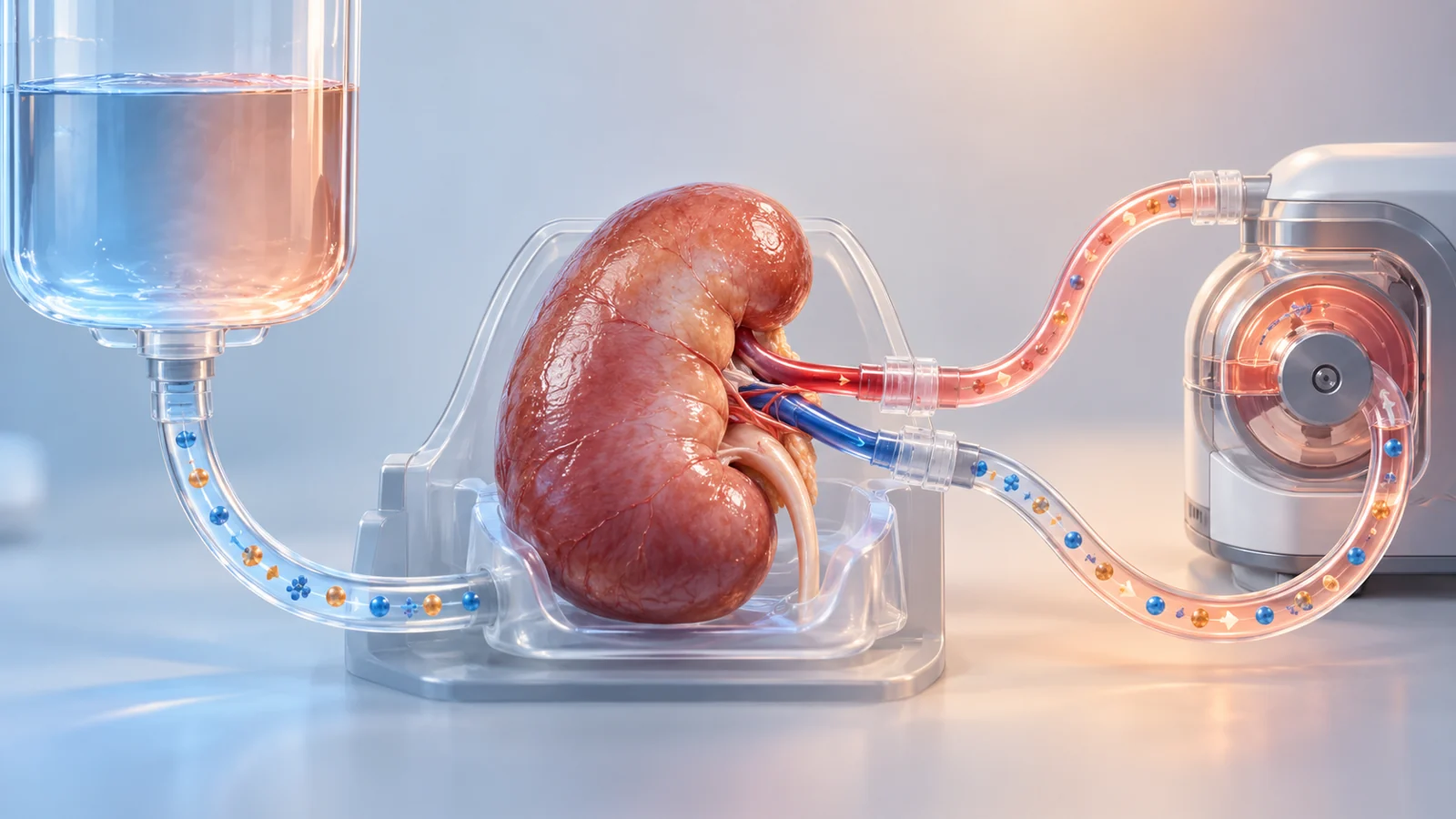
A review published on July 6, 2021, considers whether the interval between donation and transplantation could become more than a holding period. It examines machine perfusion, meaning the circulation of a carefully prepared fluid through a kidney outside the body, as a possible setting for assessing and treating the organ. The idea is appealing because a treatment could be directed at the kidney while it is isolated. The evidence, however, comes from different species, compounds, delivery routes and outcomes. It is a collection of promising approaches, not one established treatment.
The injury begins before blood flow returns
Ischaemia-reperfusion injury develops around the interruption and restoration of blood flow. A kidney removed from a donor loses its usual supply of oxygen and nutrients. Cooling and storage help preserve cell viability, but they do not make the period of deprivation biologically neutral. When circulation is restored in the recipient, the return of oxygen and blood flow can trigger a burst of reactive oxygen molecules, calcium overload, disruption of mitochondrial function, endothelial dysfunction and inflammatory or coagulation responses.
These processes can impair the kidney at several levels. Mitochondria are central to cellular energy production, so their disruption can leave tissue less able to resume normal work. Activated immune and vascular responses can add further stress to already vulnerable structures. The review describes stronger evidence of inflammatory, complement and defence-related activity in kidneys from deceased donors than in comparable living-donor material, while prolonged cold ischaemia can worsen the eventual transplant outcome.
This biology helps explain why preservation and treatment are related but different tasks. Cooling can reduce metabolism and slow deterioration. A protective compound might instead act on oxidative stress, complement activation, inflammation or another pathway involved in injury. The proposed opportunity is to combine those functions without exposing the whole donor or recipient to the same intervention at the same time.
Preservation is becoming an active treatment setting
Static cold storage remains a widely used way to preserve deceased-donor kidneys. The organ is placed in a cold solution and transported, with low temperature reducing cellular activity. Hypothermic machine perfusion adds a circulation system to the cold setting. The pump moves preservation fluid through the kidney and can provide information about how the organ behaves during storage.
Hypothermic oxygenated machine perfusion adds oxygen to that circuit. Even at roughly 4 to 10°C, cells retain some metabolism, and oxygenated perfusion is intended to support that residual activity. In rodent and pig models discussed by the review, oxygenated cold perfusion was associated with counteracting endothelial dysfunction, reducing macrophage activation and improving mitochondrial metabolic pathways. Early clinical experience and retrospective comparisons had begun examining delayed graft function and other measures of renal function, but these observations do not identify one universally superior preservation strategy.
Normothermic machine perfusion works at a temperature closer to normal body conditions. Its value is not only that drugs may behave more like they would in living tissue. The platform can also allow researchers to observe urine production, renal resistance and biochemical measures while the kidney is being perfused. Those observations create an opportunity to judge aspects of graft function before transplantation and to deliver a compound while cells and tissues remain biologically active.
The perfusate, or circulating fluid, is therefore part of the intervention rather than a neutral carrier. Whole blood can reproduce some features of physiological circulation in animal experiments, but the review describes practical and biological concerns about using it in human normothermic perfusion, including haemolysis, platelet activation and the inflammatory, complement and coagulation activity associated with reperfusion. A clinical perfusion fluid must support circulation and oxygen delivery while avoiding a new source of injury. Temperature, oxygenation, composition and the timing of exposure all change the treatment question.
The review groups the possible functions of machine perfusion into four broad aims: resuscitation, repair, rejuvenation and regeneration. Those terms describe a range of ambitions, from supporting a stressed kidney to trying to improve its condition before implantation. They do not mean that every perfused kidney can be restored or that a drug added to the circuit will produce a durable clinical benefit.
Animal studies show the idea in different ways
One of the clearest comparisons in the review comes from a porcine autotransplantation experiment involving quercetin and sucrose during oxygenated hypothermic perfusion. Kidney grafts were divided into three preservation groups. One underwent 24 hours of cold storage. A second underwent 22 hours of cold storage followed by two hours of hypothermic oxygenated perfusion with a preservation solution. The third followed the same storage and perfusion schedule, with quercetin and sucrose added to the perfusion solution.
The reported comparison gives the treatment idea a concrete shape. It separates ordinary cold storage from oxygenated machine perfusion, then asks whether adding compounds to that perfusion step changes the result. The quercetin-plus-sucrose group was associated with improved renal function, reduced oxidative stress and less parenchymal damage in the porcine model. Because the experiment involved an autotransplantation setting, a pig model and a specific schedule and solution, its findings show what happened under those conditions. They do not establish a human dose, a general benefit for all perfusion systems or a longer-lasting graft effect after clinical transplantation.
A different example concerns metformin during ex vivo normothermic machine perfusion of rat and porcine kidneys. The review describes both preconditioning and postconditioning approaches during warm perfusion. In those experiments, the interventions could be performed safely and were associated with improved kidney quality in the reported animal settings. The example matters partly because it is not the same test as the quercetin experiment: the compound, species, temperature, timing and outcome framing differ.
Taken together, the animal work supports the feasibility of asking whether a preservation circuit can carry a biologically active treatment. It does not select a best compound or show that a favorable laboratory or transplant outcome will translate directly to people. Each result remains attached to the organ model and perfusion conditions in which it was observed.
Mirococept brings the organ-directed route closer to clinical testing
The review gives complement inhibition a more developed path from animal work to human research. In a rat experiment, donor kidneys were perfused with APT070, also known as Mirococept, before 16 hours of cold storage and transplantation into compatible recipients. Compared with control kidneys that underwent cold storage, the Mirococept-perfused grafts had more than twofold higher survival rates in that experiment.
The next step described in the review was EMPIRIKAL, a multicentre randomized controlled trial in which Mirococept was administered ex vivo to deceased-donor kidneys. Its aim was to evaluate whether the treatment could reduce delayed graft function. The review also describes evidence of safety and feasibility for this organ-directed approach. Those are important translation milestones, but they are not the same as evidence that the trial demonstrated a reduction in delayed graft function. The passage supports the trial’s efficacy question and its safety and feasibility evidence, not a completed efficacy conclusion.
A recipient-treatment example shows why the route of administration matters. C1-inhibitor treatment had been studied in the donor or recipient context to reduce inflammation and delayed graft function. In recipients of kidneys from donation after circulatory death, intraoperative C1-inhibitor treatment did not reach its primary endpoint for delayed graft function, although the review reports reductions in the need for dialysis and improvements in long-term allograft outcomes. Its later discussion also associates the treatment with a lower incidence of graft failure in an updated long-term outcome definition.
Those findings cannot be transferred automatically to a kidney perfusion circuit. A compound given to a donor, during an operation or to a recipient encounters a different biological environment from the same compound delivered through an isolated organ. The review specifically distinguishes the recipient and donor strategies from the question of adding C1-inhibitor to a renal perfusion solution, for which it describes no renal perfusion-solution data. A related liver perfusion experiment with C1-inhibitor is not evidence that the same approach works in kidneys.
The central uncertainty is consequently more specific than whether a drug has ever shown a protective signal. Researchers must determine whether the compound reaches the relevant kidney structures during perfusion, whether the exposure is safe for a graft that will later be transplanted, and whether changes seen during preservation lead to meaningful and durable post-transplant benefit. The reviewed studies do not provide one answer across all drugs, temperatures, perfusates or donor-organ conditions.
A preservation circuit changes the timing of treatment
The review separates three possible intervention points. Treatment can begin in the donor before organ removal. It can occur ex vivo while the kidney is isolated on a perfusion machine. Or it can be delivered after implantation in the recipient. These routes address overlapping injury pathways, but they are not interchangeable experiments.
Ex vivo delivery has a distinctive practical appeal. It offers a contained interval in which a kidney can be perfused, observed and exposed to a candidate treatment without making the entire recipient the first test environment. Warm perfusion may provide more direct functional readouts, while cold or oxygenated cold perfusion may be useful when the preservation goal is to reduce metabolic stress. Yet the same isolation that makes the route attractive also creates technical questions about distribution, timing and the relationship between perfusion measurements and later graft performance.
That is why the 2021 review is best read as a guide to the treatment setting rather than as a verdict on a particular drug. It connects the mechanisms of ischaemia-reperfusion injury with preservation technologies and then follows selected compounds into animal experiments and early clinical translation. Its contribution is to show where an intervention might fit: before donation, during isolated preservation or after transplantation. The evidence remains too varied to support a single protocol or a class-wide claim of improved long-term human graft survival.
What this could change
A reliable organ-directed treatment could make some kidneys that currently carry greater injury risk more usable for transplantation. That could expand the pool of functioning grafts and give more people waiting for a kidney access to a transplant.
Such a future depends on more than showing that a compound changes a perfusion measurement or improves an animal outcome. The treatment would need to produce a meaningful, durable benefit after transplantation while maintaining acceptable safety. From the perspective of July 2021, machine perfusion offered a plausible place to test that possibility, but the practical benefit for patients remained conditional on successful clinical translation.
Key Sources
- Primary source: Renal Delivery of Pharmacologic Agents During Machine Perfusion to Prevent Ischaemia-Reperfusion Injury: From Murine Model to Clinical Trials.
DOI or Journal Page · Review or Meta-Analysis · 2021-07-06
Keep exploring