
Research Signal – Source date 2021-01-01
A supplement can produce a measurable change in one part of the brain without producing the same change everywhere else. A 2021 paper examined that possibility through a secondary analysis of previously completed guanidinoacetic acid supplementation trials, asking which brain regions showed increased creatine and how many participants crossed a study-specific response threshold.
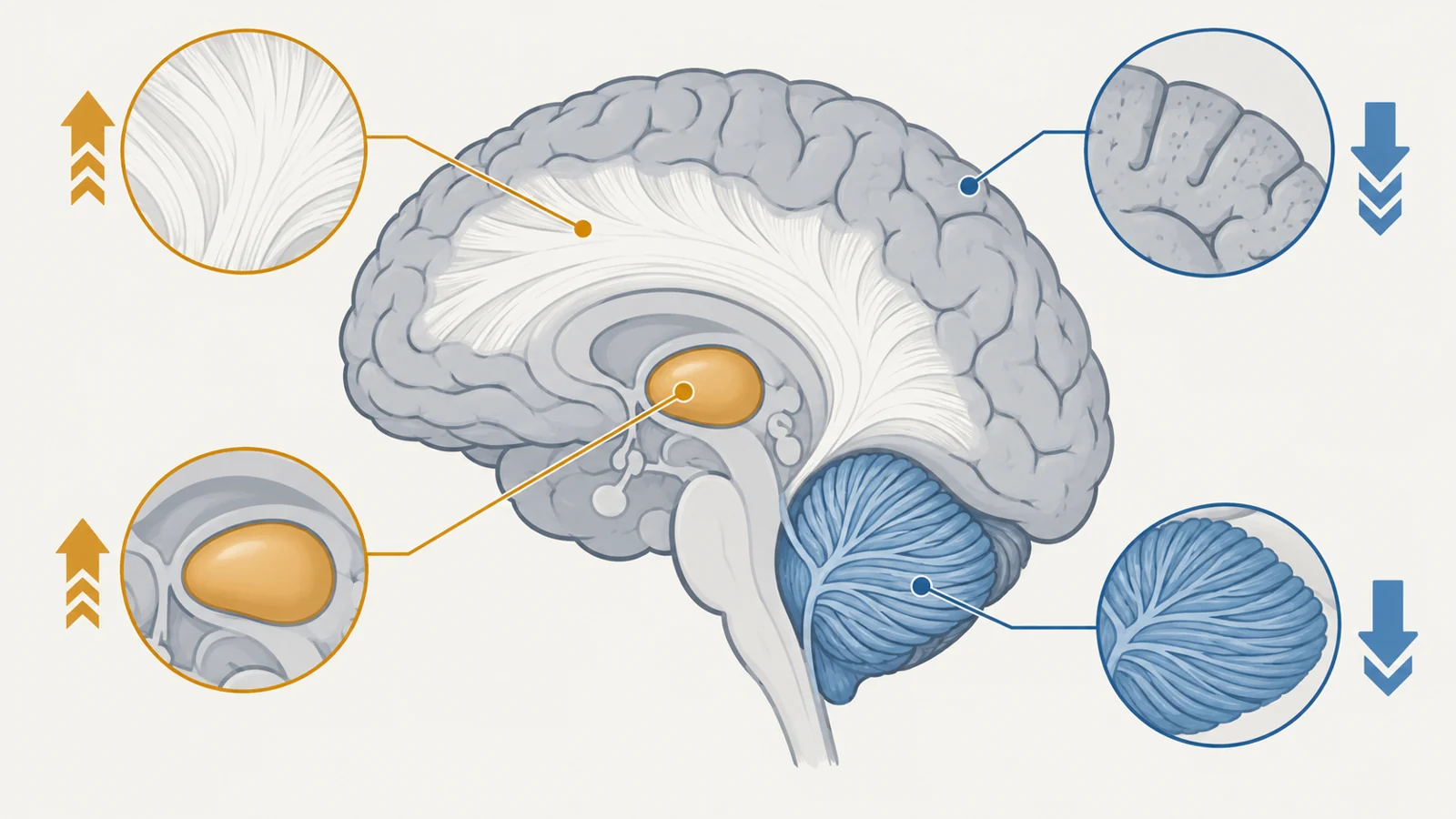
The analysis involved 19 healthy men with a mean age of 24.8 years. They received 3 grams per day of guanidinoacetic acid for four weeks. Researchers used 1.5 T magnetic resonance spectroscopy to estimate total creatine in four sampled locations: the cerebellum, white matter, grey matter, and thalamus.
The scan found a regional split
The average changes did not point in one direction across all four measurements. After 28 days, total creatine rose by 17.3% in the cerebellum, with a 95% confidence interval of 9.7% to 24.9%. It increased by 12.1% in white matter, with an interval of 5.1% to 19.1%, and by 8.9% in grey matter, with an interval of 5.2% to 12.6%.
The thalamus showed the opposite average pattern: total creatine decreased by 9.1%, with the reported confidence interval for the decrease ranging from 6.8% to 11.4%. White matter and grey matter here refer to tissue categories measured in the brain, not to separate organs. The measurements also describe selected regions, rather than a single whole-brain creatine total.
These figures are regional averages. They describe the direction and size of the measured change across the group, but they do not show whether every participant changed in the same way.
Averages and responders answer different questions
The paper also classified participants as responders or non-responders. In this analysis, a responder was someone whose measured increase in a particular region crossed the study’s threshold. That label describes a measurement rule; it does not mean the person experienced better cognition, fewer symptoms, improved everyday functioning, or better health.
The responder percentages varied by location. The cerebellum had the highest proportion, at 73.6%. White matter followed at 47.3%, and grey matter at 42.1%. In the thalamus, only 10.5% of participants—two people—experienced a relevant rise at the 28-day follow-up.
A region can therefore have a sizable group-average increase without most participants meeting the responder definition, or it can show a low average alongside a small number of individual increases. The percentages also do not establish that the same people responded in every region. The exact cutoff used for classification is not established in the material reviewed here, so the responder figures should be read as study-specific categories rather than a general measure of benefit.
The boundaries around the finding
The study population was small and specific: 19 healthy young men measured over four weeks. That makes the result useful as an observation about short-term regional creatine measurements, but it does not establish what would happen in women, children, older adults, or people with neurological or psychiatric illness. It also does not establish long-term safety, persistence after supplementation stops, or a clinical effect.
The supplied study details do not establish the comparator allocation, randomization, blinding, exact response cutoffs, or the comparison underlying the reported P value. Those uncertainties matter when judging how broadly the percentages can be interpreted. The analysis also provides no verified quantitative head-to-head comparison that would support saying guanidinoacetic acid is superior to creatine supplementation.
Most importantly, the measured chemical changes were not the same thing as a functional outcome. Magnetic resonance spectroscopy provided estimates of total creatine in sampled regions; it did not, on its own, show that the changes improved thinking, movement, symptoms, or daily life. Nor does the decrease measured in the thalamus establish that the change was harmful. The regional pattern is an observation that needs replication and further testing, not a treatment result.
What this could change
Regional effects could eventually support more targeted ways of studying impaired brain energy metabolism. For people whose illness involves a problem in brain energy handling, an intervention designed to raise creatine in a relevant region might be more useful than one assumed to affect the brain uniformly.
That possibility remains conditional. The regional differences would need to be reproduced, shown to be safe, and linked to useful functional outcomes in relevant patients before they could support a clinical strategy. The immediate contribution of this analysis is narrower but important: it shows why a single whole-brain claim can hide meaningful differences between locations and between individual responses.
Key Sources
- Primary source: Guanidinoacetic acid loading for improved location-specific brain creatine.
DOI or Journal Page · Clinical Trial · 2021-01-01
Keep exploring