
Research Signal – Source date 2024-12-18
A material intended to help repair tissue may need to do several jobs at once. It might carry a drug, provide a surface that cells can interact with, withstand physical forces and gradually break down. Making one of those functions stronger can change the others. Faster breakdown, for example, also changes how quickly the material releases its ingredients.
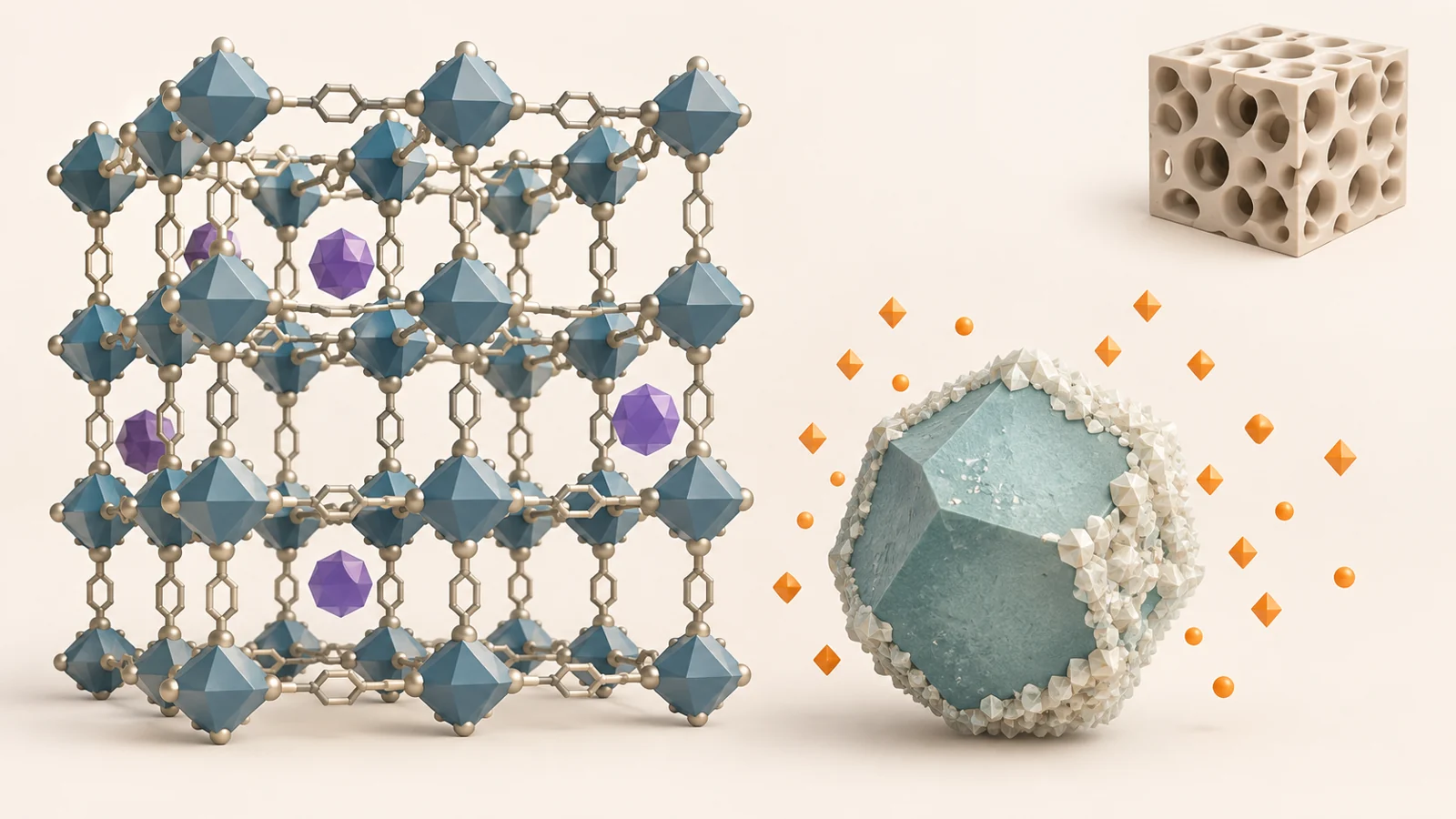
A review published on December 18, 2024, examines a developing approach to this problem: combining metal-organic frameworks, or MOFs, with bioactive glasses. MOFs are porous structures that can carry molecules. Bioactive glasses react with surrounding fluids and release ions that can influence biological processes. Together, they give researchers several ways to adjust a material’s behavior.
The publication brings together comparisons of the two material families, composite designs, hydrogel applications and antibacterial mechanisms. Its contribution is to explain how these functions can be combined and what experimental studies have achieved. It does not establish that the resulting materials are effective treatments in people.
What each material brings to the combination
A MOF consists of metal-containing connection points joined by organic molecules called linkers. The resulting crystalline structure contains pores. Changing the metal, linker or structure can alter the space available for cargo and the chemical environment that cargo encounters. This tunability is part of the attraction for drug delivery.
Yet loading a material with a drug is only part of the task. The framework must remain intact for an appropriate period and release its contents in a useful way. Rapid or poorly controlled degradation can undermine that function. The choice of metal and linker also affects how the material interacts with cells; porosity alone says little about biological suitability.
Bioactive glass contributes a different set of properties. Its composition can be based on silicates, phosphates or borates. In contact with aqueous environments, including body fluids, suitable glasses can develop a hydroxyapatite surface layer associated with their interaction with surrounding tissue. The glass also releases ions as it dissolves. Depending on composition and exposure, these dissolution products can contribute to processes such as bone formation, blood-vessel formation or antibacterial activity.
The proposed pairing therefore connects molecular storage and release with an active material surface. It also offers ways to make MOFs easier to incorporate into useful structures. These roles overlap, however: some porous bioactive glasses can themselves carry drugs. Adding a MOF has to contribute something useful in the particular composite, such as a different release response or a change in mechanical behavior.
Shape changes what the chemistry can do
The review discusses scaffolds, coatings and hydrogels because the same ingredients can serve different purposes in each format. A scaffold provides a three-dimensional structure with openings. A coating places material at an exposed surface. A hydrogel incorporates components into a water-rich polymer network that can resemble aspects of the environment around cells.
Processing determines how the components are arranged and how the resulting structure behaves. In scaffold studies, researchers examine pore architecture, compressive strength, degradation and mineral formation. For coatings, the review describes mineralization and corrosion resistance among the relevant properties. These are different tests of usefulness, even when the materials share a chemical ingredient.
Hydrogels add another design variable. The review summarizes work in which incorporating MOFs and bioactive glasses improved mechanical stability, bioactivity or antibacterial behavior while maintaining compatibility with cells under the tested conditions. Their polymer networks offer a setting for combining release functions with tissue contact. Those findings apply to the formulations studied; a hydrogel, rigid scaffold and implant coating cannot be treated as interchangeable delivery systems.
A bone scaffold reveals the tradeoffs
One concrete example comes from a 2018 study summarized in the review. Researchers made 3D-printed scaffolds containing mesoporous bioactive glass, an iron-based MOF and the tuberculosis drug isoniazid, with osteoarticular tuberculosis as the intended application. The design brought local drug delivery and a material intended for bone repair into the same structure.
The glass had a measured surface area of 395 square meters per gram. That large internal surface helps explain the interest in such materials as carriers, although it does not by itself establish how well a drug will be delivered. At the larger structural scale, the printed scaffolds had pores about 400 micrometers across. Increasing the MOF content did not substantially alter that overall pore architecture.
Other properties did change. Higher MOF content increased compressive strength and accelerated scaffold degradation. It also lowered the pH of the simulated body fluid used in testing, which the review attributes most probably to acidic products released as the MOF broke down. The scaffolds retained surface bioactivity in that fluid across the tested MOF amounts.
This example makes the engineering problem tangible. Changing the mixture affected strength, breakdown and surrounding chemistry together. A stronger scaffold was not simply the same scaffold with a better strength score. The summarized study also reported sustained, pH-responsive drug release, giving researchers several linked behaviors to balance.
The endpoints need to be read separately. Mineral formation in simulated body fluid shows a surface reaction under laboratory conditions. A drug-release measurement describes delivery behavior. Neither alone establishes successful treatment of an infected bone defect in a person. The value of the experiment lies in showing which functions can coexist and how altering the formulation changes them.
Wound materials expose the importance of dose
Soft-tissue designs bring different demands into view. In a 2024 study discussed in the review, researchers incorporated bioactive-glass particles and ZIF-8, a type of MOF, into fibers made from two polymers, PCL and PVA. They produced the fibers using microfluidic electrospinning to create a scaffold intended for wound healing.
Adding the particles preserved the interconnected fiber network but increased surface roughness and tensile strength. The fibers also stretched less before breaking. That combination matters for interpreting an apparent mechanical improvement: greater strength and greater flexibility are separate properties.
The composite showed antibacterial activity against E. coli and S. aureus. The review connects this behavior with ion release and the resulting alkaline conditions. It also describes accelerated wound healing, thicker granulation tissue and increased blood-vessel formation in the experimental work it summarizes.
Alongside those findings, the same discussion reports toxicity to L929 fibroblasts in cell testing, most probably because of high ion concentrations. The wound-healing observations therefore cannot serve as a blanket safety verdict. Different tests expose different aspects of how a formulation behaves, and a favorable tissue response in one setting does not erase an adverse cellular response in another.
This is especially relevant to antibacterial materials. The review discusses released metal ions and organic linkers as contributors to bacterial inhibition. Their concentration and release rate also shape exposure for nearby tissue. Controlling release over time is consequently part of the biological design, rather than merely a way to make a drug supply last longer.
What must be established before medical use
The review’s literature search focused on 2020–2024, while including relevant older publications because the combined-material field was still small. It assembles studies using different glasses, MOFs, processing methods and biological tests. Those examples establish particular material behaviors; they do not identify one formulation that is optimal for bone repair, wound healing, drug delivery and infection control.
For translation, the authors emphasize matching degradation and stability to the physiological conditions of the intended application. Composition determines what is released, while structure and processing help determine how that release unfolds. A useful formulation must sustain an appropriate exposure as its components dissolve or break apart.
Another unresolved layer is the interaction with living cells and the immune system. The authors call for deeper study of these responses, including whether particular compositions can influence specific cellular pathways. Demonstrating a material’s surface reaction or antibacterial activity addresses only part of that biological question.
The review places successful laboratory and animal preclinical testing, followed by regulatory approval, on the path toward clinical use. Its examples support continued development of specific candidates. They do not establish clinical efficacy, routine adoption or readiness for sale. The work still required concerns the complete formulation in its intended setting, including its changing behavior over time.
What this could change
If researchers can coordinate cargo release, glass dissolution and scaffold breakdown while validating the resulting cell and immune responses, one material could combine functions that are often investigated separately. A structure for bone repair could provide physical support and local drug delivery during an appropriate period, while maintaining a surface favorable to tissue interaction. A wound material could combine sustained delivery with antibacterial activity at exposures compatible with surrounding cells.
That capability would make the timing of a material’s behavior part of its therapeutic design. The longer-term possibility described by the review is to combine these chemistries with fabrication methods such as 3D printing to build more complex structures that resemble aspects of tissue architecture. With the biological and regulatory bottlenecks resolved, MOF–bioactive-glass composites could expand what a scaffold, coating or dressing can accomplish at the site where it is needed.
Key Sources
- Primary source: Metal-organic framework (MOF)-bioactive glass (BG) systems for biomedical applications – A review.
DOI or Journal Page · Peer-Reviewed Paper · 2024-12-18
Keep exploring