
Research Signal – Source date 2024-10-18
A lightweight panel has to do more than resist a force. Depending on its job, it may need to cushion an impact, withstand compression, or remain securely bonded as its layers deform. Honeycombs, wood, and other biological structures offer ways to arrange material around those competing demands.
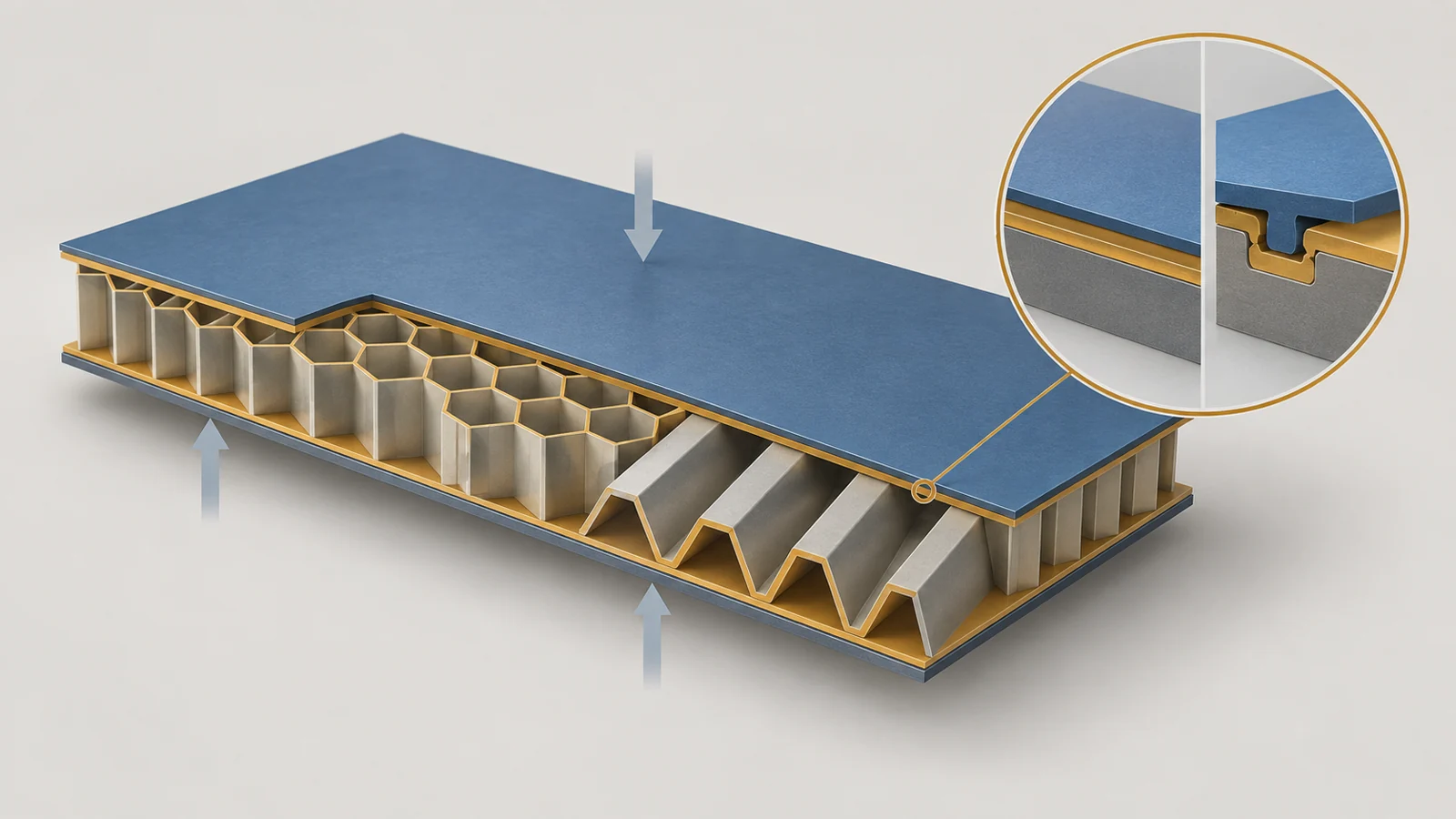
Sandwich composites are layered materials with strong outer skins, called face sheets, and a lightweight core. They are used in aerospace, marine engineering, and cushioning packaging. Their performance depends on both the structure inside the panel and the connections that hold its layers together.
A review published in Polymers on October 18, 2024, brings those two problems together. It surveys biological patterns used in core design, methods for joining different materials, computational tools, and manufacturing processes. Its contribution is a synthesis of reported designs and comparisons, rather than a newly tested material ready for deployment.
The useful question is how a borrowed structure changes the way a panel carries a load—and whether that behavior survives the choices needed to manufacture it.
Geometry changes how a core responds
A honeycomb is an arrangement of walls and spaces. Changing the wall thickness, cell shape, or reinforcement changes how loads pass through that arrangement and how it deforms. The studies discussed in the review examine square, hexagonal, circular, and modified cells, including cells with variable wall thickness. The biological inspiration supplies a starting geometry; the engineering work determines its dimensions and material.
That distinction helps explain why “stronger” can mean several different things. Stiffness describes resistance to deformation. Energy absorption concerns how much energy a structure takes up as it deforms. A core designed to resist movement and a core designed to cushion a blow need not have the same shape.
One example in the review is a bidirectional corrugated core inspired by the surface structure of a mantis shrimp appendage. Corrugations running in two directions provide a different arrangement of load-bearing contacts from a pattern running in one direction. The cited study reported 60% greater specific energy absorption than a conventional unidirectional corrugated structure and 58.6% greater than a triangular structure. Specific energy absorption means energy absorbed per unit mass, making it particularly relevant to lightweight design.
Wood-inspired structures reveal a different adjustment. In the experiments summarized by the review, smaller spiral angles were associated with greater stiffness and elastic modulus, while larger angles favored resistance to twisting and greater deformation. Adjusting the angle therefore changes the balance of properties without simply adding material. A tube or support column can require a different balance from an impact-absorbing core.
These comparisons need to retain their original scope. The review brings together results from different materials and designs, and it explicitly recognizes that material choice affects the reported performance. The numbers should be read as outcomes of particular comparisons, not as a standardized ranking of biological shapes or a universal prescription for the best core.
Combining patterns gives each structure a different job
A single geometry can leave some locations carrying much more stress than others. The review discusses combining biological patterns to distribute that stress more evenly while bringing together different kinds of mechanical behavior.
One hybrid draws on the S-shaped internal structures of cuttlefish bone, spiderweb architecture, and the porous structure of pomelo peel. These inspirations contribute ideas for absorbing energy, dissipating impact, and cushioning. The experiments summarized in the review found improved energy absorption and shock reduction in the combined design.
The engineering rationale is functional. A cellular arrangement may supply support, another pattern may help distribute forces, and porous regions may contribute cushioning. Combining them creates more ways to control where deformation occurs. The review also describes finite-element analyses in which integrated biomimetic structures reduced stress concentrations relative to single-structure designs.
The resulting object is an engineered abstraction of those features. Its usefulness comes from the mechanical roles of its walls, curves, and spaces, rather than its resemblance to an animal or plant.
The bond between layers is part of the structure
An elaborate core still has to transfer forces to and from the outer skins. The review identifies the interface between these different materials as a central problem and examines two major approaches: adhesive bonding and mechanical interlocking.
Adhesives can spread stress across a connection, contribute toughness, and absorb some energy during damage. They also offer practical advantages, including low weight and relatively straightforward assembly. Biological ideas extend to the adhesive itself. The review describes work inspired by skeletal muscle structures and by the water-attracting and water-repelling interactions of mussel foot proteins.
Choosing an adhesive requires attention to the materials it joins. Its chemistry must be compatible with them, and the bond must retain useful properties in its working environment. Aging and environmental exposure can reduce bond strength. A connection that performs well initially therefore raises a separate question about performance over time.
Mechanical interlocking uses engaging geometric features to connect layers. The physical connection can carry load without relying solely on an adhesive, reducing dependence on the adhesive’s resistance to aging or environmental conditions. The review discusses interlocking as a way to improve load sharing and reduce localized damage.
That advantage addresses a particular failure mechanism. It does not make every interlocked panel durable in every setting. The shape of the connection, the materials, and the way the part is made still determine whether the layers can work together under the intended loads.
Computing helps connect design choices to behavior
The computational approaches surveyed in the paper operate at different scales and answer different questions. Finite-element analysis divides a structure into smaller modeled regions to calculate its response to loading. It can help identify stress concentrations and explore how changing an interlocking feature affects the connection.
Molecular dynamics examines interactions at the atomic or molecular scale. The review includes examples involving interface adhesion and surface behavior, illustrating how these calculations can investigate mechanisms beneath the level of a visible cell or corrugation. They address a different part of the problem from a simulation of a complete panel.
Inverse analysis starts with observations or experimental results and works backward to estimate unknown properties or parameters. This is useful when designers can measure a response more readily than they can directly determine every property responsible for it.
Machine learning can connect material composition, geometry, and processing choices with mechanical properties. The review discusses predictions of interface strength and fracture behavior, along with approaches that combine finite-element calculations and machine learning. A computationally demanding set of simulations can provide data from which a faster predictor is trained, allowing more candidate designs to be screened.
These tools help decide which possibilities deserve closer investigation. Their predictions depend on the data and assumptions behind them, so agreement with physical testing remains essential. A fast prediction of bond strength is a different achievement from a manufactured panel maintaining that bond in service.
Printing the shape introduces another set of tradeoffs
Traditional sandwich construction can require making the core and face sheets separately before joining them. Additive manufacturing offers routes to complex internal shapes and, in some cases, integrated construction. The review compares three approaches whose practical differences matter to the final material.
Selective laser sintering builds parts by sintering powder layer by layer. It can produce complex forms without a dedicated mold, making it useful for prototypes and small batches. But powder-based construction can introduce roughness, porosity, and imperfect bonding. Cleaning and additional finishing or treatment can add time and cost. Producing the intended outline is only one part of producing the intended mechanical response.
Stereolithography uses light to cure photosensitive resin. It offers fine detail and smooth surfaces, making intricate biological geometries accessible for testing. One study summarized in the review used this route to compare a beetle-forewing-inspired model with a honeycomb model, reporting roughly two to three times the compressive strength and energy-absorbing capacity for the beetle-inspired design. The process’s reliance on suitable resins also constrains material selection.
Fused deposition modeling deposits melted filament in successive layers. The review highlights its relatively low equipment and material costs, as well as the possibilities of using multiple materials to form the skins and core together. Its limitations include voids, imperfect adhesion between printed layers, and anisotropy—mechanical behavior that changes with direction. Printing accuracy and surface quality also affect how closely a manufactured part follows its design.
These processes make manufacturing an active design variable. Wall geometry, layer thickness, and material connections must all emerge from the process with the properties the design requires. The review concludes that further work is needed on how processing parameters affect the overall mechanical performance of sandwich composites. The collected examples support continued development; they do not establish production-scale reliability or broad readiness for adoption.
What this could change
If biological geometries can be manufactured consistently and joined with durable interfaces, they could expand the choices available for lightweight structural panels and cushioning components. A core that absorbs more impact energy for its mass could help packaging protect contents with less structural weight. In aerospace or marine engineering, a core and its face sheets that reliably share loads could support lighter components with the mechanical behavior their application requires.
Integrated manufacturing could also reduce the number of separate fabrication and joining steps for suitable designs. Reaching those benefits depends on solving the connected problems described in the review: directing forces through the core, maintaining the connections between layers, and reproducing both through a workable manufacturing process. Nature provides several useful structural ideas; turning them into dependable components requires those pieces to function together.
Key Sources
- Primary source: A Review of the Biomimetic Structural Design of Sandwich Composite Materials.
DOI or Journal Page · Review or Meta-Analysis · 2024-10-18
Keep exploring