
Research Signal – Source date 2023-02-01
Removing a pollutant from water does not necessarily mean destroying it. It may simply have moved onto a treatment material. That distinction helps explain interest in combining biochar, a carbon material used to trap pollutants, with nanoparticles—tiny particles that can add other functions.
A review published in the February 1, 2023 issue of Environmental Research examines these combinations for pollution treatment in soil and water. Its central attraction is the possibility of bringing surface capture and chemical breakdown together in one composite material.
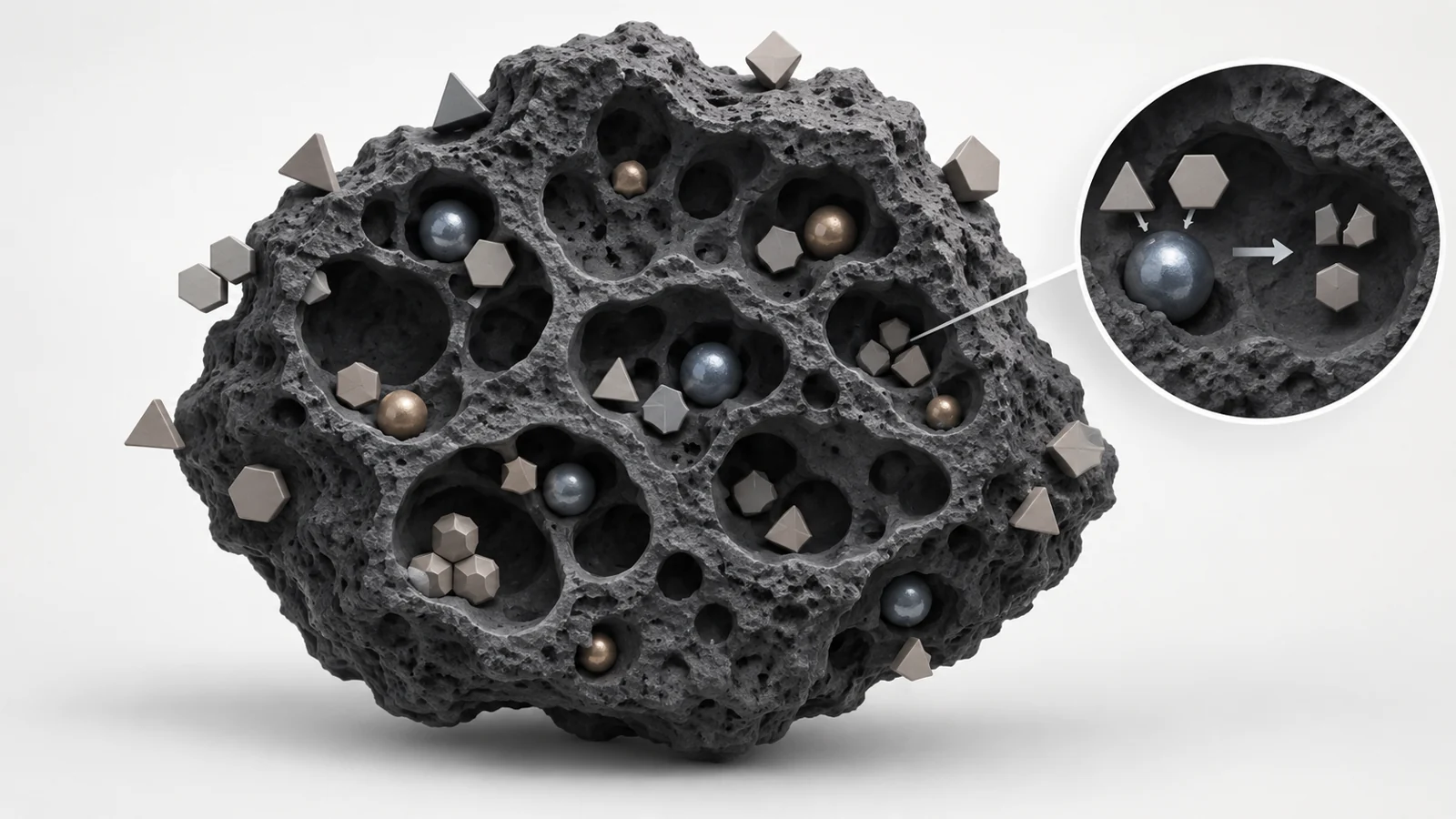
How the two components can work together
Biochar can hold pollutants through adsorption. The word describes substances attaching to a surface, including accessible surfaces inside a porous material. A pollutant captured this way can be separated from its surroundings while remaining chemically intact. Capture therefore changes where the pollutant is; it does not, by itself, establish what ultimately happens to it.
Catalytic nanoparticles provide a different function. A catalyst helps a chemical reaction occur, and catalytic degradation means chemical breakdown of the pollutant. The review’s abstract describes composites in which biochar performs adsorption while catalytic nanoparticles support degradation. It explicitly says these functions can operate concurrently. Readers need not imagine a fixed sequence in which every pollutant must first be caught and then passed to a particle.
This division of labor gives a reason to combine the components. A treatment material could offer surfaces that interact with pollutants alongside sites that help transform them chemically. However, breakdown alone does not demonstrate that the resulting substances are harmless. Nor does it establish complete mineralization—the conversion of a pollutant into simple inorganic substances—or show that treated water is safe to drink. Those are separate outcomes that require their own evidence.
Why pores and surface chemistry matter
The review highlights porous structure, active surface area, and active surface groups among the relevant material features. Pores create internal spaces where contact can occur. Active surface area concerns the surface available to participate in treatment, rather than merely the particle’s visible outline. Surface groups are chemical features that help determine how that surface interacts with substances around it.
These details make the composite’s structure part of its function. Putting two ingredients together is only the starting point; their accessible surfaces and chemical interactions matter too. The abstract also identifies recovery or separation as a useful property, connecting the material’s behavior during treatment with the practical question of what can be collected afterward.
A broad application range is not a universal treatment
The authors describe a review covering preparation techniques, remediation mechanisms, advantages, disadvantages, and future research directions. Its scope spans multiple composites and pollutants in both soil and water. That breadth introduces a family of approaches, rather than establishing that different formulations or environmental settings are interchangeable. A material suited to one treatment problem cannot be assumed to work equally well in another.
This account is grounded in the review’s abstract, which does not provide enough detail for a verified quantitative comparison or deployment assessment. It cannot establish a particular formulation’s removal efficiency, reaction speed, operating lifetime, or advantage over a named alternative. The same evidence boundary prevents conclusions about affordability, long-term environmental safety, or effectiveness across soil and water conditions. These are limits on what can be concluded here, not assertions that the full paper omits those subjects.
What this could change
If suitable composites can combine these functions reliably, remain environmentally safe, and be recovered or managed after use, water-treatment operators and contaminated-site cleanup teams could gain materials that perform more than one treatment job in the same place. Bringing pollutant contact and catalytic activity together could help integrate treatment steps, giving communities dealing with contamination additional options tailored to particular pollutants and environments.
Key Sources
- Primary source: Remediation competence of nanoparticles amalgamated biochar (nanobiochar/nanocomposite) on pollutants: A review.
DOI or Journal Page · Review or Meta-Analysis · 2023-02-01
Keep exploring