
Research Signal – Source date 2022-10-29
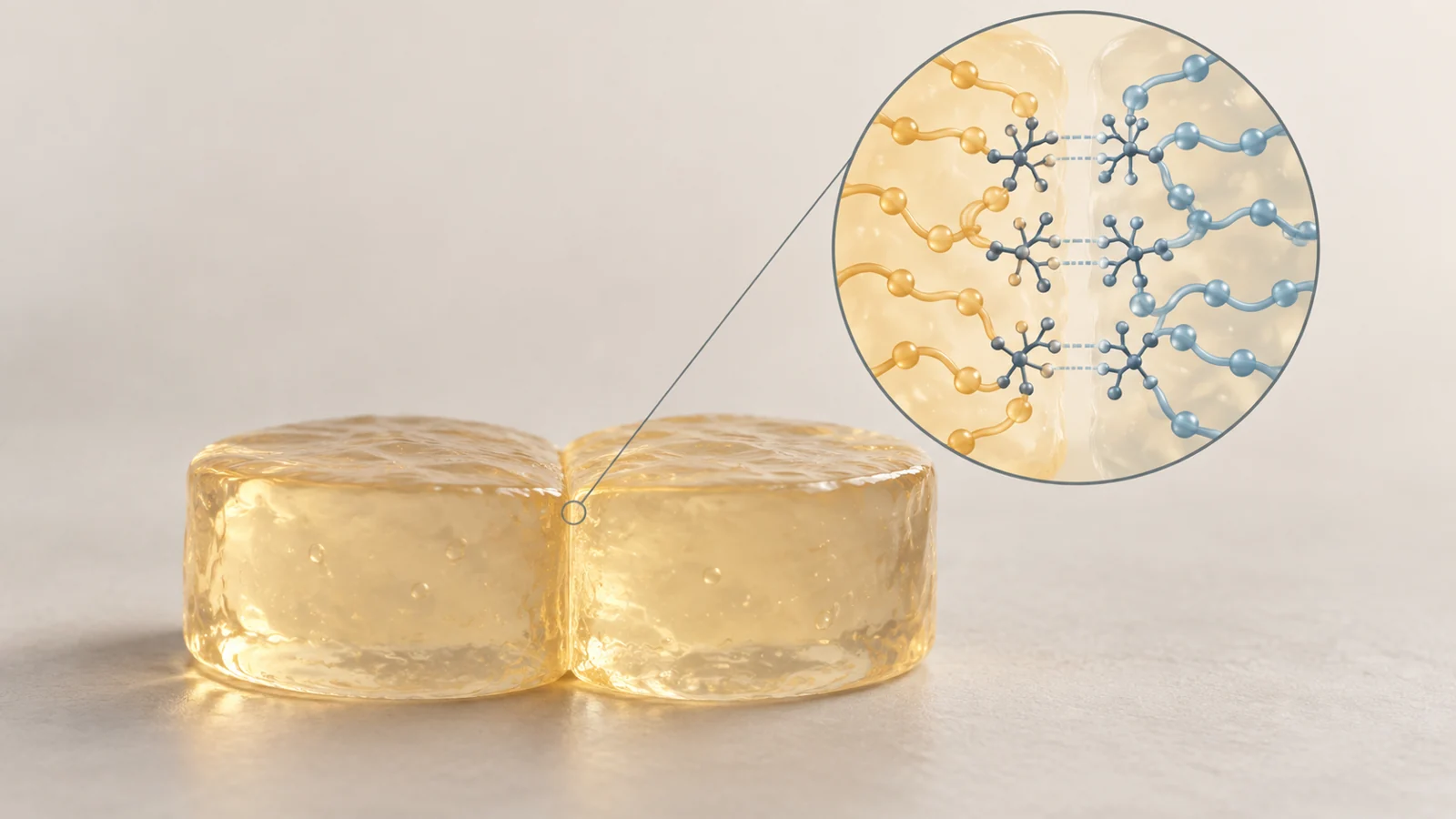
The researchers cut a gel into two pieces, brought the cut faces together and left them at room temperature. After 25 minutes, the pieces had joined. In a separate microscope observation, a surface crack narrowed and disappeared over the same period.
Those observations anchor a laboratory study published on October 29, 2022, in Molecules. Its material was a hydrogel—a water-rich polymer network—made from chemically modified alginate. The researchers connected its chains with compact, branching molecules that could form reversible bonds. Once damaged surfaces were touching, those connections could rebuild.
The study also reported much faster recovery in a test that repeatedly deformed the gel. Understanding what happened requires separating three events: making a gel, reconnecting cut surfaces and restoring its elastic response after deformation. Each reveals something different about how the material works.
Connections that can rearrange
Alginate supplies the long polymer chains forming the network. The team treated it with sodium periodate, an oxidizing chemical that creates aldehyde groups along those chains. These groups provide attachment sites for the crosslinker, the molecule that connects one chain to another.
The crosslinker was poly(amidoamine), or PAMAM. It has a tree-like branching structure called a dendrimer, with many amine groups at its outer ends. The researchers used a fifth-generation version, described in the paper as roughly spherical and about five nanometers across. Its many terminal groups give a single connector multiple opportunities to attach to surrounding alginate chains.
An aldehyde group and an amine group can react to form an imine bond. These bonds are reversible, allowing connections within the network to exchange and reform. When damaged gel surfaces are placed together, new connections can develop across the contact area. The pieces do not move toward one another on their own; contact is part of the experiment.
The authors proposed that clustering many reactive ends on branched connectors encourages molecular interactions and speeds bond exchange. The experiments demonstrate a working reversible network built with that architecture. How much of its speed comes specifically from branching is a separate question from whether the network can reconnect.
Three different meanings of fast
Gel formation was already underway during preparation. Mixing took about 2.5 minutes before rheological measurements began. At the start of those measurements, all three formulations behaved more like elastic solids than flowing liquids. That places their transition to gel-like behavior within the mixing interval, without identifying an exact gelation time for each sample. Connections continued developing afterward.
Repair of a visible cut took longer. In the formulation called ADA20-PAMAM, the separated pieces joined after 25 minutes at room temperature. Under a microscope, a surface crack had narrowed after five minutes, become difficult to distinguish after 15 minutes and disappeared after 25 minutes. Pieces made with two different formulations could also join, showing that the reconnection was possible across that compositional difference.
The seconds-scale result came from a rheometer, an instrument that deforms a material and measures its response. One useful measurement is the storage modulus, which describes the elastic component of that response. The team alternated gentle deformation at 1% shear strain with severe deformation at 350%, where the network lost its gel-like behavior.
For the least oxidized formulation, ADA8-PAMAM, the storage modulus began near 90 pascals, fell to around 10 pascals during severe deformation and rose to 72 pascals within 30 seconds after gentle deformation resumed. That was approximately 80% of its starting value. The other two formulations were reported to regain their initial storage modulus almost immediately when the strain was lowered.
These tests probe different scales of damage. The rheometer tracks the network’s elastic response after deformation; the cut experiment follows reconnection at an interface. Neither a vanished crack nor recovery in the rheometer establishes that a rejoined cut can bear its original load. The 30-second and 25-minute observations therefore answer different questions about repair.
More attachment sites bring a competing cost
The team prepared alginate using oxidation inputs of 8%, 20% and 30%, producing the three formulations named ADA8, ADA20 and ADA30. Those percentages describe the amount of oxidizing reagent relative to alginate’s repeating units. The researchers separately characterized the resulting aldehyde groups available for bonding.
Increasing oxidation changed more than the number of attachment sites. It also shortened the alginate chains. The reported average molecular weight fell from about 121 kilodaltons for the starting alginate to roughly 67, 43 and 39 kilodaltons at the three increasing oxidation inputs. More places to connect were accompanied by shorter lengths of polymer to connect together.
That competition appeared in the mechanical measurements. In the initial time-dependent test, the storage modulus was about 247 pascals for ADA8-PAMAM, 1,336 for ADA20-PAMAM and 707 for ADA30-PAMAM. The middle formulation was the stiffest under those conditions. The authors suggested that the bulky PAMAM connectors could obstruct additional contacts when working with shorter alginate chains.
Other measurements gave a different ordering. During the frequency sweep, which changed how rapidly the material was deformed, the most oxidized formulation had the highest storage modulus. The cyclic recovery experiment also began with different modulus values from the initial test. A stiffness number needs its measurement context; the results do not support a single rule that more oxidation always produces a stiffer gel. Formulation changes both the available chemistry and the physical arrangement of the network.
Antibacterial activity raises a biological question
The researchers separately exposed Staphylococcus aureus and Escherichia coli to the hydrogels. The detailed methods describe a two-hour incubation at 37 °C. A small plastic film made from PET sat beside the gel, giving the team a surface on which to observe bacteria. This matters because images of bacteria on that neighboring film are a different observation from bacterial attachment to the gel itself.
Electron microscopy and fluorescent live/dead staining supported antibacterial activity against both species. For S. aureus, the images showed fewer bacteria and membrane changes consistent with damage. The authors connected this activity to PAMAM’s positively charged groups interacting with bacterial membranes.
The assay descriptions contain reporting ambiguities. The conclusion refers to room temperature, whereas the detailed experiment specifies 37 °C. The starting bacterial concentration is also written in an unclear form. These details limit quantitative interpretation, and a reliable killing percentage cannot be inferred from the descriptions provided.
PAMAM’s interaction with cells is also relevant to eventual use. The paper itself discusses toxicity concerns associated with its positive charge and cites earlier work on modifying its surface groups. That background does not establish tissue compatibility for this complete gel formulation. Antibacterial activity and compatibility with human cells are separate properties that a biomedical material would need to combine.
What the comparison can establish
The authors compared their 25-minute crack disappearance with approximately one hour reported in earlier work on an alginate gel with linear crosslinkers. That comparison gives a reason to investigate branching as a design choice. It does not isolate branching as the cause of the difference: the earlier result comes from another study, rather than an otherwise identical gel tested alongside this one with only its connector shape changed.
For practical use, the next challenge extends beyond the laboratory recovery measurements. A soft scaffold would need to retain the structural properties required for its role. A drug-delivery matrix would need to preserve its intended release behavior as bonds exchange and damage accumulates. The short observations here do not establish sustained repair or preservation of either function during service. Those application requirements determine whether the molecular design becomes useful outside the test setup.
What this could change
If reversible branched connections continue rebuilding under relevant conditions, and the complete formulation proves compatible with tissue, alginate-based biomedical gels could retain structural continuity after minor damage. That could extend the useful life of soft scaffolds or drug-delivery matrices whose performance depends on keeping a connected polymer network.
Material developers would gain a way to tune repair and mechanics through both chain chemistry and connector architecture. Eventual biomedical users could benefit from gels that maintain their intended function for longer after everyday deformation. The October 2022 study supplies a concrete starting point for that possibility: a network whose molecular connections can reorganize and bridge damaged surfaces brought back into contact.
Key Sources
- Primary source: The Design of Rapid Self-Healing Alginate Hydrogel with Dendritic Crosslinking Network.
DOI or Journal Page · Peer-Reviewed Paper · 2022-10-29
Keep exploring