
Research Signal – Source date 2022-09-18
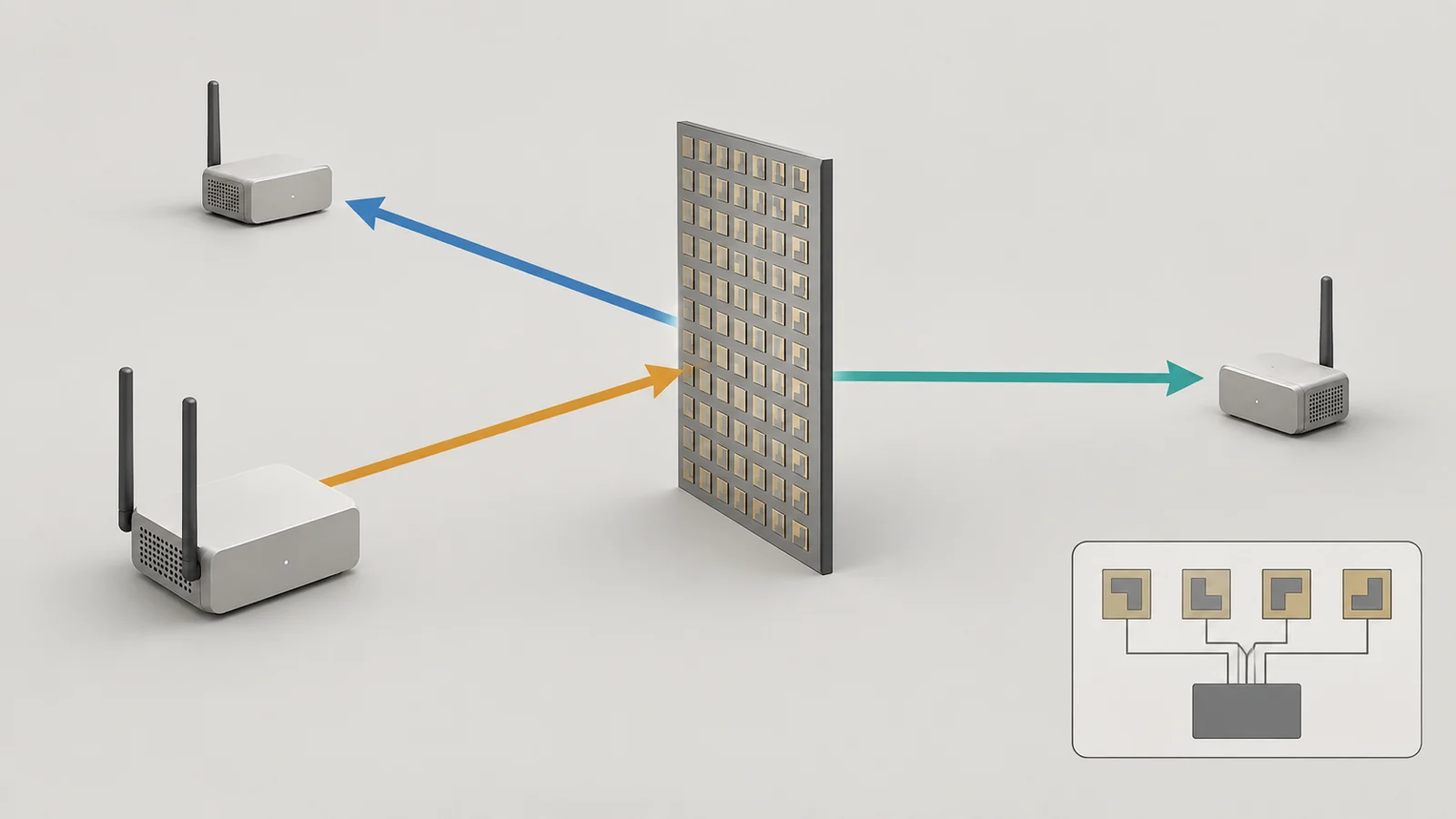
A wireless signal’s route depends partly on the surfaces it encounters. A thin engineered panel could make one of those encounters adjustable. By changing the response of small elements across its surface, the panel can redirect an incoming wave toward a chosen location. Designs that control both reflection and transmission extend that possibility to receivers on either side.
A review published on September 18, 2022, brings together the materials, control hardware and communication research behind this idea. It describes metasurfaces—thin engineered surfaces that control electromagnetic waves—and how they can become reconfigurable, programmable or adaptive. The communication evidence includes prototypes tested indoors and outdoors, alongside substantial theoretical work. The central question is how these different pieces might add up to useful wireless coverage.
How small elements steer a larger wave
A metasurface contains an arrangement of elements smaller than the wavelength it is designed to control. Each element interacts with the incoming wave, altering properties such as its amplitude or phase. Amplitude describes the size of the oscillation; phase describes the position within its repeating cycle. Waves with different phases have their peaks and troughs at different points.
The elements act collectively. If neighboring elements impose different phase changes, their outgoing waves combine into a reshaped wavefront. A carefully chosen pattern can steer a beam or focus energy toward a location. This gives engineers a way to control direction through the surface’s electromagnetic response, without necessarily turning the whole panel.
In a fixed metasurface, the available response is largely built into its materials and geometry. Tuning adds a way to change that response after fabrication. Adjusting the entire panel together can change its overall behavior; adjusting individual elements allows different settings across the panel. That local control is what makes a changing spatial pattern possible.
A programmable surface connects those adjustable elements to control hardware. The review describes field-programmable gate arrays, or FPGAs, which supply coding sequences that switch the surface between configurations. One pattern might steer a beam in one direction, while another changes the direction or produces a different wavefront. Changing settings over time adds another dimension of control. The reviewed designs include time modulation and combined space-and-time modulation, which can also manipulate frequency components.
Adaptation requires an additional step. A controller can replay predetermined patterns without knowing whether they suit the surroundings. Sensors and feedback can provide information that lets a system change its settings in response. The review discusses sensing environmental conditions and feedback for communication control. Programmability alone therefore does not imply that a panel independently adapts, and machine learning is not a requirement for every programmable design.
The hardware must match the wavelength
The same goal—changing how an element interacts with a wave—requires different hardware at different frequencies. The review compares electrical, optical, mechanical, chemical and phase-transition approaches. Three examples show why there is no single tuning mechanism that transfers unchanged from wireless microwaves to infrared light.
At microwave frequencies, small electronic components offer a practical route to local control. A PIN diode can switch between states, giving an element a discrete choice of responses. A varactor diode changes its electrical capacitance with applied voltage, allowing continuous adjustment in suitable designs. These components can be connected to control circuits so that individual cells receive different settings. The resulting panel combines a patterned electromagnetic structure with an electrical addressing system.
For infrared light, the review describes transparent conducting oxides, including indium tin oxide. Changing the density of mobile charge carriers changes the material’s optical response. In one reviewed approach, electrically tuning that carrier density within resonator arrays changes the phase of reflected light. Here, the ability to alter the material is only part of the design problem. The depth over which electrical control acts can limit the size of the optical change, prompting approaches such as multiple gates.
Mechanical tuning changes the geometry itself. Folding structures based on origami or kirigami can rearrange the surface’s constituent cells; stretching a substrate changes their configuration. These approaches offer substantial changes in some demonstrated devices, including optical applications. The review also identifies slower response, sensitivity to the environment and difficulty controlling individual elements as limitations of mechanically stretchable substrates.
The choice therefore depends on what must change, how far it must change and how quickly. A device that adjusts its overall optical response has different requirements from a panel that rapidly sets a separate phase at each cell. Fabrication complexity and compatibility with control electronics also matter. A successful microwave circuit establishes a capability in that frequency range; its components cannot simply be carried over to an infrared surface.
Reaching receivers on both sides
A reflecting surface redirects an incoming signal back into the region on the incident side of the panel. This can create an alternative path to a receiver, but it leaves the opposite side outside that reflection-based arrangement. A transmitting surface instead lets a controlled outgoing wave emerge on the other side.
The review discusses designs that combine these functions, including simultaneously transmitting and reflecting reconfigurable intelligent surfaces, known as STAR-RISs. Their appeal is geometric. A transmitter can illuminate a surface that directs reflected energy toward a user on one side and transmitted energy toward another user on the other side. The surface’s control settings help determine how those two paths are formed.
“Full-space” control refers to access to both sides of the surface. It does not mean that every location around a panel receives a usable connection. Direction, the division between reflection and transmission, and the particular configuration still shape who can be served. The reviewed examples also differ in how their modes work: some switch among functions, while others support reflection and transmission simultaneously under specified conditions. Those are distinct hardware capabilities, even when they share the same broad ambition.
What the communication demonstrations establish
The review explicitly says that much research on reconfigurable intelligent surfaces for wireless communication is theoretical and that experimental trials are limited. Within that picture, it describes a communication prototype evaluated in indoor and outdoor field trials. It also reports feedback-based adaptive beamforming that enables controlled reflection without changing communication standards. These examples connect adjustable surfaces to functioning communication arrangements.
A separate demonstration addresses a different task. A system using a two-bit space-and-time coding metasurface transmitted two pictures simultaneously to two designated users at different locations in real time. That is a concrete example of controlling communication channels through a coded surface. It should retain its own scope: it is neither the same experiment as the indoor and outdoor prototype trials nor a demonstration that every tuning mechanism in the review can perform the same task.
For surfaces serving both sides, the review includes simulations in which optimized surface settings improve coverage relative to a reflection-only arrangement. Such comparisons help explain the potential value of transmission as an additional route. Their results depend on the modeled system and optimization choices. They do not supply a universal percentage gain in coverage or throughput for an installed panel.
Several remaining hardware problems bear directly on how flexibly a system can operate. The authors identify independent control of amplitude and phase as an important challenge. Adjusting the strength of an outgoing wave separately from its position in the oscillation cycle would give designers more freedom than phase control alone. They also describe switching-speed limits in microwave designs using PIN diodes or varactors, and the need for suitable materials and local tuning mechanisms at higher frequencies. Many of the space-and-time coding surfaces discussed are reflection-only, motivating work on transmitting designs and alternative ways of feeding waves into the surface.
Dependable coverage is a system-level question beyond these individual demonstrations. It requires the surface, controller and communication link to work together under the conditions in which users need service. The trials and simulations summarized here support specific capabilities, but do not establish reliable operation across arbitrary buildings or a common accounting of whole-system energy use. The appropriate reading of the September 2022 evidence is a set of demonstrated functions and promising arrangements, with practical network performance still requiring broader validation.
What this could change
If controllable panels can maintain useful performance under practical operating conditions, installed surfaces could become adjustable parts of a wireless connection. A panel on a building facade or billboard could provide an alternative signal path when an obstacle obstructs the direct link between a transmitter and a user. Changing the panel’s settings could then change where that path leads.
Combining reflection and transmission could extend the usefulness of a single installation to users on either side. For someone with an obstructed direct connection, the downstream benefit would be another controllable route by which a signal could reach them. The infrastructure possibility is to make selected surfaces active participants in directing radio waves, giving communication systems an additional way to respond to where service is needed.
Key Sources
- Primary source: Recent Progress in Reconfigurable and Intelligent Metasurfaces: A Comprehensive Review of Tuning Mechanisms, Hardware Designs, and Applications.
DOI or Journal Page · Peer-Reviewed Paper · 2022-09-18
Keep exploring