
Research Signal – Source date 2021-02-25
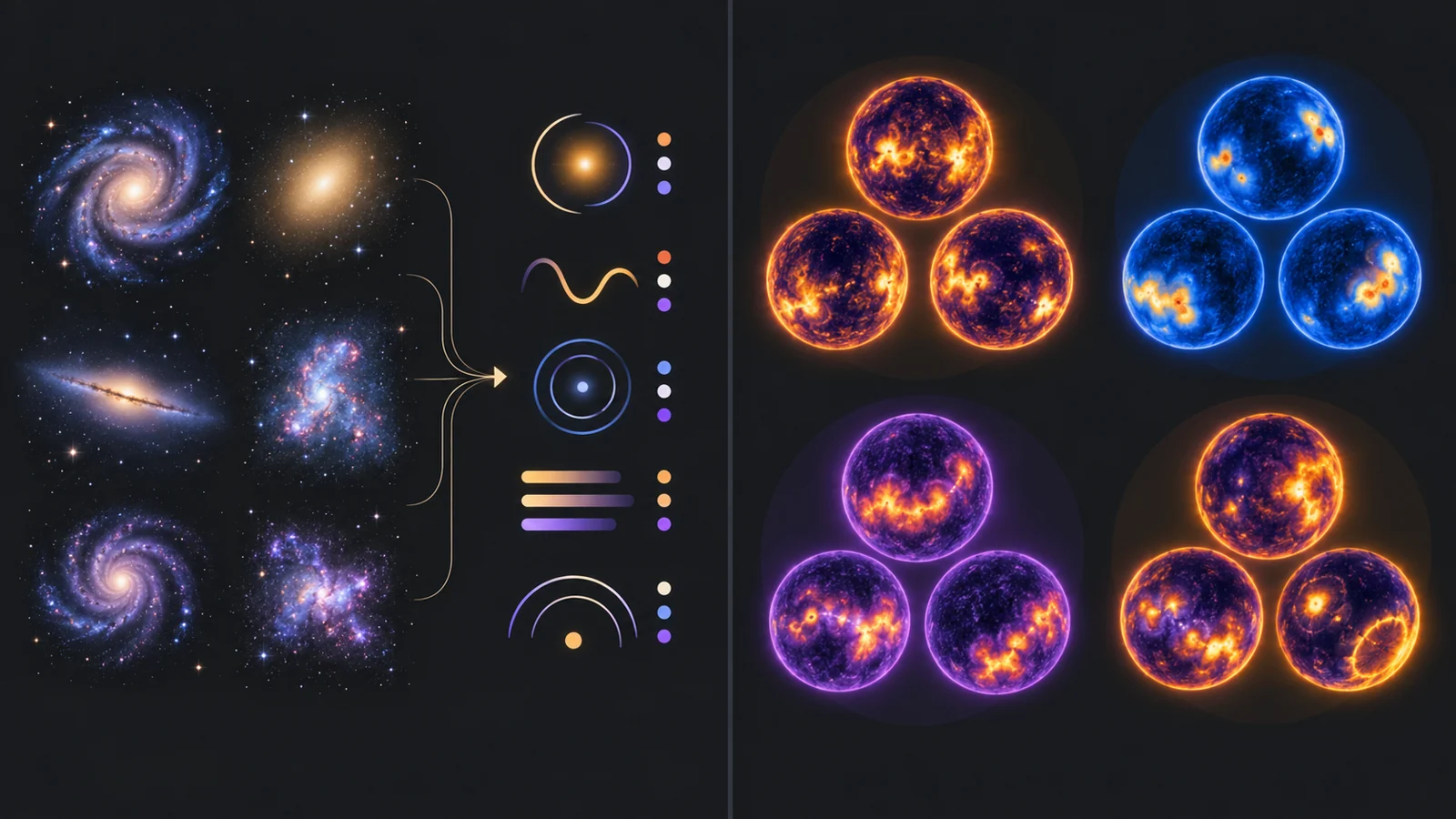
For astronomers, machine learning can help with two quite different problems. One is estimating properties of galaxies quickly enough to make large collections of observations more manageable. Another is organizing images of the Sun so that patterns become easier to investigate. Both can support scientific discovery, though each contributes a different kind of result.
The February 25, 2021 arXiv preprint Machine Learning for Scientific Discovery brings these tasks together. Its authors describe models that predict parameters related to galaxy star formation, alongside an exploratory use of machine learning to group solar radio observations. The useful distinction is between answering a question whose desired output is already specified and exploring data to decide which questions deserve attention.
Learning to estimate how galaxies form stars
A galaxy’s star formation history describes how its production of stars changes over time. Researchers represent that history using parameters—adjustable quantities in a model. Estimating those quantities helps them characterize a galaxy through more than its appearance in an image.
The authors approach this estimation task with supervised learning. During training, a model learns relationships between input information and target values. Once trained, it can use those relationships to produce estimates from inputs, without learning the relationship anew for every prediction. The work also uses deep learning to capture nonlinear relationships, where changes in an input do not translate into a simple proportional change in an output.
This separation between training and prediction explains the computational appeal. Building a useful model takes work, but applying the trained model can be fast. The authors report reduced prediction time and small prediction errors for their galaxy work, describing rapid estimates as an advantage available after training.
They compare predicted values with estimates from magphys, the reference method identified in their results. That comparison gives the accuracy claim a concrete meaning: it concerns how closely the machine-learning predictions match the reference values. Prediction speed answers a separate question about how quickly those estimates can be produced. A model’s agreement with a reference and its computational convenience therefore need to be assessed separately, even when both contribute to its usefulness.
The scientific task also remains specific. Here, “prediction” means estimating parameters from input data. It does not mean forecasting the future behavior of individual galaxies. The immediate contribution is a way to obtain quantities relevant to understanding their star formation histories more efficiently.
Finding structure in solar radio images
The solar application begins with a less prescribed question. Instead of asking for a particular target value, the authors explore how observations resemble one another and where unusual cases appear. They use radio images of the Sun from the Murchison Widefield Array, a radio telescope array.
Visual inspection can reveal striking features, but it becomes restrictive when researchers must compare large numbers of observations across many dimensions. A person can look through images and notice familiar shapes. Keeping track of numerous attributes and their relationships across a large collection is a different challenge. Expectations and prior experience can also influence which features attract attention.
The authors use self-organizing maps, an unsupervised learning method, to explore this problem. In plain terms, the method organizes data according to similarity, making groupings and differences easier to examine. “Unsupervised” means that the task is not driven by a supplied correct answer for every observation, as it is in the galaxy parameter prediction task.
This changes what the output is useful for. An arrangement of similar observations can help researchers inspect recurring patterns, compare groups and locate cases that stand apart. The authors describe their solar-image work as a promising example of using such methods to uncover patterns, clusters and anomalies.
The choice of what information represents each observation matters. An algorithm compares the features it receives; those choices shape which observations appear similar. Organizing a collection computationally can expand the range of comparisons researchers can consider, while leaving them with a more focused set of patterns to investigate.
Turning an unusual result into a physical question
The handoff to scientific interpretation comes when researchers ask why a prediction or grouping looks the way it does. The authors suggest comparing machine-learning outputs with existing models and investigating cases where they disagree. Such disagreements could help expose where a physical model needs closer examination or improvement.
An unusual output, however, does not identify its own cause. It could draw attention to meaningful physical behavior, but interpreting it requires returning to the observations and the assumptions behind the analysis. Likewise, agreement with magphys estimates establishes agreement with that reference; it does not independently establish that the inferred galaxy properties are physically correct.
The challenges the authors identify are connected. Data availability determines what a model can learn from, while feature choices determine which aspects of those data enter the comparison. Data volume and processing capacity constrain how much can be analyzed. Interpretability then affects whether researchers can connect a numerical estimate or a group of images to a useful account of the underlying physics. Faster computation helps with part of this sequence, but the scientific value depends on the whole sequence working.
The two applications also call for different judgments of success. A galaxy parameter estimate can be compared with a reference value. An exploratory grouping of solar images must be assessed for the structure it reveals and the investigations it enables. The reported performance of the galaxy models does not supply a shared accuracy measure for both tasks or establish that either approach will be equally useful on other datasets.
The preprint supports a case for faster estimation and computer-assisted exploration. It does not establish a particular new physical law, solar mechanism or class of astronomical object. Its description of rapid prediction after training should also be understood as a computational capability, rather than evidence of an operational telescope system delivering real-time results. The opportunity presented in February 2021 is to make more observations scientifically usable while retaining the work of interpretation.
What this could change
If the galaxy estimates remain useful across the observations astronomers need to analyze, lower prediction costs could let them characterize more galaxies with a given amount of computing time. That would widen the basis for comparing star formation properties across collections of galaxies. The payoff would extend beyond saving time on an individual calculation: more observations could contribute to investigations of how galaxies form stars.
For solar research, organizing large collections of radio images could help astronomers examine recurring behavior and unusual cases that would be difficult to identify through inspection alone. If those groupings can be interpreted reliably, they could direct attention toward observations that sharpen physical explanations. Together, the two approaches suggest a broader research capability—using rapid estimates and systematic comparisons to bring more of the recorded sky into scientific analysis.
Key Sources
- Primary source: Machine Learning for Scientific Discovery
arXiv · Preprint · 2021-02-25
Keep exploring