
Research Signal – Source date 2021-01-01
A material that recovers after damage also needs to withstand forces before damage occurs. An experimental polymer study published on January 1, 2021, approaches that design problem through lignin, a renewable natural polymer. Its rigid backbone offers multiple sites for attaching other polymer chains, providing a way to change the material’s architecture while incorporating a biomass-derived ingredient.
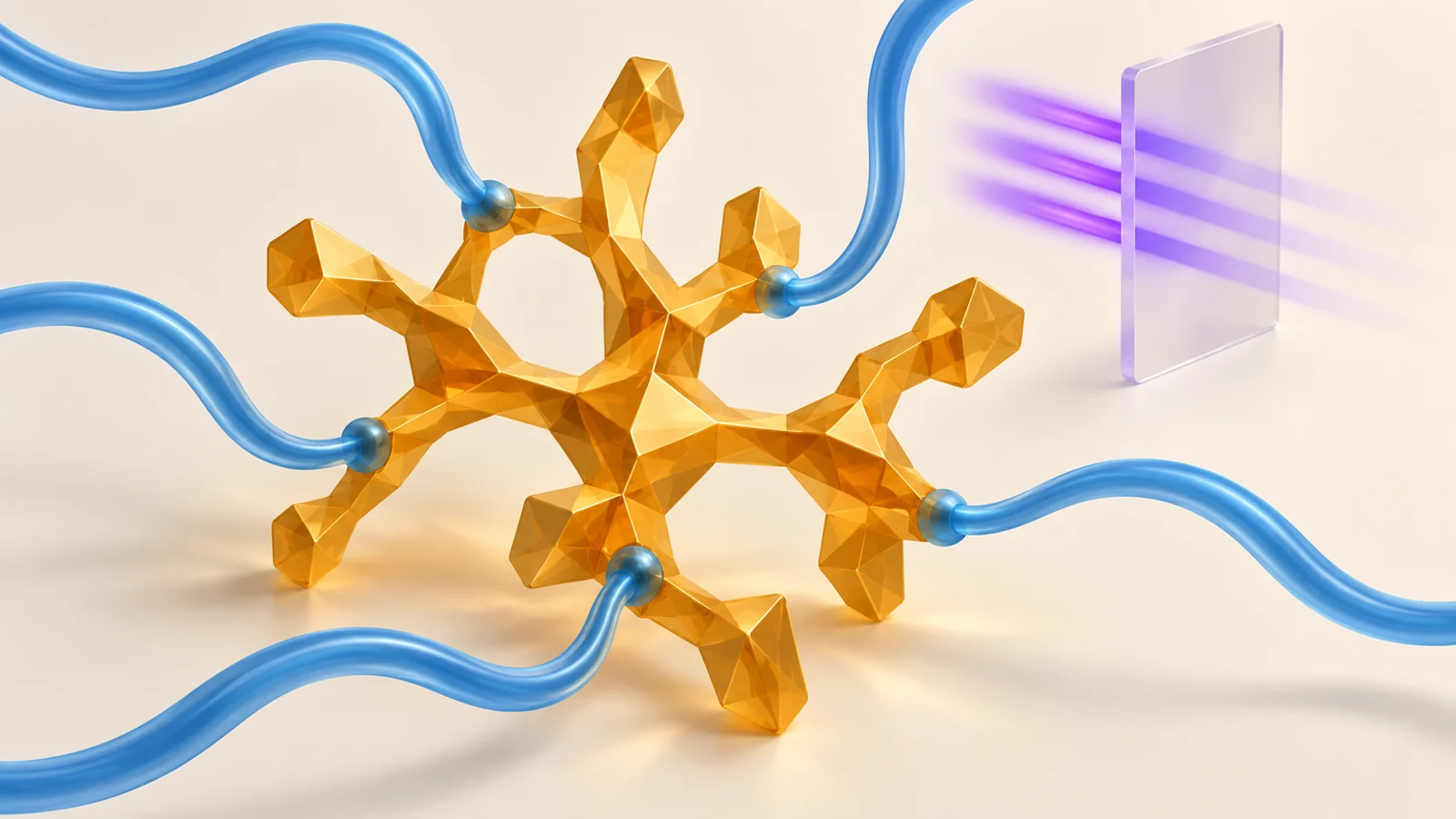
The structural role matters. Lignin’s aromatic backbone—a structure containing chemical rings—can serve as a scaffold for multiple attachments. The researchers used organosolv lignin to make a copolymer containing diacetone acrylamide and 2-hydroxypropyl acrylate. They attached polymer units through a synthesis method called ARGET-ATRP and named the resulting material LPDH. Here, “grafted” describes the attachment of polymer chains to the lignin structure.
Strength, stiffness and recovery tell different stories
The study’s abstract reports ultimate tensile stress as ≤6.3 ± 1.4 MPa. Ultimate tensile stress is the greatest pulling force per unit cross-sectional area that a sample sustains during a tensile test. It helps describe resistance to failure under tension; it does not tell us how easily the sample stretches under a smaller force.
That second question is addressed by stiffness. The reported Young’s modulus was 194.2 ± 46.1 MPa, a measure of how strongly a material resists elastic stretching. A higher modulus means more stress is needed to produce the same small elastic strain. Strength and stiffness therefore answer different questions, even though both use the same pressure unit, the megapascal. The abstract describes improved mechanical properties, but its compressed account does not establish the comparison needed to calculate a gain over another material.
Recovery asks a third question—how much useful mechanical behavior returns after damage. The authors describe 86% recovery of tensile strength and extensibility, with extensibility referring to the ability to stretch. That combined wording should not be read as two independently specified 86% results, or as a recovery rate that applies to every formulation and condition. It concerns the return of measured properties, rather than simply whether a damaged surface looks closed.
Ultraviolet absorption adds an optical function
The researchers also report that the copolymers absorbed ultraviolet radiation. This is a separate function from their response to pulling or damage: it concerns how the material interacts with light. For a proposed protective coating, absorbing incoming UV could help limit how much reaches the surface beneath it. Demonstrating absorption in a polymer, however, does not by itself establish how much protection an applied layer provides. That depends on factors such as which wavelengths it absorbs and how much radiation passes through the coating.
From a synthesized polymer to a useful coating
One practical feature of the synthesis is that the team used commercially available organosolv lignin directly, without purifying that starting material. This removes a separate lignin-purification step from the reported preparation and helps explain why the authors propose possible industrial manufacture. It does not establish the cost, throughput or consistency of producing the finished copolymer. Likewise, a renewable lignin component does not make the whole material renewable, biodegradable or environmentally benign.
The route to a coating also depends on how repair works under usable conditions. The abstract available here does not give enough detail to assess healing time, temperature, required stimulus, damage protocol or repeated repair cycles. Nor does it support conclusions about coating adhesion, quantified UV protection or long-term outdoor performance. Those limits concern what can be concluded from this account; they do not establish that the full paper lacks such tests. The reported properties provide a reason to investigate a coating application, while its practical value would depend on retaining them through manufacture, application, damage and exposure.
What this could change
If these functions can be retained in an adherent coating that repairs under practical conditions, coating developers could gain a route to protective layers that recover useful mechanical performance after damage while absorbing UV. For people who use coated surfaces, the potential payoff would be a layer that remains useful longer before replacement or reapplication. Lignin’s multiple attachment sites offer the material-design route toward that possibility, and direct use of a commercial starting material gives developers a concrete preparation strategy to build on.
Key Sources
- Primary source: Valorization of organosolv lignin: Architectural strategy to enhance mechanical strength and UV protection in self-healing polymers
DOI or Journal Page · Peer-Reviewed Paper · 2021-01-01
Keep exploring