
Research Signal – Source date 2026-07-18
A carbon-fiber composite combines reinforcing fibers with a surrounding material, such as epoxy. Describing it by the amount of fiber and the average angle of misalignment leaves something important out. Those numbers cannot fully describe how individual fibers are distributed inside the material, even though their arrangement influences mechanical behavior. An image supplies spatial information that a short table of design parameters misses.
A research article published on July 18, 2026, introduces an AI approach called ORDER that learns from both kinds of information. It connects images of internal fiber arrangements with numerical descriptors while organizing what it learns around similarities in material properties. Tests on two datasets suggest that this approach can improve property prediction, retrieval of related examples, and generation of candidate microstructure images. The contribution is a computational method for exploring material designs; establishing the performance of a manufactured composite requires further validation.
Learning relationships from incomplete descriptions
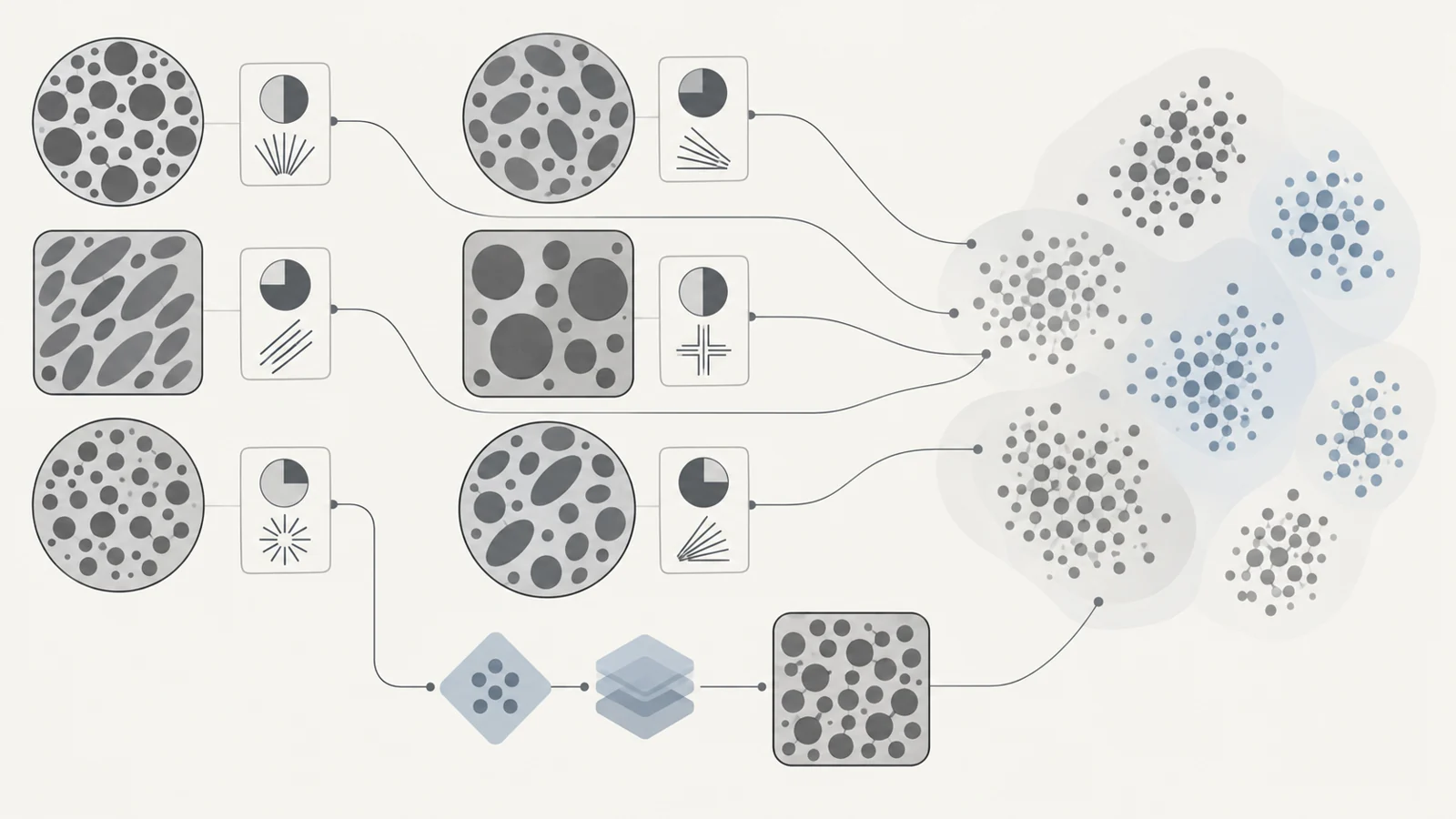
ORDER gives each image and its associated numerical descriptors a position in a shared “latent space”—a learned map represented internally by numbers. One encoder processes the image; another processes the table. Training encourages the two representations of the same material example to match.
Matching alone creates a tension. Conventional contrastive training pulls a paired image and descriptor record together while pushing unmatched records apart. Yet two different records may describe materials with very similar mechanical properties. ORDER adds an objective that encourages examples with more similar target properties to have more similar representations. This is its ordinal component: the model learns relative relationships between examples, preserving information about which property values are closer to which others.
The two objectives can compete. An alignment objective might separate two images because they belong to different records, while the property-based objective draws them together. The authors test both a fixed balance, selected through validation, and a version that adjusts the balance during training. Neither approach wins every task, making the choice of training strategy part of the result rather than an incidental setting.
A further step addresses scarce property measurements. During pretraining, ORDER can replace property-derived rankings with rankings estimated from physics-based material models. For the carbon-fiber dataset, these estimates use fiber volume fraction and mean misalignment. For the Nanofiber dataset, they use mat density and the interaction between collector speed and direction. A useful estimate need not reproduce every absolute property value, but it must preserve the ordering relationships on which the learning objective depends.
This reduces the need for target-property annotation during pretraining. The later property predictor still learns from examples with known target values. The distinction matters because physics-derived guidance makes one stage less dependent on labels without removing physical characterization or property supervision from the overall workflow.
What the two datasets test
The evaluation uses a public Nanofiber dataset and an authors’ simulated carbon-fiber/epoxy dataset. The latter contains 436 combinations of design descriptors for CF-T700 material, with fiber volume fractions from 0.32 to 0.65 and mean misalignment angles from zero to five degrees. Simulations produce corresponding microstructure images and target properties, including tensile yield strength and elongation.
That is a bounded design domain. Its numerical controls, constituent materials, and simulated examples provide a concrete test of learning under limited data. They also define the conditions against which the results should be read.
Approximately 15% of each dataset is held out before training. The remaining data is divided into separate pretraining and property-prediction subsets, each with training and validation portions. The property predictor therefore learns on a different subset from the one used to learn the representations, and test images and descriptors remain unseen during pretraining.
The comparisons also address two potential sources of advantage. Retrieval methods use the same pretrained vision backbone, helping isolate the effect of their training objectives. And the authors distinguish ORDER variants that use actual property rankings during pretraining from surrogate variants that use physics-derived rankings. The former receive additional property information that some baselines do not; the surrogate comparisons are especially relevant to the claim about reducing annotation needs.
Why five search results can tell different stories
Imagine supplying numerical descriptors and asking the system to retrieve five corresponding microstructure images. A standard retrieval score counts the search as successful if the exact paired image appears anywhere in that list. The other four candidates can have quite different properties without changing that verdict.
The paper shows why this is a limited measure of usefulness. In illustrated searches, competing methods all include the correct match, yet their other retrieved candidates differ substantially. ORDER returns sets with smaller property deviations from the query. For an engineer exploring alternatives, those additional candidates could be the useful part of the search: several plausible options can support a broader investigation than a single exact record.
ORDER’s fixed-weight variant achieves the best matching accuracy in most tested settings, and its surrogate-trained counterpart performs closely. But the authors also examine the properties of the entire retrieved set. This separates successful record matching from the quality of the alternatives a search offers.
When pictures add information
Property prediction reveals why neither images nor numerical descriptors should automatically take priority. In the simulated Composite dataset, the tabular inputs provide only coarse information about fiber amount and average misalignment. Images contribute spatial details that those inputs leave unresolved.
The Nanofiber descriptors are richer. There, numerical information can already be competitive with, or better than, image information for some properties, including elongation. The value of an image consequently depends on what the table already tells the model and which property it is being asked to predict.
Combining both modalities improves prediction across the methods and properties shown in the paper’s comparison. ORDER variants have broad advantages: the authors report the lowest error in 25 of 28 tabular- or image-feature prediction cases when comparing them with two methods that also encode continuous property information.
There are meaningful exceptions. One competing method gives the best fused-input prediction of fracture strength in the Nanofiber dataset, and specialized tabular models remain strong on individual properties. These results favor an approach to representation learning, while leaving room for different models to suit different prediction targets. They also show that some gains come from combining complementary inputs, rather than from the ordinal objective alone.
From descriptors to a candidate image
The generation experiment asks whether the learned representations can help produce a microstructure image from numerical design inputs. It uses two stages. A first network translates descriptor features into a distribution of image features. A diffusion decoder then turns those features into a candidate image. The generation architecture and training procedure are held constant across the compared methods, so the experiment tests the contribution of the representations supplied to it.
Evaluating these images requires more than judging their visual resemblance to examples. A plausible-looking cross-section could contain the wrong number of fibers, pack them too densely, or fail to reflect changes in misalignment. The authors therefore supplement standard image metrics with structural checks for detected fiber count, an orientation-related measure, and the fraction of image area occupied by fiber contours. They validate these measures against descriptor labels on real dataset images.
The dynamically weighted ORDER variant has the lowest absolute error across all three structural checks. It also has the strongest rank correlation for fiber count and the orientation-related measure. A competing method slightly exceeds it at preserving the relative ordering of occupied-area fractions, but has a larger absolute error.
That distinction is useful. A generator can correctly rank which examples should be more densely packed while consistently producing too much or too little packing. Relative order and absolute structural accuracy answer different questions, so both deserve attention.
The output remains a candidate image. Its structural fidelity does not establish mechanical performance, a manufacturable three-dimensional arrangement, or a validated fabrication process. Those are separate steps between computational exploration and a material that can be made and used.
Where transfer becomes harder
A model trained within a limited range of properties must eventually confront examples outside it. The paper examines representations for test samples whose property ranges were absent during training. ORDER retains clearer patterns of property-related similarity than the alignment-focused comparisons, although those patterns weaken for all methods under the shift.
This analysis offers evidence about the organization of learned features. It does not, by itself, establish reliable property predictions throughout unfamiliar ranges. Using the approach beyond the tested fiber fractions, architectures, or constituent materials would require checking both prediction performance and the assumptions behind the physics-derived rankings.
Those rankings are a particularly important dependency. If a surrogate orders examples incorrectly in a new setting, it can guide pretraining toward the wrong relationships. Several desired properties can also compete: similarity in one mechanical response need not imply similarity in another. The authors identify uncertainty estimation and handling competing target properties as areas for further development.
For practical use, uncertainty would help distinguish a candidate worth investigating from a confident-looking extrapolation. Moving toward production would additionally require connecting predictions and image proposals to physical tests and fabrication constraints. The computational benchmarks alone cannot establish realized savings in laboratory costs or development time.
What this could change
If the learned relationships remain useful under experimental validation and the surrogate rankings hold within the intended design domain, ORDER could support a more capable early design assistant. Engineers could begin with a small collection of characterized materials, combine numerical controls with images, and explore candidate arrangements alongside estimates of their mechanical behavior.
Connecting that capability to validated simulation and fabrication methods could help direct limited testing capacity toward promising parts of the design space. The potential payoff is a more informed search for usable fiber-reinforced materials, with computational proposals helping determine what is worth making and testing.
Key Sources
- Primary source: Learning ordinality-aware multimodal representations for composite materials design.
DOI or Journal Page · Peer-Reviewed Paper · 2026-07-18
Keep exploring