
Research Signal – Source date 2021-08-02
The jacket looked promising until its wearer tried to move. Made from pieces of treated pine bark, it had a material whose feel and color resembled leather. Yet the person wearing it could not even lift his arms. The bark resisted movement strongly in one direction and was fragile across the other.
That awkward garment provides a revealing starting point for a study published on August 2, 2021. In Advanced materials design based on waste wood and bark, researchers connect the structure of tree materials with experiments in design. Their pine-bark jackets show why making a material pleasant to touch is only part of making it useful. A second prototype, woven from narrow bark strips, offered flexibility for movement by changing how the pieces were arranged.
Bark textiles themselves have a long history. The paper describes traditions of beaten bark cloth and objects made from bark strips or yarn. The contemporary opportunity concerns the large amounts of bark produced as a wood-industry by-product. The researchers ask how its existing structure might support useful objects with relatively little processing.
Why the direction of a strip matters
Bark has several jobs on a living tree. Its tissues help transport and store water and nutrients, while its outer layers protect against environmental challenges. Those jobs produce a complex material whose properties vary between species, between trees and even along a single trunk. Choosing bark for a textile therefore begins with choosing a particular part of a particular tree.
Scots pine illustrates the difference. Young trees and higher parts of the stem have thin bark known as mirror bark. Near the bottom of an older trunk, the bark becomes thick and flaky. The pine-bark design experiments used the thin material. Its structure and dimensions offered possibilities quite different from those suggested by a rough piece of old bark picked up from a forest floor.
Direction matters within that thin material, too. A strip can strongly resist stretching along its length while being vulnerable when pulled across it. This dependence on direction is called anisotropy. In the sewn jacket, the preferred material direction was so stiff that it constrained the wearer, while the weaker transverse direction limited how the panels could accommodate movement. Joining large pieces with seams left those competing demands inside each panel.
The paper often discusses this behavior in terms of fiber direction, but pine bark should not be imagined as a bundle of conventional bast fibers ready to spin into thread. Its microscopy description specifically notes the absence of those fibers. For the textile experiment, the useful building unit was a strip of bark with its existing layered, directional structure.
Drying changes the starting material
Freshly removed mirror bark is flexible. For the prototypes, the researchers used a historical hand-peeling method, working with simple wedge-shaped tools on pine trees near Potsdam, Germany. They report obtaining pieces as long as 10 meters. That harvesting account shows what careful removal could provide for the experiment; it does not by itself establish how routine industrial residues would supply textile material.
As the bark dries, its behavior changes sharply. It becomes harder, stiffer and brittle, and the thin sheets can crumple and fracture. To examine that change, the researchers pulled wet and dry strips along the material’s preferred direction. The samples were approximately 1–2 millimeters thick.
The reported stiffness was about 360 megapascals for wet bark and 4.7 gigapascals for dry bark—roughly a thirteenfold difference. Here, stiffness describes how strongly the material resists stretching under load. It does not mean that dry bark is thirteen times stronger or better suited to clothing. The dry material was also more brittle, making the loss of flexibility a central fabrication problem.
To retain flexibility, the team experimented with glycerine, drawing on a method previously used to preserve leaves. Treated pine bark acquired the feel and color they compared with leather. That observation establishes a useful treatment effect for their design work. The underlying explanation for the increased flexibility, and why different barks respond differently, remains a research question in the paper.
Weaving gives the pieces room to work together
The first jacket exposed a second problem beyond movement. Sewing it required large, relatively defect-free pieces of bark. Cutting suitable panels left a substantial amount of offcut material. Even an impressively long harvested sheet could be an inefficient starting point if only selected areas could become garment panels.
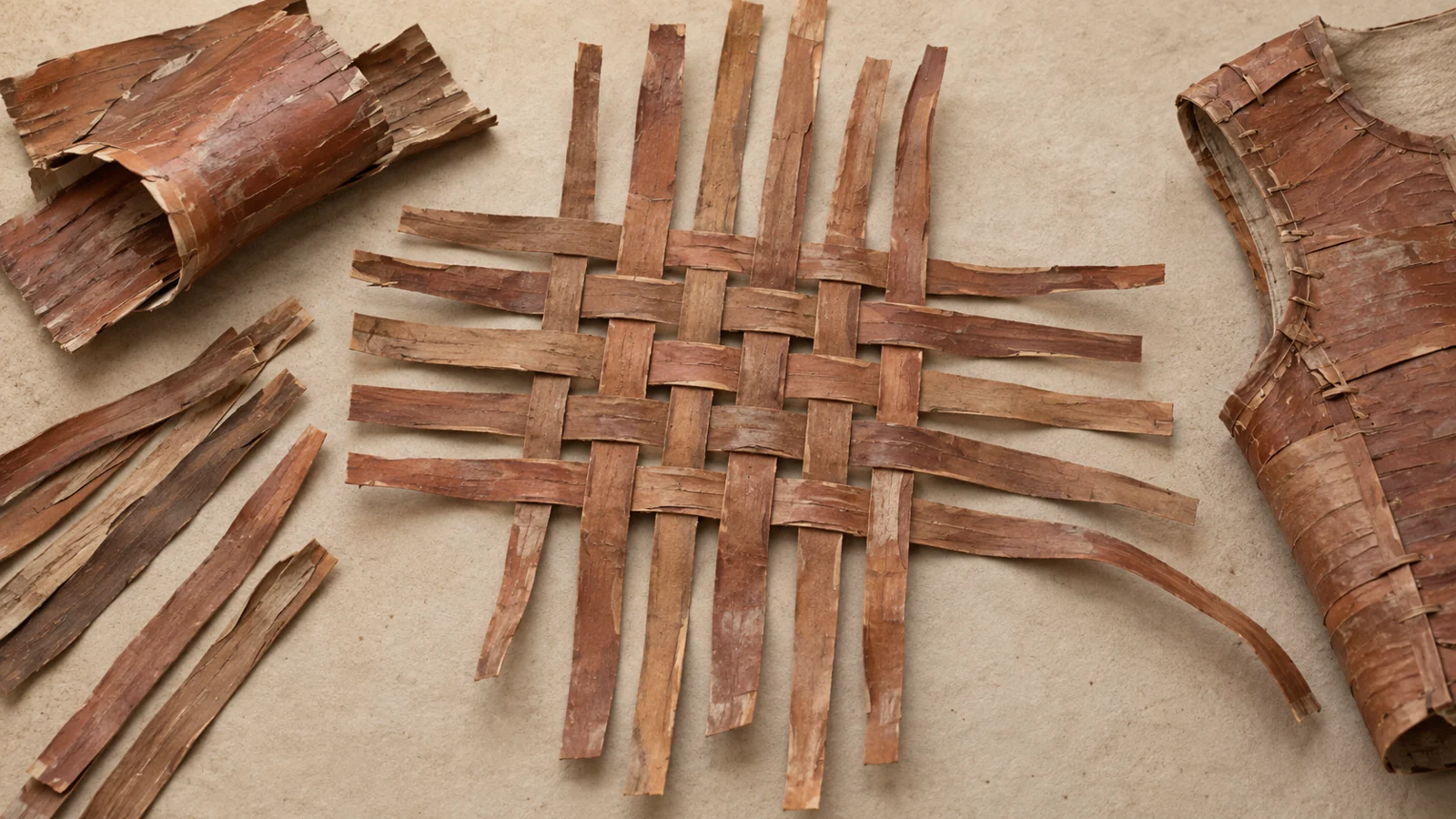
Weaving changed the size and arrangement of the useful pieces. Narrow strips could act as the elements of a fabric, crossing one another at right angles. This allowed the designers to work with the bark’s better properties along the strip direction while using interlacing to influence the behavior of the whole sheet. It also reduced dependence on finding large intact panels.
For the woven jacket, the team chose twill, the weave familiar from denim. Its staggered crossings create a different arrangement from a simple alternating over-and-under pattern. The researchers made larger woven sheets and cut the jacket pieces from them. They report that the resulting construction supplied the flexibility needed for movement.
The design change is consequential because a fabric’s behavior depends on both its constituent material and how those constituents meet. Changing the weave gives designers another way to adjust flexibility and strength without permanently joining the strips with glue. In these prototypes, treatment made bark available as a flexible working material, while weaving changed how that material could accommodate the shape and movement of a body. The demonstrated outcome is a workable design response to the sewn jacket’s constraints, without a quantified claim about how much movement or wear performance improved.
The remaining hurdles are in the material and its supply
The pine result cannot simply be carried over to any pile of bark. The authors describe limited success when extending their glycerine experiments across the barks discussed, including larch and spruce. They suggest that differences in outer-bark structure, cellulose orientation or chemistry might help explain the response, but leave the reasons unresolved. Even within pine, variation along the tree makes raw-material selection part of the challenge.
For everyday use, flexibility would have to persist beyond fabrication. The paper identifies drying over time, durability, smell and water-repelling behavior among the questions needing further work. A leather-like feel and a jacket that permits movement do not establish equivalent comfort, tear resistance or wear life. Repeated wearing, wetting, drying and storage would all matter to whether the material remained useful.
Supply presents a separate constraint. The experiments relied on deliberately harvested bark, whereas the broader opportunity lies in a wood-industry by-product. Connecting those two requires a consistent way to obtain suitable pieces from that stream. The presence of abundant bark does not guarantee an abundance of thin, intact strips with the properties needed for weaving.
The environmental case also depends on more than the origin of the material. The researchers deliberately avoided hazardous chemicals and energy-intensive processes, aiming to preserve options for reuse and eventual recovery. Those choices express a design intention, not measured lifecycle savings or commercial cost competitiveness. Collection, treatment, drying, service life and final recovery would all influence the eventual balance. Likewise, proposed uses in huts, tents or pavilions remain design possibilities; they should not be read as evidence of weatherproofing, fire performance or building suitability.
What this could change
If designers can maintain flexibility and durability while obtaining suitable bark consistently, woven strips could turn a wood-industry by-product into adaptable indoor fabrics and spatial coverings. The paper points toward interior textiles and spaces defined by bark fabrics. Different strip widths and weave patterns could let designers tailor sheets to the form of an object or enclosure, extending the material’s usefulness beyond the demanding task of dressing a moving body.
There is also a possible second life built into the construction. Because strips can be interlaced without permanent adhesive bonding, a bark fabric could potentially be adapted into a different object with limited reworking. The authors propose this kind of reuse as an alternative to completely reprocessing the material at every change of purpose. If that approach proves practical, bark could provide successive periods of service before final recovery, adding useful applications between its removal from a tree and its eventual use as a feedstock or fuel.
Key Sources
- Primary source: Advanced materials design based on waste wood and bark.
DOI or Journal Page · Peer-Reviewed Paper · 2021-08-02
Keep exploring