
Research Signal – Source date 2024-10-25
Keeping muscle with age involves more than retaining its size. The force that muscle produces, the fat distributed through it and its ability to repair itself all help determine how well it works. A measurement of muscle mass captures only part of that picture.
A review published on October 25, 2024, brings these features together through the biology of aging fat tissue and cellular senescence, a persistent state in which cells stop dividing. It asks how changes in tissue composition and inflammatory activity might contribute to declining muscle function—and why polyphenols, plant compounds found in foods, are being investigated in this setting.
The paper, Body Composition and Senescence: Impact of Polyphenols on Aging-Associated Events, draws on laboratory experiments, animal research, human observations and clinical studies. Its contribution is to connect those lines of evidence. It is a review of existing work, rather than a new trial testing a treatment for muscle loss.
Muscle quality depends on its surroundings
The authors highlight the Health ABC study as an important influence on how researchers understand body composition in older adults. In their account, muscle quality—including strength relative to mass and fat infiltration—helps explain the functional problems associated with sarcopenia, the loss of muscle mass and strength.
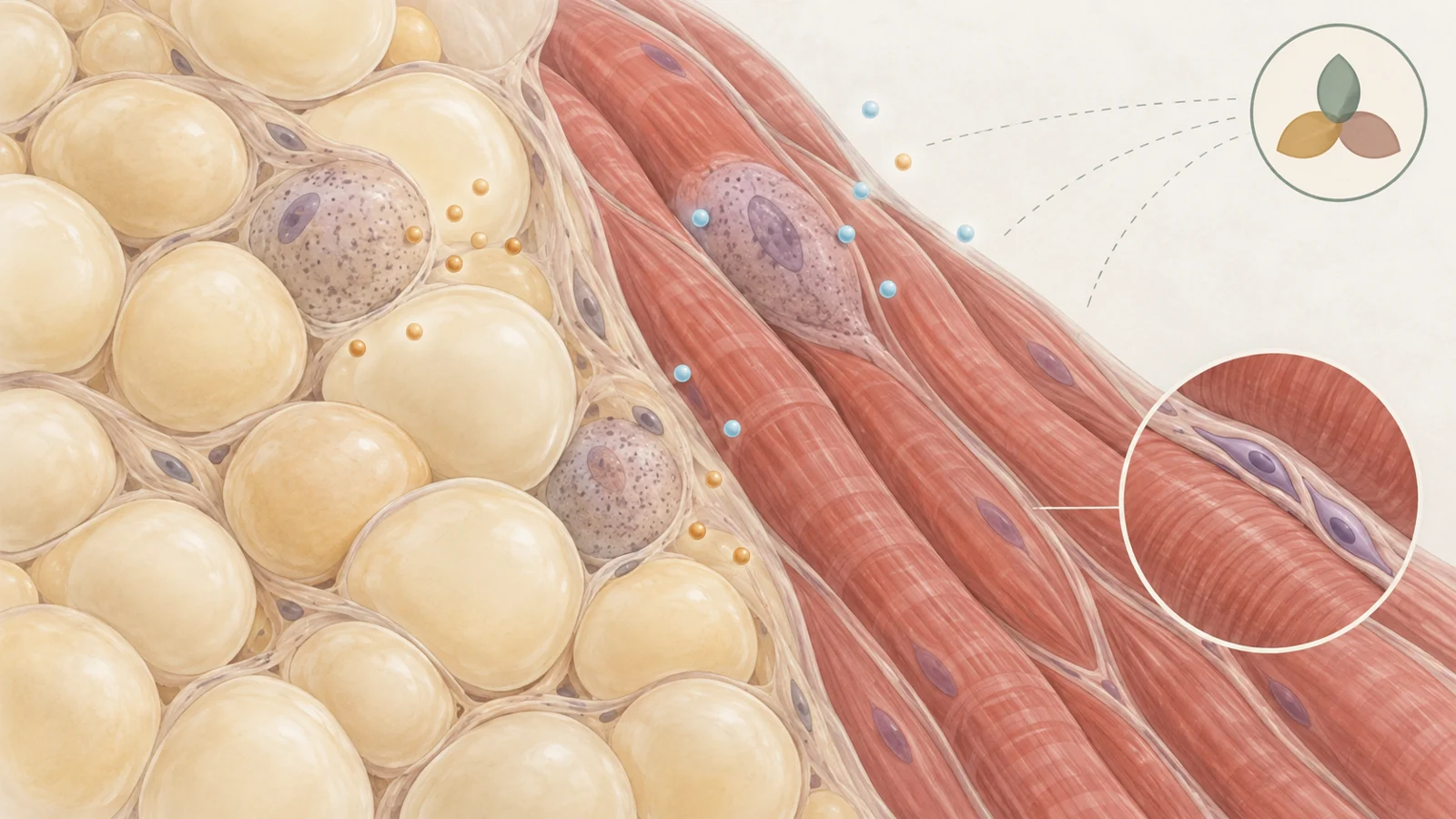
Where fat accumulates matters. The review describes deposits between muscles, within muscles but between their fibers, and inside muscle cells. These locations are associated with differences in muscle function. Fat tissue also acts as an endocrine organ, releasing substances that affect other tissues, so its influence extends beyond the space it occupies.
With aging, dysfunctional fat tissue can contribute to chronic, low-level inflammation, impaired responses to insulin and the redistribution of lipids into other tissues. Muscle therefore operates within a changing chemical environment as well as a changing physical one.
Cellular senescence provides one connection between these processes. A senescent cell has entered a stable arrest of cell division, accompanied by changes in metabolism and other cellular activities. Some senescent cells develop a senescence-associated secretory phenotype, or SASP: a pattern of secretions that can promote inflammation and help spread senescence to nearby cells. Stopping division does not mean a cell stops influencing its neighbors.
Senescence also has useful roles, including tumor suppression and aspects of wound healing. The concern described in the review is its accumulation alongside declining clearance of senescent cells. Under those conditions, persistent secretions can contribute to tissue dysfunction. This offers a way to understand communication between aging fat and muscle without making senescence the explanation for every aspect of muscle aging.
The repair reserve can also change
Muscle contains satellite cells, stem cells that help maintain and repair muscle fibers. These cells can become active when needed, contribute to repair and replenish their own population. Their ability to move between a resting state and an active one makes them a reserve for regeneration.
This distinction matters when discussing cells that stop dividing. Satellite cells are proliferating repair cells; they are different from the mature muscle fibers that generate force. A loss of regenerative capacity in the reserve can affect the tissue even when the immediate question concerns the performance of existing fibers.
The review describes research in aged rodents linking increased reactive oxygen species—chemically reactive molecules—to a persistent pre-senescent state in some satellite cells. Those cells lost their normal, reversible resting state, compromising their ability to renew themselves and respond to injury.
The surrounding tissue can further constrain repair. The authors discuss changes in another population of progenitor cells that can promote fibrous tissue formation and interfere with satellite-cell function. Yet the relationship between aging, injury and new fat formation remains unsettled. The review recounts differing findings in mice about whether younger or older animals form more fat during repair. The local environment and the repair process cannot be reduced to a simple rule that older tissue always produces more fat.
What a resveratrol experiment actually measured
Polyphenols enter this biological picture because experiments suggest that some can influence inflammatory signaling and processes associated with senescence. One concrete example in the review involves the annual fish Nothobranchius guentheri, fed a diet enriched with resveratrol until 12 months of age.
The review reports reduced activity of senescence-associated beta-galactosidase, an enzyme activity used as a marker of senescence. It also describes reduced activity in the NF-κB inflammatory signaling pathway, lower levels of certain pro-inflammatory signaling proteins and an increase in the anti-inflammatory protein IL-10. Together, these measurements point to changes in the animals’ senescence-associated and inflammatory biology.
The distinction is between changing a measured cellular state and demonstrating what caused that change or what it accomplished. Lower marker activity does not, by itself, establish that resveratrol selectively removed senescent cells. Nor does this set of fish measurements establish recovery of muscle function in older people. The experiment gives researchers a concrete biological response to investigate; the mechanism of selective cell clearance and the benefit to human strength require their own evidence.
Getting a compound to the tissue is part of the question
The identity of a plant compound is only one part of an intervention. Its preparation and the way the body processes it affect exposure. The review’s discussion of curcumin illustrates why two products containing the same named substance may deliver different amounts to the body.
Curcumin has poor water solubility, limited gastrointestinal absorption and rapid metabolism and excretion. In a randomized crossover study in healthy people summarized by the authors, researchers tested strategies for increasing curcuminoid bioavailability. Micellar solubilization, a formulation approach that helps disperse poorly soluble compounds, markedly increased bioavailability. Taking the tested combination of other phytochemicals alongside curcumin did not produce that improvement.
That result concerns delivery. Greater absorption does not itself establish improved muscle function or slower aging, but it changes how a biological experiment should be interpreted. The formulation is part of what was tested, not an incidental detail that can be dropped when describing the result.
Urolithin A raises a different issue: biological conversion. The review describes it as a product of bacterial fermentation and discusses foods containing ellagic acid, including pomegranates and strawberries, as potential sources of precursors for its production in the colon. Consuming a precursor-containing food therefore involves a conversion step that administering urolithin A directly does not.
This helps explain why ordinary foods, concentrated extracts, specially formulated compounds and administered metabolites cannot be treated as interchangeable. They represent different routes of exposure. A result for one preparation cannot automatically be assigned to everything associated with the same plant or chemical family.
Human results answer different questions
The clinical studies summarized in the review span several parts of aging biology. One completed study involved women with moderate skin photoaging who consumed a cocoa flavanol-rich product. According to the review, the study reported favorable effects on facial wrinkles and elasticity. Those are human outcomes, but their relevance is specific to the skin measures and participants studied.
The authors also discuss research whose benefits were still being investigated. In their October 2024 account, a Canadian study of administered urolithin A in frail older adults was ongoing, with muscle mitochondrial quality as its target. Mitochondria are central to cellular energy supply, making this a question directly relevant to muscle biology. The stated aim, however, describes what the study sought to test rather than a result it had achieved. The review also distinguishes studies that had been completed but whose findings had not yet been published.
These distinctions determine how far a claim can travel. A skin outcome does not establish preserved mobility, and a mitochondrial measurement would not alone demonstrate that an intervention maintains strength by clearing senescent cells. That stronger claim connects several steps: a defined intervention reaches relevant tissue, changes senescent-cell biology through a demonstrated mechanism, and produces a lasting functional benefit in people. Evidence for one step cannot stand in for the entire sequence.
The human studies also differ in their participants, preparations and outcomes. Their results cannot simply be combined into a general promise that polyphenols slow aging. For the muscle question, measures such as strength and walking performance would connect tissue-level effects to everyday function; duration and safety would determine whether a benefit could become useful beyond an experimental setting.
What this could change
If a defined polyphenol intervention can safely improve the biology of aging fat and muscle, and those changes produce durable functional benefits in humans, it could offer a way to help older adults retain mobility and independence. The possible path runs from a less disruptive tissue environment and better-supported repair to muscle that continues to perform useful work.
The practical payoff would be felt in activities such as rising from a chair, climbing stairs and moving around without assistance. From the review’s October 2024 perspective, connecting those abilities to a specific, reproducible intervention is the prospect that gives this research its importance. Understanding the interaction between fat, inflammation and muscle repair could help turn a broad interest in plant compounds into approaches designed around preserving the functions people depend on.
Key Sources
- Primary source: Body Composition and Senescence: Impact of Polyphenols on Aging-Associated Events.
DOI or Journal Page · Peer-Reviewed Paper · 2024-10-25
Keep exploring