
Research Signal – Source date 2025-04-07
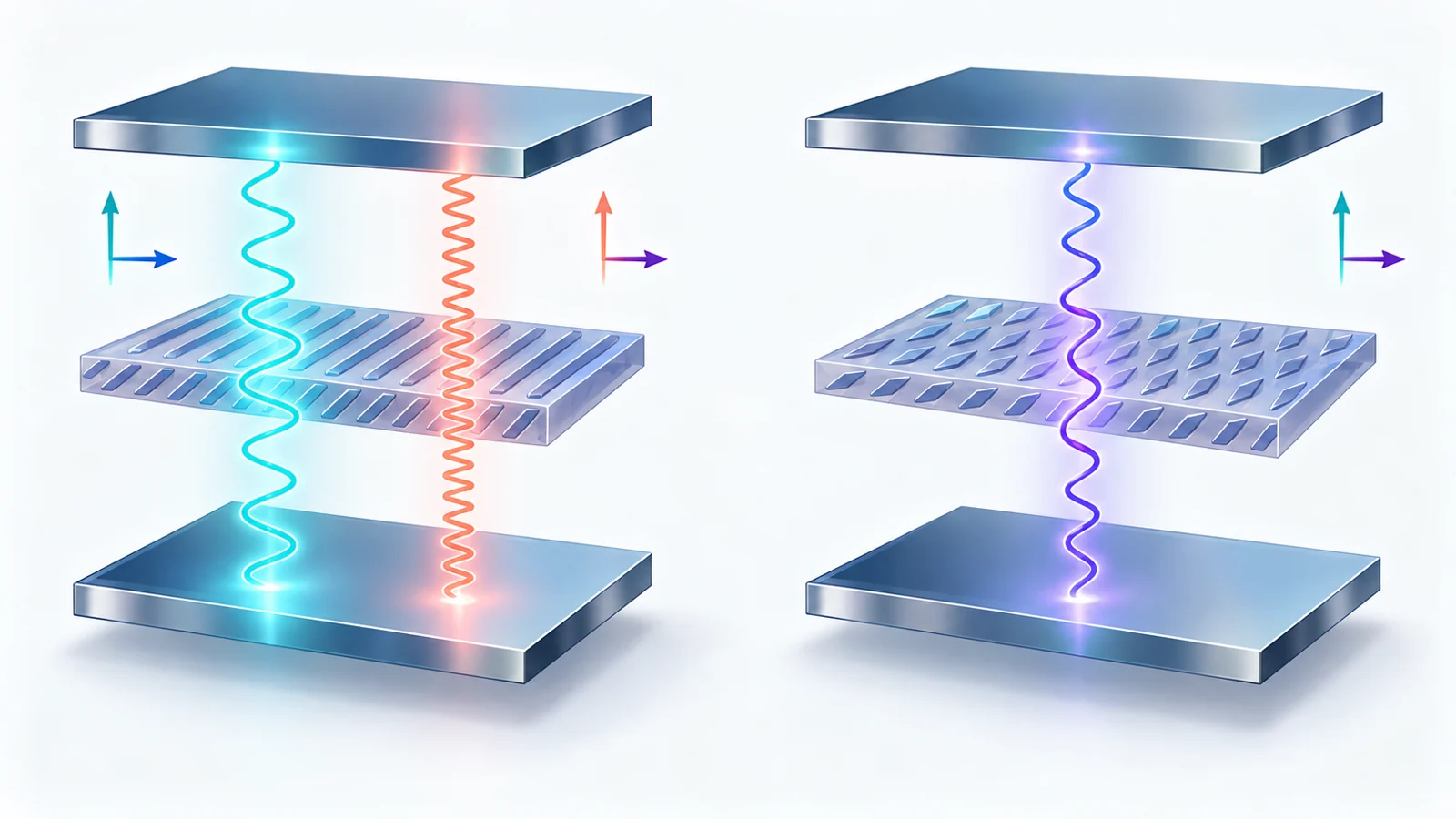
Light trapped between reflecting surfaces can behave differently depending on the material it encounters. In research published on April 7, 2025, scientists describe a cavity in which direction-dependent optical properties couple different polarizations of light. Their simulations connect this interaction to two distinct kinds of motion at different frequencies—polarization-dependent separation and a trembling trajectory.
The study also addresses a physical requirement for producing these effects. The authors report a metamaterial placed inside the cavity to realize the necessary optical response, supported by simulations and experimental measurements. Understanding the result means distinguishing that material realization from the simulated motion.
Why the material changes the motion
A Fabry-Pérot cavity confines light between two reflecting surfaces. The light forms modes, or patterns of electromagnetic oscillation supported by the cavity. Those modes can have different polarizations—the orientation and pattern of the light’s electric-field oscillation.
The material inside the studied cavity is anisotropic, meaning its optical response depends on direction. The particular form examined here is biaxial anisotropy. This directional response allows cavity modes with different polarizations to interact, linking the light’s polarization state to how it moves.
The researchers describe that interaction using an effective optical gauge field. Here, the term names a mathematical description of how the coupled light modes evolve. It lets the researchers connect the cavity’s optical properties with the behavior of a moving packet of light, without implying the creation of a new fundamental field.
Their simulations examine wave packets near band crossings, where branches of the cavity’s allowed optical modes meet. They also follow the evolution of “pseudo-spin,” a way of representing the polarization-related state of the coupled modes. Together, these calculations relate changes in polarization to changes in the packet’s motion.
Separation and trembling at different frequencies
The two motion regimes have different signatures. In the optical spin Hall effect, light separates according to polarization. Zitterbewegung, a term meaning trembling motion, describes an oscillating trajectory. One behavior concerns polarization-dependent separation; the other concerns a packet’s wavering movement.
The abstract links a transition between these regimes to different light frequencies in the biaxial cavity. Frequency therefore matters to the kind of motion the model produces, alongside the material’s directional properties. The effective gauge-field description brings both behaviors into the same account of interacting cavity modes.
This is the central dynamics result: the simulations describe both the movement of the light packet and the accompanying evolution of its polarization-related state. The two are connected parts of the cavity’s behavior.
What the material measurements establish
To realize biaxial anisotropy, the authors propose and implement a cavity-embedded metamaterial—an engineered structure designed to provide a particular optical response. They use effective-medium theory, which describes a structured material through its overall optical properties rather than treating every constituent separately.
That step matters because a model requires a physical structure with the right directional response. The abstract reports simulations and experimental measurements supporting the metamaterial realization, giving the proposed cavity ingredient a basis beyond the theoretical description alone.
The available abstract does not, however, establish that those measurements directly observed the frequency-dependent transition between separation and trembling. It also provides too little detail to assess the measurement scope, operating conditions, losses, or quantitative agreement with simulation. Those limits concern what can be concluded from the abstract; they do not establish that such information is absent from the complete paper. A demonstrated material ingredient also does not by itself establish a completed optical device or a performance advantage.
What this could change
If the modeled behavior can be made reliable in practical cavities, designers could use the material response and light frequency to select how differently polarized light travels. That could support optical components that separate or redirect light according to polarization, with frequency providing another way to choose the motion regime.
The causal link is specific: a realizable anisotropic material couples polarization modes, that coupling shapes their motion, and controllable motion could become useful in polarization-sensitive devices. The study connects the simulated behavior with a reported route to making the required material response—a step toward that capability.
Key Sources
- Primary source: Engineering effective optical gauge fields in anisotropic Fabry-Pérot cavities.
DOI or Journal Page · Peer-Reviewed Paper · 2025-04-07
Keep exploring