
Research Signal – Source date 2022-10-16
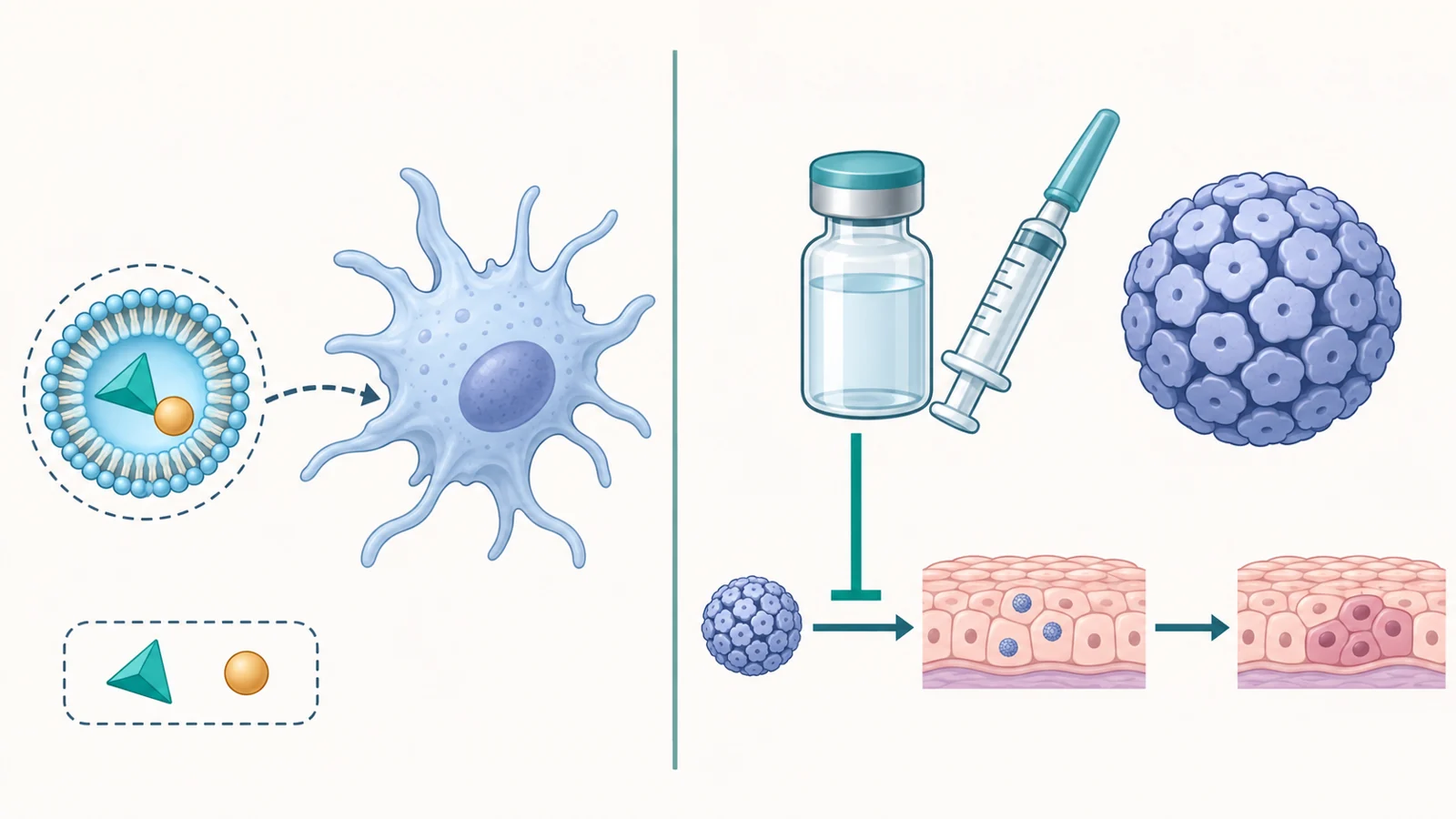
HPV vaccination shows how preventing a cancer-causing infection can also prevent some cancers. A different challenge lies ahead for cancers without a viral cause: an immune vaccine would need to recognize a dangerous change in tissue early, before invasive cancer develops, while avoiding harm to healthy cells.
A 2022 review, Advances in Nanotechnology for Cancer Immunoprevention and Immunotherapy, surveys how nanoparticles might help deliver the ingredients of such vaccines. Its examples range from animal experiments to a human immune-response finding, but they measure different things. The review does not test a new nanoparticle vaccine in people or show that one prevents nonviral cancer.
Prevention begins at a different point
Immunotherapy is intended to help the immune system treat cancer that already exists. Immunoprevention aims to change immune activity before cancer develops, reducing the chance that disease will start or progress. The distinction matters because a preventive intervention is offered to someone who may be healthy, or who has a precancerous change, rather than to someone facing established cancer.
A premalignant lesion is an abnormal area of tissue that could progress to cancer. It remains localized, unlike an invasive cancer that has crossed into surrounding tissue and may spread. For prevention, recognizing the earlier state creates an opportunity: an immune response could be directed at a concerning lesion before it becomes invasive. But the target must be distinctive enough to avoid attacking healthy tissue.
HPV vaccination offers a comparatively clear case. Vaccines such as Gardasil and Cervarix target virus-like particles made from HPV proteins. They prevent infection with cancer-linked HPV types; they do not need to identify a developing nonviral tumor. The review describes evidence linking vaccination with reductions in HPV infection and precancerous cervical lesions, as well as lower invasive cervical cancer risk in a cited study. This is established virus-linked prevention, not proof that the same strategy can prevent cancers with no viral cause.
A useful target must appear at the right time
For nonviral cancers, researchers must identify a target that appears on a premalignant lesion and can prompt a useful immune response. The review distinguishes tumor-associated antigens, which can be present in both cancer and healthy cells, from tumor-specific antigens, which arise from changes found only in cancer cells, including some mutations. A target shared with healthy tissue can raise concern about unwanted effects; a highly specific target may be harder to identify and may differ between tumors.
The review points to MUC1, a protein elevated in some colorectal polyps associated with increased cancer risk, as one vaccine target. It also describes antigens associated with melanoma in animal work. These examples illustrate the selection problem: a target needs to be present early enough to matter, sufficiently linked to the cells of concern, and capable of being recognized by the immune system. Finding a possible antigen is only one step toward a preventive vaccine.
Tiny carriers can bring ingredients together
A vaccine antigen is the feature the immune system is meant to recognize. An adjuvant is an ingredient that stimulates immune activity. Antigen-presenting cells (APCs) are immune cells that take up material and display pieces of it to other immune cells, helping direct their response. For an anticancer vaccine, delivering the antigen and adjuvant to these cells—and coordinating their arrival—can matter.
Nanoparticles are tiny carriers that can package vaccine ingredients. The review describes designs that load both antigen and adjuvant into one carrier, so they can reach the same APC together. Some particles may also help ingredients accumulate in lymph nodes, where immune responses are organized, rather than dispersing quickly through the body. A carrier’s size, surface charge, shape, and other properties influence where it travels and how cells take it up. The review discusses medium-sized particles, roughly 5–100 nanometers, as one range that may reach lymph nodes effectively in particular delivery contexts; it is not a universal recipe for every vaccine.
The delivery problem is more than transport. An antigen may be broken down before immune cells can use it, or may not be presented in a way that produces the intended response. The review describes an experimental nanoparticle vaccine designed to deliver a tumor antigen and an immune stimulant into immune cells before the ingredients are broken down. That is a proposed way to improve delivery, not evidence that the approach prevents cancer in people.
Early examples measure different outcomes
In a mouse melanoma model, researchers used biodegradable nanoparticles carrying two short protein fragments associated with melanoma. The review reports that immunized animals had slower development of melanoma cells. This is a preclinical result in an animal model. It shows a change in tumor development under the conditions studied, not a demonstrated preventive effect in people.
Other examples answer different questions. In another mouse study, selenium nanoparticles were given before breast tumors were induced. The review reports stronger inflammatory signals, more activity in natural killer cells (a type of immune cell), and longer survival in those mice. A separate lung-cancer approach paired a vaccine with another drug; the review reports more immune cells in tumors and slower cancer spread. These are different outcomes: the lung-cancer measures concern an existing tumor, and neither example shows that a nanoparticle vaccine prevents cancer in people.
The review also cites a human MUC1 vaccine example: after receiving a vaccine that included an immune-stimulating ingredient, 43% of patients developed antibodies against MUC1. This measured an immune response, separate from the nanoparticle animal studies. It does not establish that the vaccine prevented colorectal cancer or that a nanoparticle carrier produced the response. For prevention, the crucial outcome is whether progression to cancer changes, alongside what harms the intervention may cause.
Choosing whom to protect carries its own risk
An intervention given before invasive cancer develops has a different risk calculation from treatment for advanced disease. A person may need to be identified as sufficiently likely to progress, and the tissue change must be at a stage where prevention could still help. For some cancers, the path from precancerous change to invasive disease is difficult to predict. The review also notes that nonviral tumors are harder to target than virus-linked cancers, where the viral proteins provide a clearer target.
Safety therefore matters especially. A preventive vaccine would be given to people who may never develop cancer, so even a plausible immune benefit must be weighed against adverse effects. Targets that are also present in healthy tissue add another concern. The review discusses promising preclinical and early clinical work, but the surveyed examples do not establish safe, effective nanoparticle prevention for a defined human population, or a general clinical or cost advantage across cancer types.
What this could make possible
A person with a well-characterized, high-risk precancerous lesion might someday receive an immune intervention designed to stop that lesion from progressing before invasive cancer requires treatment. That possibility depends on identifying a target that marks the concerning tissue and reliably delivering both the antigen and the immune stimulus. HPV vaccination already prevents some virus-linked cancers; the new capability would be dependable prevention for a specified nonviral lesion. Target selection, safety, and clinical validation remain essential steps.
A meaningful nearer milestone would be a controlled study in a defined high-risk group that follows progression to cancer and records adverse effects, rather than relying on an immune response alone. Such a study could begin to show whether a candidate preventive strategy changes the outcome people need to avoid.
Key Sources
- Primary source: Advances in Nanotechnology for Cancer Immunoprevention and Immunotherapy: A Review.
DOI or Journal Page · Review or Meta-Analysis · 2022-10-16
Keep exploring